Unlike traditional task-specific AI, foundation models learn from massive, multimodal, unlabeled datasets, opening big possibilities in radiology (and challenges too).
Magda Paschali, PhD & Akshay Chaudhari, PhD share key insights on the @RSNA podcast
Hospitals vary widely in their patient populations, imaging protocols, and workflows. An AI model trained in one environment may not generalize well to another. Without rigorous evaluation, it is uncertain whether AI tools will perform as expected in new deployment settings.
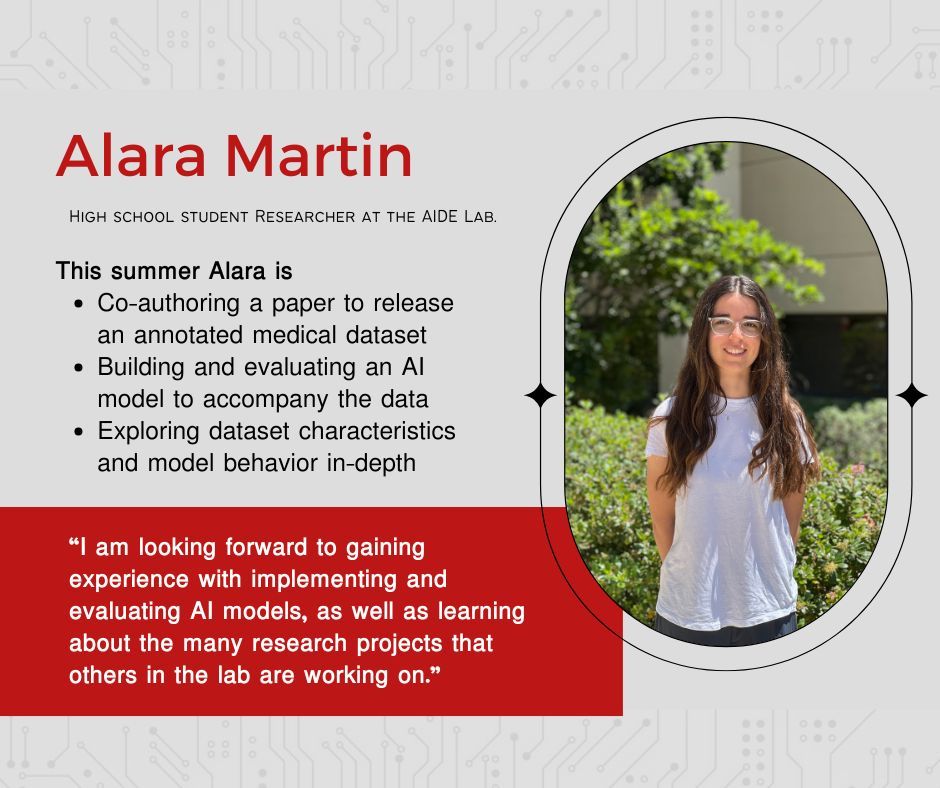
This summer, we’ve welcomed a few student researchers to Stanford’s AIDE Lab
They’re tackling real-world challenges in AI & healthcare from radiograph evaluation models to boosting AI performance without retraining.
Meet Samhita, Alara & Nathan!
We are excited to invite you to participate in an online research study at @StanfordMed focused on improving patient-centered communication in healthcare 🩻 This study involves using a grading scheme designed to assess the quality of patient-friendly radiology reports 🗒️
Your perspective will provide valuable insights that help ensure the grading scheme is effective and easy to use. Participation is entirely voluntary, and all responses will be kept confidential.
Falta una semana para @Khipu_AI , la mayor conferencia de AI de LATAM, que este año tendrá lugar en Santiago de Chile!
Incluso si no quedaste seleccionado/a, hay varios eventos abiertos al público Jueves y Viernes a los que podés sumarte con registro previo.
Toda la info aca👇
Read the full paper 👉 https://t.co/3RiqrYkR4i
Evaluate your own clinical histories 👉 https://t.co/N7990dgMRK
Check out our open-source code and model 👉 https://t.co/jlsUTHtl8f
Our method provides a way to reliably compare and assess the quality of clinical histories at scale and highlights the overall potential of AI tools for quality assessments of text
We show that LLMs can assess the quality of clinical histories at scale:
💡 Our fine-tuned Mistral-7B model achieved 91% accuracy, matching or even surpassing inter-radiologist agreement
💡Applied to 48,942 clinical histories, only 26.2% contained all five essential elements
Radiologists depend on concise, relevant, and complete clinical histories to accurately interpret imaging studies and provide a more useful radiology report. However, the clinical histories accompanying imaging orders are often incomplete, inconsistent, or missing key details
Producing a benchmark for completeness in extracted clinical history, an easily deployable fine-tuned open-source LLM rivaled GPT-4 Turbo in performance, with substantial agreement with radiologists. @magdapasc@Dr_ASChaudhari https://t.co/KD1u76FvpX
Producing a benchmark for completeness in extracted clinical history, an easily deployable fine-tuned open-source LLM rivaled GPT-4 Turbo in performance, with substantial agreement with radiologists. @magdapasc@Dr_ASChaudhari https://t.co/KD1u76FvpX