Are we adapting to climate change? In new preprint, we use decades of data on 21 outcomes around the world & measure whether they have become less sensitive to a given change in climate. We find clear evidence of such adaptation in only ~25% of cases. 1/x https://t.co/XUgjMj2Pdc
Announcing v2 of our climate adaptation conference at Stanford, this Oct 10-11. Please submit! Looking for empirical work on adaptation & will consider earlier-stage working papers as well as more polished work. Submission deadline July 15. Plz share, RT https://t.co/8mRtifb54C
New working paper on climate, wildfire smoke, and mortality, expertly led by @minghao_qiu@StanfordECHOLab . We find that by mid-century in the US, damages from mortality from wildfire smoke are about equal to the sum of all other climate damages in recent estimates 🧵
My @StanfordECHOLab group is hiring a Research Data Analysis (aka pre-doc) to work with us full time starting next summer. Our RAs are co-authors and treated as colleagues. Strong programming background in R or python is required. Plz apply or RT! https://t.co/yJkLh7ruKi
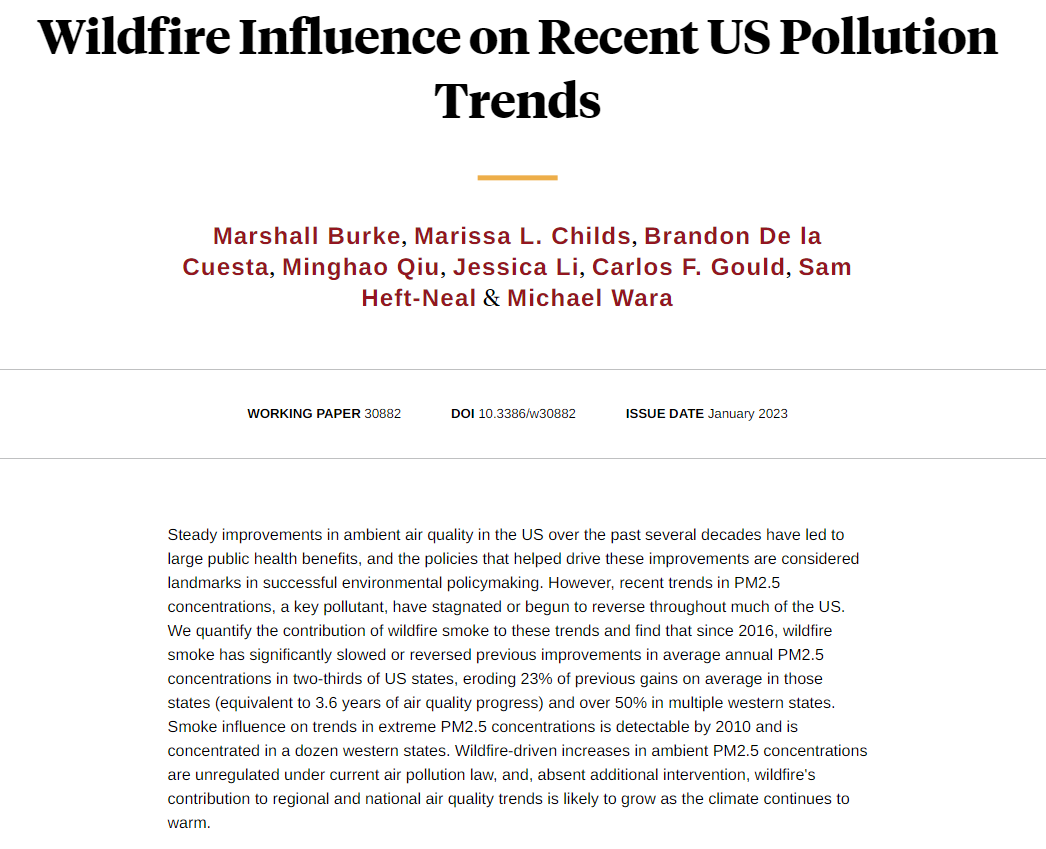
Startling new study from @MarshallBBurke, @MichaelWWara and company finds that wildfire smoke has slowed down air-quality progress in 30 states and reversed progress in 11 others. The worsening air pollution is especially bad in the West: https://t.co/oAJa7tA3tj
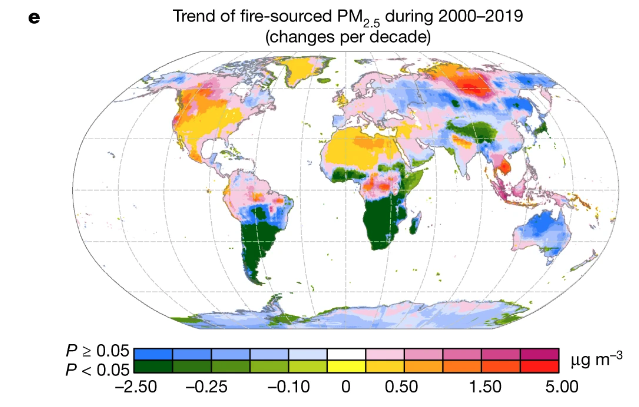
@MarshallBBurke Our paper dovetails nicely with another Nature paper out today that estimates global PM trends from landscape fire. Their estimates for the US look highly consistent with ours, and also point out much higher burden in lower-income countries. https://t.co/uZ21Tg1XbM
Second paper on wildfire smoke from our @stanfordecholab group out this week. This one quantifies the contribution of wildfire to US PM2.5 trends. We find much broader wildfire influence than previously estimated, on both avgs and extremes. Quick thread. https://t.co/uMpR0zYV3V
Couple of wildfire papers out from our echo lab group this week. First one out yesterday, expertly led by @samheftneal@StanfordECHOLab , on smoke effects on emergency dept visits in California. Some surprises! Quick thread
ttps://www.pnas.org/doi/10.1073/pnas.2302409120
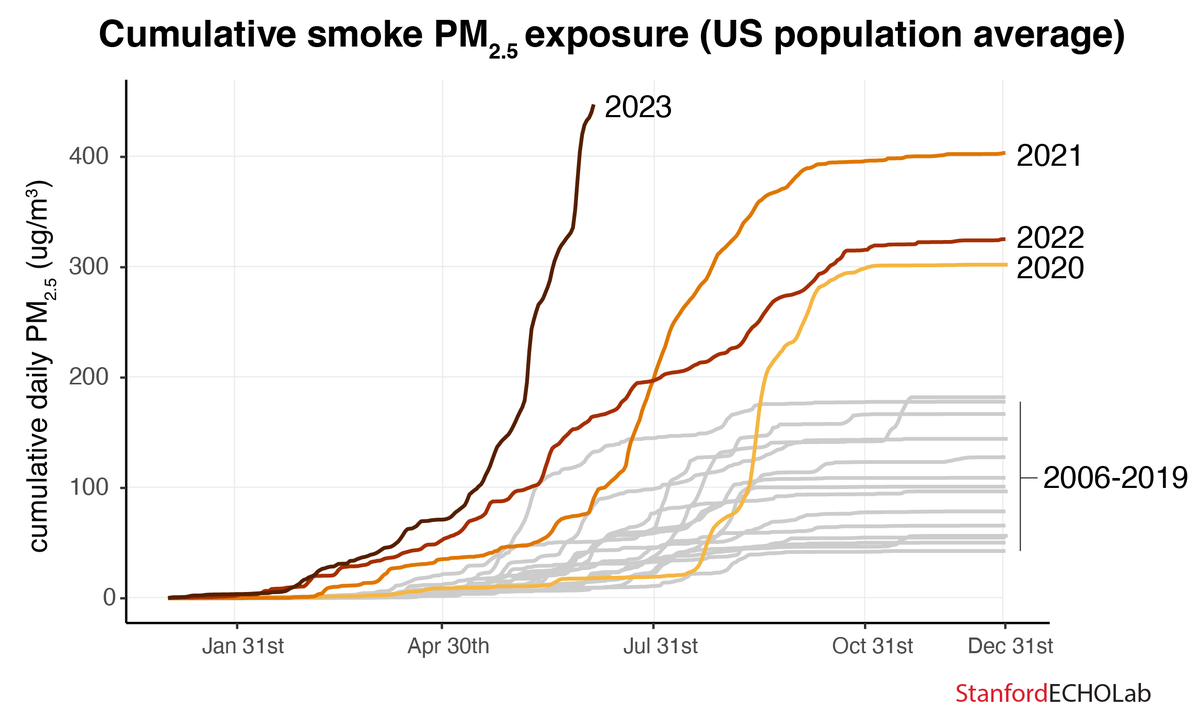
For the average American, we @StanfordECHOLab calculate that cumulative smoke exposure (PM2.5 exposure on each day, summed across days) through mid-2023 is already way worse than total cumul exposure in every year since 2006. And main fire season in West is just getting started.
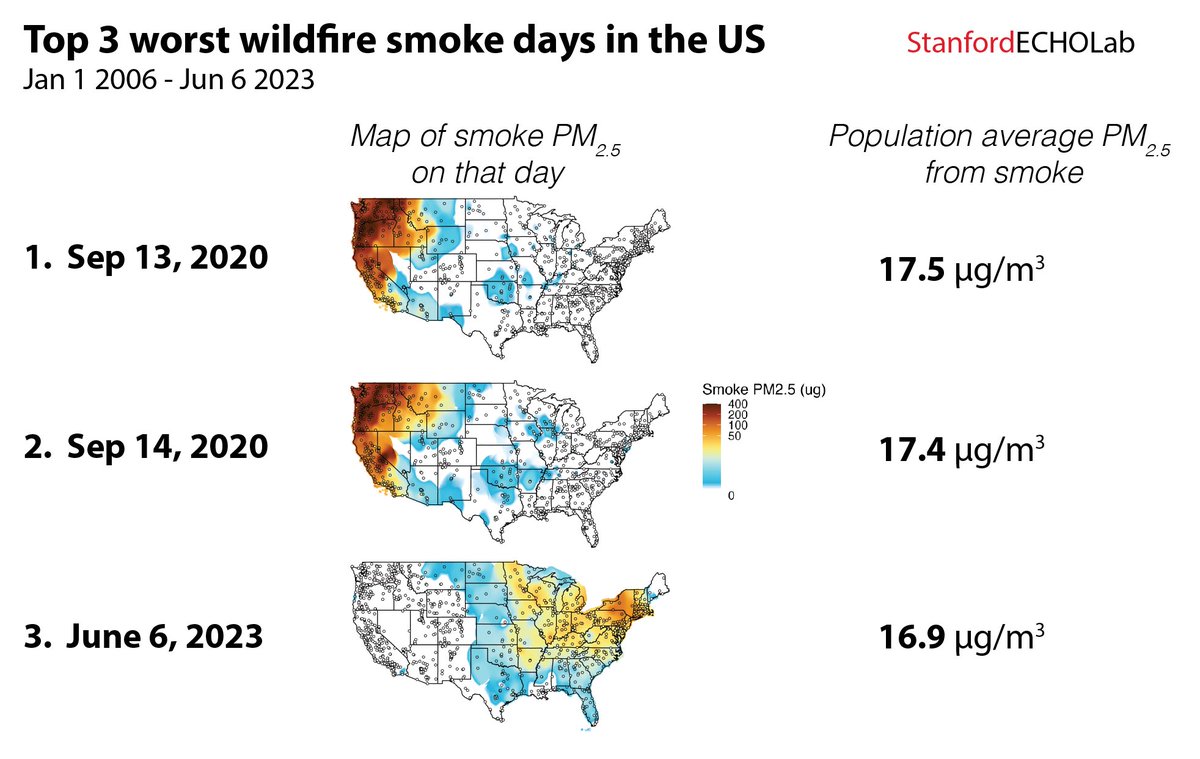
Yesterday was the 3rd worst wildfire pollution event in US history, we calculate, just behind 2 days in 2020 that hit the west coast. Don't have today's data yet, but it could be the worst. Pollution levels are lower in this ongoing event but many more people are exposed.
Quick 🧵 on historic wildfire smoke event ongoing throughout eastern Canada and much of eastern US. Monitors showing very high levels of PM for thousands of miles. For reference, background levels are ~10ug, so these levels are way above normal.
For those interested in evidence on the air quality and health benefits of transitioning from gas to electric cooking, check out these two new pre-prints lead by @gould_cf. Both suggest large benefits using designs that improve on what's in literature. Quick 🧵
Improvements in air quality are slowing or being reversed in the US, and wildfires are substantially to blame, from @MarshallBBurke, Marissa L. Childs, Brandon De la Cuesta, @minghao_qiu, Jessica Li, Carlos F. Gould, Sam Heft-Neal, and Michael Wara https://t.co/OKAkULH55f
I'm hiring 2 full time RAs/pre-docs for a summer 2023 start date. You will work in a collaborative lab environment, and nearly all past RAs have had their names on multiple pubs. Coding experience in R/python desired. Plz retweet! #EconTwitter https://t.co/XlzJsZACJk
Before twitter implodes, please check out our new paper on using satellites+ML to do large-scale public policy evaluation. Application is to impacts of electrification expansion in Uganda. Great team effort led by @NWRAT + @atlasai_co . quick thread below. https://t.co/cm5o5GKumN
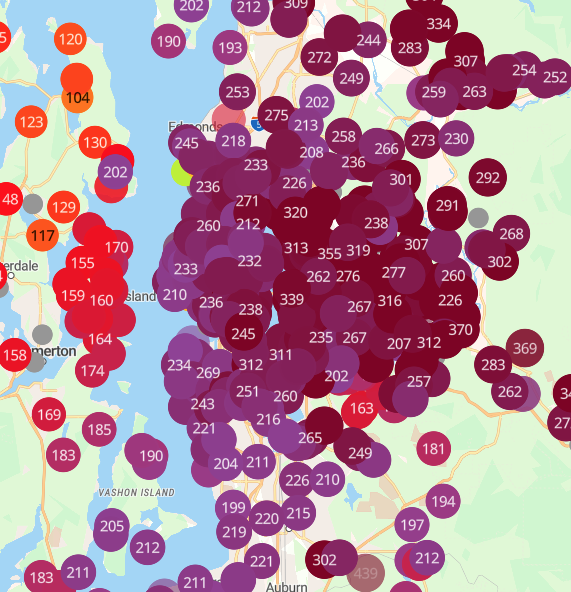
Really terrible outdoor air around Seattle today, but just as important to look at what's going on inside buildings as well as outside. And that picture is ... also very bad. Here's outdoor & indoor purple air this morning - lots of indoor readings way into the 100s. Terrible!
Check out our new paper on the impacts of wildfire smoke exposure on test scores, expertly led by @jeffliwen. Smoke exposure during school year lowers test scores at end of year, w/ monetized costs in billions annually. https://t.co/4G9fApblVZ
We have a new paper + dataset out today measuring daily wildfire smoke PM2.5 across US back to 2006, expertly led by @marissalchilds@StanfordECHOLab . Below is an animation of 2020 data.
paper: https://t.co/MtYxbvQEkM
data: https://t.co/Wun5zk4KB1
Quick thread below
For the ultrarunning nerds, some stats and analysis in advance of the incredibly stacked #UTMB later this week. Writing by the incomparable @MountainRoche, stats by me. https://t.co/6oO3MiDgp8