@JasonColavito The topic of UFOs and Nazis are deeply intertwined. Also you can platform people you don't agree with. It's how the marketplace of ideas thrive.
J’ai entendu dire que la France était finie, qu’il était trop tard pour la sauver.
Mais la France est toujours aussi belle, enviable même. Sa grandeur n’a pas disparu, elle ne demande qu’à renaître.
Nous avons surmonté en un an un problème cent fois plus grave, sans avoir les moyens dont dispose la France.
La France pourrait y arriver en une semaine.
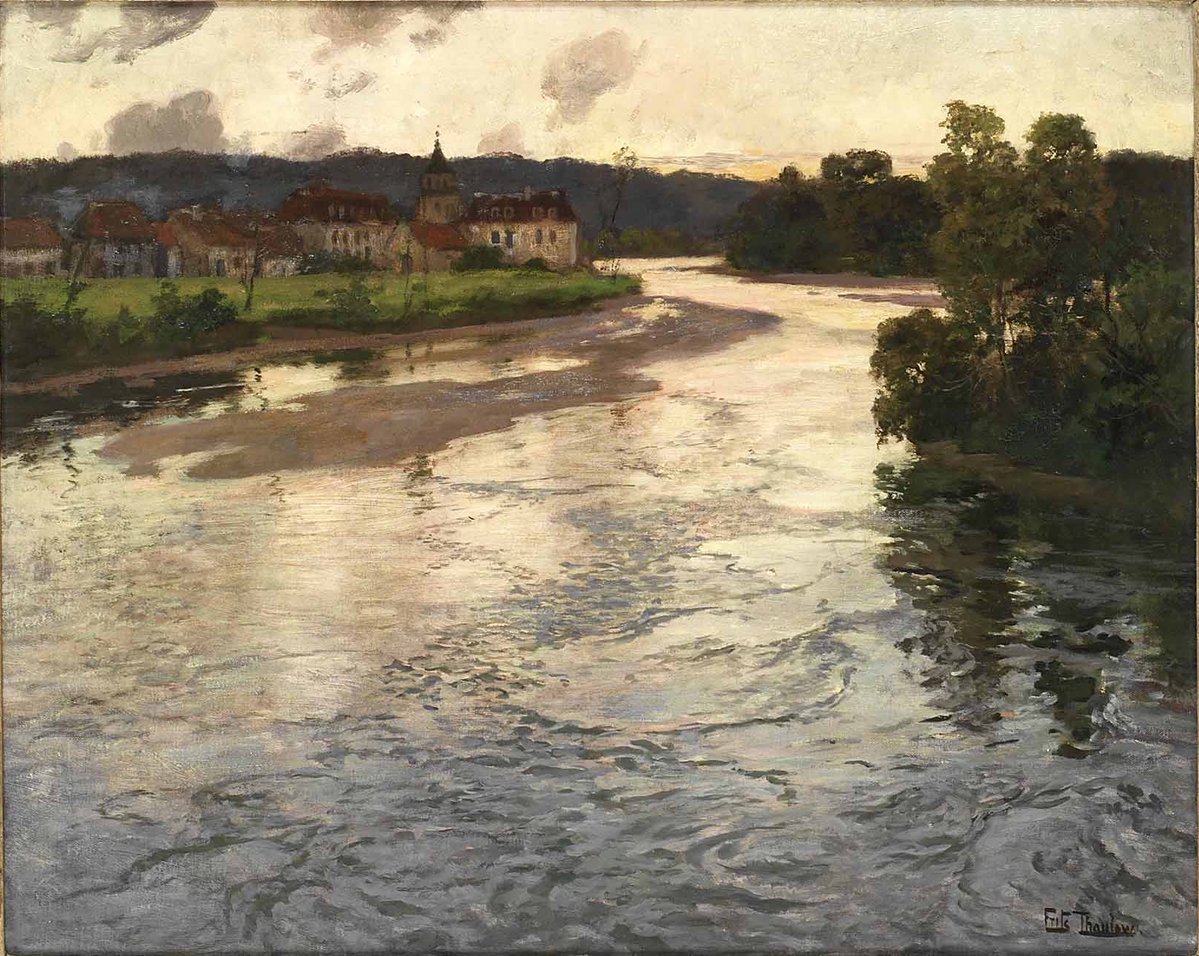
This is not a photograph.
Every leaf and every reflection was put there by hand, in oil, by the Danish painter Peder Mørk Mønsted in 1894.
It is called Wooded path by a river, and it captures the hardest thing there is to paint: a forest in full sunlight. Light through trees never falls evenly. It scatters into countless flecks of brightness and shadow, a glow on one leaf, darkness on the next, a glint on the water that would vanish the moment a cloud passed. Get those even slightly wrong, and the whole thing collapses into a green blur.
Mønsted got every one of them right, and in doing so he captured something anyone who has stood alone in a wood will recognize immediately: that hush that falls over you, the sense of being completely at peace, and the feeling that the whole world has paused to breathe…
Anthropologist Olga Soffer (1942-2026) spent much of her career asking a deceptively simple question: What if archaeologists had been overlooking some of the most important technologies of the Ice Age because they did not survive in the ground?
Olga Soffer, who has died aged 83, brought a revolutionary idea into the conversation about prehistoric ice age people: women mattered. Inspired when working on archaeological excavations in the former USSR, and by remains from a dig in Moravia, in the 1990s she presented a case for women as makers of textiles, baskets and nets, critical to survival in bleak northern conditions 30,000 years ago. She challenge a familiar picture of prehistoric life dominated by men hunting large animals with stone weapons. Her research drew attention instead to technologies often associated with women: weaving, basketry, cordage, net-making and textile production.
Working with colleagues on archaeological material from Eastern Europe, Soffer examined impressions preserved in fired clay and other evidence suggesting that sophisticated fiber technologies existed as early as roughly 30,000 years ago. Her achievement was the more remarkable for her career path. By then a professor of anthropology at the University of Illinois, she had obtained her three degrees over three decades, partly while also working as a cosmetics buyer and fashion promoter for a New York department store.
Since the 20s, Soviet Russia, looking to historical materialism, generously funded large archaeological excavations. Unlike most of her colleagues in the west, Soffer, whose family had fled Tito’s Yugoslavia and settled in Brooklyn in 1955, could read the reports. In 1977 she began years of travel and research, supported by grants from the US government, the National Geographic Society and many others. Among 30 sites she worked on, four stood out: Mezhyrich, Ukraine; Avdeevo, Russia; and Dolní Věstonice and Pavlov, Moravia (now in Czechia).
The implications went well beyond clothing.
A net could capture fish, birds or small animals. Baskets made gathering, carrying and storing food more efficient. Cordage could be used for traps, shelters and countless everyday tasks. Textiles offered protection in brutally cold environments. But there was a problem with how prehistory had traditionally been reconstructed. Stone survives. Plant fibers usually do not.
A spear point can remain in the earth for tens of thousands of years, while a woven bag, fishing net or length of cord disappears. Archaeologists therefore inherited a record that naturally made some kinds of labor far more visible than others.
At such places, people built tent-like houses with mammoth bones. At Mezhyrich, 160 kilometres south of Kyiv, male archaeologists credited the remains to heroic male hunters. To Soffer there were too many mammoths – one house was assembled from 95 jaws. She argued instead that the bones had been collected from natural death sites, while noting that archaeologists had overlooked remains of smaller animals. “Maybe they killed one mammoth every 10 years,” she commented, “and never stopped talking about it.”
Already doubting the existence of male-dominated ice age communities, in 1990 she noticed marks in a few tiny clay fragments excavated decades before at Pavlov. She showed them to James Adovasio, an archaeologist at Mercyhurst College, Pennsylvania, who had been digging with her at Mezhyrich, and who knew about basketry and textiles. He recognised impressions of woven threads. They went on to identify 79 such marks among thousands of clay scraps, from Dolní Věstonice and Pavlov, with explosive implications.
#archaeohistories
WORMWOOD kills 98% of "cancerous" cells.
("Cancerous," infected by parasites and microbes)
Wormwood by itself can kill 33% of "cancerous" cells, but by adding iron to it, it can kill 98% of cancer cells, since the cells themselves contain a large amount of iron.
Recipe 1:
In case of suspected tumor formation and for prevention.
Wormwood powder - 1 teaspoon, pour 200 ml of boiling water, leave for 40 minutes. Take 1/3 cup a day 30 minutes before meals, the course is 10 days, then a 10-day break and repeat 2 more times.
Recipe 2:
For recovery after chemotherapy.
75% alcohol - 9 parts.
Wormwood - 1 part.
Put everything in a glass jar and leave for 7 days. Take 1 tablespoon 2 times a day before meals.
Recipe 3:
In the initial stage.
Wormwood - 1 tablespoon pour 250 ml of boiling water and boil for 20 minutes. Cool and strain, take 1 tablespoon 3 times a day before meals.
We all know that during the Crucifixion of Jesus Christ, there was a solar eclipse. I tracked the eclipse and found that it occurred in the third month of the year 33, when Jesus was 33 years old. The eclipse was visible from the South Pole in the zodiac constellation of Pisces, the Fish, a symbol of Jesus Christ, announcing the beginning of the Age of Pisces and the rise of Christianity. I tracked the date and recorded the eclipse shown on the left.
Exactly 2,000 years later, in the third month of the year 2033, there will be another solar eclipse. This time, it will be visible from the North Pole at the end of the zodiac constellation of Pisces, announcing the end of the Age of Pisces.
What is particularly interesting is that the Morning Star, the planet Venus, is visible during both solar eclipses, exactly 2,000 years apart and in the same month. To make it even more intriguing, the eclipses are visible from opposite ends of the planet, the South and the North, representing the masculine and the feminine, the life force and the spirit!
Make of this what you will, but the signs are in the stars.
Ten million people have watched an MIT professor accidentally destroy the executive coaching industry.
He filmed the lecture once in January 2018 and died eighteen months later.
Executive coaches charge fifteen thousand dollars a session to teach a third of what he covered in one hour for free.
His name was Patrick Winston. He ran the MIT Artificial Intelligence Laboratory from 1972 to 1997 and wrote the AI textbook every computer science major in the world read for thirty years.
Every January for four decades, he gave a lecture called "How to Speak."
His entire framework fits on a napkin.
Do not read. Be in the image. Keep images simple. Eliminate clutter. Start with an empathetic connection. End with a punch line the audience can repeat over dinner. Never open with a joke. Never end with "thank you."
That last rule alone has probably cost the executive coaching industry a hundred million dollars.
"Your success in life will be determined largely by your ability to speak, your ability to write, and the quality of your ideas. In that order."
That is the actual opening line of the lecture. Winston believed it strongly enough to spend fifty years teaching computer scientists how to talk.
Founders spend $80,000 on an MBA and then hire a communications coach to teach them the same material Winston filmed once for free. Engineers write brilliant code and lose promotions to teammates who watched this lecture on the train.
The lecture is free on MIT OpenCourseWare. The textbook is free on his page.
Winston died in 2019. Almost none of the ten million viewers have actually implemented the four rules on the napkin.
The napkin is free. The willingness to actually use it in your next meeting is the entire edge.