Here's the 7-step system to get cited by ChatGPT:
1/ Set your AI visibility baseline.
Open GA4. Find how much traffic AI is sending you.
2/ List the sources AI trusts in your niche.
Run 100 queries your buyers actually ask. Log every domain that appears in the answers. That list is your placement roadmap.
3/ Rewrite your content for AI extraction.
Move the direct answer to the top of every page. One idea per section.
4/ Add proof signals to your site.
- Last updated dates.
- Author bios.
- Review widgets.
5/ Repurpose to platforms AI already trusts.
- LinkedIn Pulse.
- Medium.
- Reddit.
You don't need new content. You need your existing content on domains LLMs already cite.
6/ Earn external validation.
Refresh your G2, Capterra, and Trustpilot listings. Get into "best of" comparison articles. AI needs third-party confirmation before it recommends you.
7/ Build your Reddit presence.
Reddit appears in 40% of commercial ChatGPT answers. Participate in threads that rank.
Repost and save this if you found it useful.
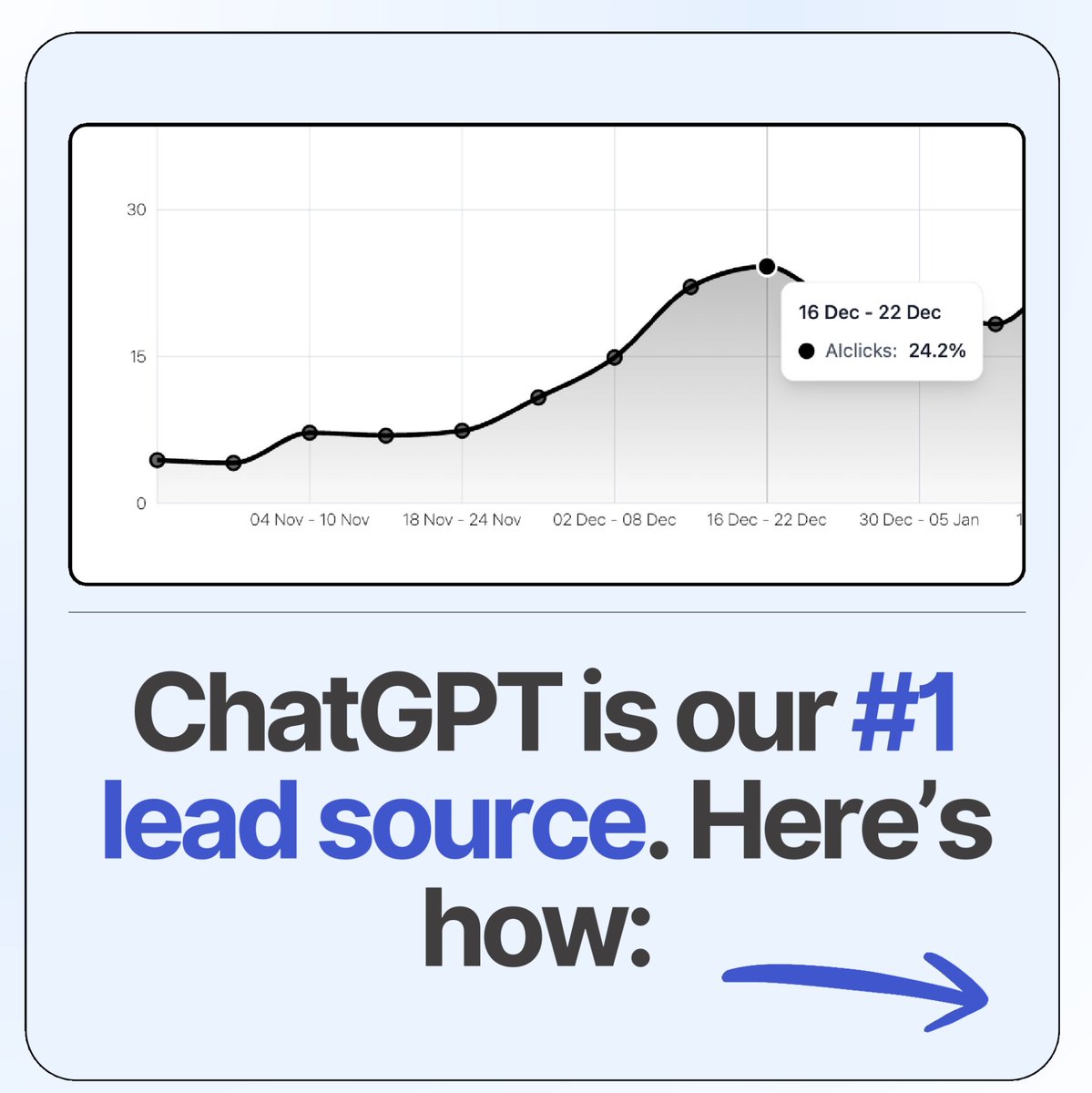
ChatGPT is now our #1 lead source. Here's the 5-step GEO strategy we use:
1/ Track 300 prompts, get 5,000+ cited sources
We set up AIclicks to track every question buyers ask AI about our category. Each answer came with sources. Those sources became our roadmap.
We optimized around what AI already cited, not around what we wished it would.
2/ Build landing pages based on citation patterns
Perplexity tracker pages kept appearing in our source data. So we built one. It started appearing in AI answers because AI already trusted that page format. We looked at what types appeared most in our sources, then created our version of each.
3/ Publish listicles that place your brand first
"Best X" blog lists make up 43.8% of all AI-cited page types, per Ahrefs. We wrote listicles where we rank #1 and explain why. Those pages now appear across hundreds of AI answers.
4/ Build external mentions systematically
We sent 1,678 emails through a single Blog Collab campaign. The ask was simple: include us in your article, we include you in ours.
5/ Engage in Reddit threads AI already cites
We engaged in 160+ Reddit threads with a combined 50,000 organic visitors per month. Those threads now carry 3,000+ LLM mentions of AIclicks.
We track over 10,000+ brands inside ChatGPT every single day. And the data says something most people would never guess.
The brands winning in AI answers aren't the ones with the biggest budgets.
Some have websites that make SEO specialists cringe. They still show up. They still get cited.
We took one brand from invisible to $40,000 in revenue from ChatGPT recommendations alone.
We took ourselves to the top AI visibility tool in 90 days. 20% visibility across 300 tracked prompts. Against giants and well-funded startups.
Here's the 5-step framework we use:
1/ Track the right questions, not the answer
Stop checking if you're mentioned and look at the sources AI cites instead. Track hundreds of high-intent prompts, and 300 of them hands you ~5,000 cited URLs to target.
2/ Create content based on citation patterns
The top cited sources show you exactly what AI wants. Build landing pages and listicles around those patterns, and list your brand as the best option with a comparison table.
3/ Get mentioned in external sources
LLMs compare you across third-party articles, not just your own site. Find the cited listicles, reach out to authors, and offer a mention swap.
4/ Win the directories and review sites
AI pulls reviews and sentiment from G2, Trustpilot, and niche directories when it compares brands. Ask for reviews and optimize your profile, because this is where your sentiment gets decided.
5/ Show up in social and community content
Reddit, YouTube, LinkedIn, and Medium all get cited by AI. Comment in popular threads, sound human, and skip the links.
Final takeaway: To win in AI search, you need to be the most cited brand in your niche. Not the biggest. The most referenced across every source AI reads.
P.S. Want to see your own cited sources? Go to aiclicks and start tracking your industry.
Most blog posts get zero citations from ChatGPT or Perplexity.
Not because the content is bad. Because the structure is wrong.
Here's how to format a blog post so AI actually picks it up:
1/ Start with the exact question as your H1
Forget keyword-stuffed titles. Write the question people type into ChatGPT. "What's the best AI visibility platform?" beats "AI Visibility Platform Guide" every time.
2/ Add author credibility and freshness signals
AI models favor up-to-date, expert-backed content. Add "Reviewed by," "Last updated," and fresh case studies near the top.
3/ Answer the question in the first 2 sentences
Don't make the reader scroll. Give the direct answer right away. AI pulls from pages that front-load the solution.
4/ Include a TL;DR summary
Bullet the key points for skimmability. AI models use this to confirm your page covers the right topic.
5/ Use visuals next to citable content
Pair images or charts with stat-backed text. LLMs use cited content to validate claims. Give them something worth citing.
6/ Format with clean H2/H3 headings
One idea per section. Clear structure lets AI pull individual answers from specific parts of your page.
7/ End with a CTA
Invite comments, feedback, or a related action. It signals your page drives real engagement.
Final takeaway: AI search rewards pages that answer clearly, not pages that rank cleverly.
Save this image. Apply it to your next post.
3,000+ people read my Reddit Guide on AI SEO. Here's how you can do it in a few simple steps:
(One client using this strategy now generates $5,000-$7,000 in recurring revenue purely from LLM recommendations.)
What you'll learn in this video:
→ Why Reddit is the #1 source AI tools cite (and how to use that to your advantage).
→ How to find already-trending threads in your niche with thousands of monthly visitors.
→ Why comments outperform new thread creation for faster ROI.
→ How to post authentic, value-driven comments that Reddit won't remove.
→ How to use AIclicks to find the exact Reddit threads AI is pulling answers from.
→ How Reddit optimization boosts both AI visibility and organic Google rankings.
→ The full export and comment workflow we use across 10+ industries.
Watch the video here:
ChatGPT is our #1 lead source at AIclicks. Here's how you can do it too:
We went from zero AI visibility to one of the most cited brands across ChatGPT, Google AI Overviews, and Claude.
Some stats:
- 300+ prompts tracked.
- 5,000+ cited sources mapped.
- 160+ Reddit threads.
- 50K monthly organic visits.
- 3,000+ LLM citations.
Here's the 5-step system we used to get there:
1/ Create content based on AI citation patterns
Track the prompts your buyers ask AI, because 300 prompts gives you about 5,000 cited sources to reverse-engineer.
Instead of guessing what works, we rebuild the formats AI already rewards.
2/ Publish listicles that put you in the answer
"Best tools for X" pages dominate AI citations.
So we write our own and explain why we belong on the list. Then we trade placements with authors writing theirs.
3/ Format every page for AI crawlers, Google, and humans
- Quick citable answers up top.
- Author bios with social links.
- Last-updated dates.
- Expert review notes.
- Embedded YouTube.
Each signal increases the odds of being cited.
4/ Build mentions on the sources AI already trusts
We cold email authors of top-cited pages and offer mention exchanges, then list in directories and review sites, all with zero budget.
This way our domain rating climbed without a single paid backlink.
5/ Be the #1 comment on Reddit threads AI loves
We engaged in 160+ threads pulling 50,000 monthly organic visits, and that single channel drove 3,000+ LLM citations.
Top comments win both Reddit and AI engines.
The #1 Reddit growth hack for AI SEO in 2026:
1/ Track your core questions in an AI visibility tool
Take the 50-100 questions your buyers ask and monitor them across ChatGPT, Perplexity, Gemini, and Claude.
2/ Filter the Reddit threads that AI actually cites
The tools will show you which Reddit discussions appear in AI-generated answers ranked by frequency and mention count.
3/ Engage with every high-citation thread
- Go into the comments.
- Add value.
- Share real experience.
Why this works:
AI models pull from Reddit threads that have high engagement and fresh, relevant comments. When you show up in the threads that are already being cited you're inserting yourself into the sources AI is already using.
A fintech brand started investing in GEO 2 months ago. Today they are among top 3 in their market by citability. Here's exactly what they did:
1/ Set up prompt tracking across 170+ high commercial intent queries
They mapped every question a buyer in their space would ask an AI.
- "Best [category] tools."
- "Top [use case] platforms."
- "Compare X vs Y."
Then they tracked those prompts weekly across 6+ AI models.
2/ Found which sources AI was already citing They looked at what pages, articles, and domains the AI models actually pulled from when answering those prompts.
- Reddit threads.
- Industry listicles.
- Review roundups.
- Comparison posts.
3/ Created content for the exact source types that worked
Based on what the AI cited, they built commercial listicle posts and landing pages targeting the same topics and formats.
They ran the same loop: track prompts, find sources, publish content, check what moved.
Within 8 weeks they went from invisible to top 3 across their tracked prompt set.
What's next: targeted outreach to the highest-cited third-party sources in their industry.
The goal is to get mentioned directly inside the pages AI already trusts
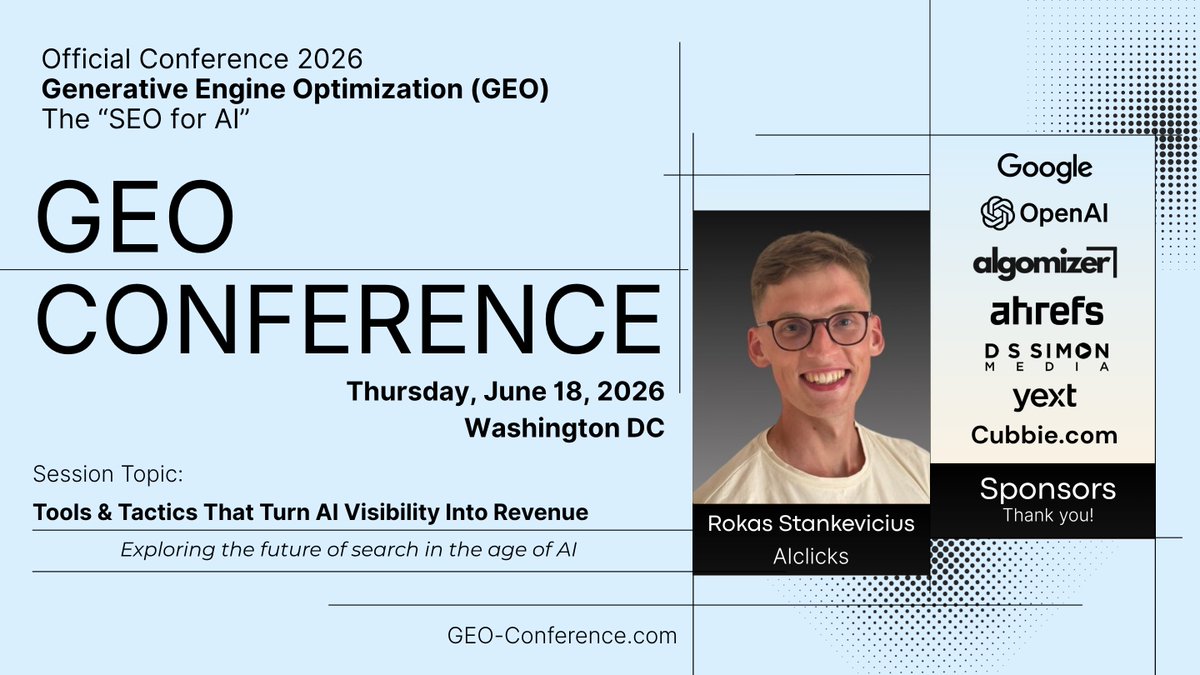
I'm speaking at the #GEOConference in Washington DC on June 18.
It's oen of the biggest AI SEO event in the world. 200+ companies, 20+ talks, two tracks. The last two editions sold out.
I'll be sharing what's actually moving the needle in AI search visibility.
If you're going, let me know. I have a discount code.
AIclicks is becoming the most practical AI visibility tool for SEO power users in brands and agencies.
Here's what we shipped in the last couple weeks:
1/ Sources page now has an interactive graph.
When AI tools answer a question, they pull from specific sources across the web. Some sources get cited constantly. Others barely at all. Now instead of a static table, you see trends over time. Which sources are rising, which are falling, and where you should focus next.
2/ LLM view is live.
ChatGPT, Perplexity, Gemini - they all behave differently. Different sources, different brands they mention, different ways they respond to the same question. Before, you got one combined score. Now you can open each AI engine separately and see exactly how your brand performs inside each one.
3/ Prompt page is fully interactive. You could already select exact topics or individual prompts and track your performance at a granular level. What's new is the graph. Now you see how each prompt trends over time visually, spot which ones are climbing, and which are dropping.
And some smaller updates:
- Dashboard now supports weekly and monthly views, not just daily. Useful when reporting to clients or leadership who care about trends over time.
We're one of a few who support 12 month trends view!
- Sentiment tracking table got a full cleanup. More granular, easier to read at a glance.
What's coming next?
API and MCP integrations. So you could use and leverage your AI visibility data with the tools your team already uses.
Our biggest marketing channel costs us $0.
ChatGPT sends us 10-20% of our sales calls every month.
And we don't win on budget.
We win because we built AIclicks for ourselves first, used it on real client accounts, and proved it worked before we sold it to anyone.
If it works for us in one of the most competitive SaaS categories right now, it can work for your brand too.
Try it out here: aiclicks .io
One of our agency partners came to us with a growing problem.
Their clients were INVISIBLE in the AI search.
And no one could explain exactly why leads were slowing down.
Fast forward 90 days:
- new premium service line
- higher LTV across their entire portfolio
- a revenue stream their competitors still can't replicate
Because we installed a system built across 4 layers:
1/ AI prompt research
→ Mapping exact questions buyers type into ChatGPT and Perplexity
→ Identifying visibility gaps competitors hadn't claimed yet
2/ Content optimization for AI
→ Restructuring pages so AI models can extract and cite them
→ FAQ architecture built around real buyer language
3/ External visibility building
→ Reddit activation inside conversations AI tools pull from
→ Review optimization on G2 and Trustpilot for AI citations
4/ AI share of voice tracking
→ Monitoring visibility across ChatGPT, Perplexity, Gemini and Claude
→ Competitor mention tracking inside LLM answers
Every layer depends on the others.
Most agencies DIY one or two, see weak results and conclude AI SEO doesn't work.
It works. They just ran half the system.
This partner ran all of it.
Zero new ad spend.
Zero new hires.
Just higher value from relationships they already had.
PS - If you want to see how this could work for your agency, DM me "PARTNER" and I'll break it down for you.
Google didn't warn anyone.
One day you're ranking #2 for your best keyword.
The next, users get a single AI-generated answer at the top of the page and never scroll down to find you.
Your traffic dropped. (massively)
Your team blamed seasonality.
Your agency said "it's an algorithm update, give it time."
But it wasn't an update.
It was a structural shift.
Google didn't just change its algorithm.
It added an AI layer on top of everything you spent years building.
Now instead of showing 10 links and letting users decide, it reads those links, summarizes them, and picks ONE winner to recommend.
The other 9 become invisible.
Here's what makes this painful: your SEO isn't broken.
Your rankings might still be fine.
But your visibility is gone because rankings and recommendations are two completely different games now.
A brand sitting at position #88 on Google can be the top recommended answer in ChatGPT.
A brand sitting at #5 can be completely absent from every AI result. The rules changed without a memo.
Most marketing teams are still running the same playbook from 2021.
- Tracking keyword rankings.
- Monitoring domain authority.
- Celebrating page one wins.
None of those metrics tell you whether ChatGPT, Perplexity, or Gemini are recommending your brand or your competitor when a buyer asks a question you should own.
The brands that figure this out in the next 6 months are going to pull so far ahead it won't be a fair fight.
The ones that don't will wonder why their organic strategy stopped working.
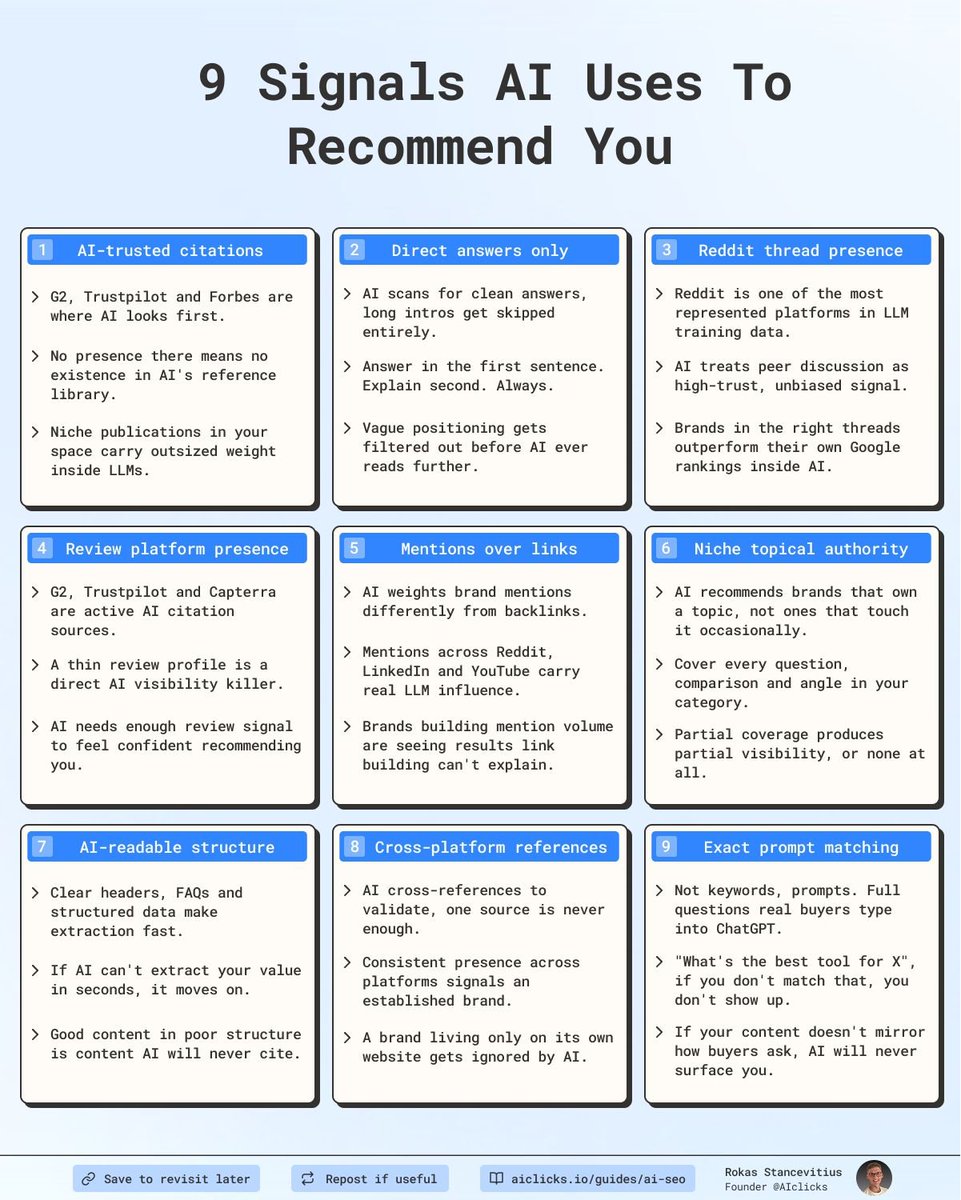
Here are the 9 signals that determine whether AI recommends your brand:
Save this. Most brands are invisible because of number 3.
1. You're cited by sources AI already trusts
AI doesn't crawl randomly. It pulls from sources it learned to treat as authoritative. G2, Trustpilot, Forbes, niche publications in your space. No presence there means no existence in AI's reference library.
2. Your content answers questions directly
AI scans for clean, extractable answers. Long intros and vague positioning get skipped completely. Answer first. Explain second. Always.
3. You show up in Reddit threads
Reddit is one of the most heavily represented platforms in LLM training data. AI consistently treats peer discussion as high-trust, unbiased signal. Brands that appear naturally in the right Reddit threads tend to show up far more consistently across AI answers than brands that don't.
4. You have review platform presence
G2, Trustpilot, Capterra. AI actively cites these when recommending products. A thin review profile is a direct visibility killer.
5. Your brand gets mentioned not just linked to
Traditional SEO chases backlinks. AI visibility appears to weight brand mentions differently. Consistent mentions across Reddit, LinkedIn, review sites and YouTube comments seem to carry significant influence inside LLMs. The brands building mention presence right now are seeing results that pure link building alone doesn't explain.
6. You have topical authority in your niche
AI recommends brands that own a topic completely. Not brands that touch it occasionally. You need content that covers your category from every angle, every question, every comparison.
7. Your site structure is AI readable
No technical jargon. Clear headers. FAQ sections. Structured data. If AI can't extract your value proposition in seconds, it moves to your competitor who made it easier.
8. You're referenced across multiple platforms
One strong source isn't enough. AI cross-references. A brand mentioned consistently across Reddit, LinkedIn, review sites and publications gets treated as established. A brand living only on its own website gets ignored.
9. Your content matches the exact prompts buyers use
Not keywords. Prompts. The full natural language questions real people type into ChatGPT. If your content doesn't mirror how your buyers actually ask questions, AI will never surface you as the answer.
Most brands have none of these in place.
Their competitors are quietly building all of them.
How many of these does your brand actually have? (be honest).



![stanrokas's tweet photo. A fintech brand started investing in GEO 2 months ago. Today they are among top 3 in their market by citability. Here's exactly what they did:
1/ Set up prompt tracking across 170+ high commercial intent queries
They mapped every question a buyer in their space would ask an AI.
- "Best [category] tools."
- "Top [use case] platforms."
- "Compare X vs Y."
Then they tracked those prompts weekly across 6+ AI models.
2/ Found which sources AI was already citing They looked at what pages, articles, and domains the AI models actually pulled from when answering those prompts.
- Reddit threads.
- Industry listicles.
- Review roundups.
- Comparison posts.
3/ Created content for the exact source types that worked
Based on what the AI cited, they built commercial listicle posts and landing pages targeting the same topics and formats.
They ran the same loop: track prompts, find sources, publish content, check what moved.
Within 8 weeks they went from invisible to top 3 across their tracked prompt set.
What's next: targeted outreach to the highest-cited third-party sources in their industry.
The goal is to get mentioned directly inside the pages AI already trusts](https://pbs.twimg.com/media/HGiEbl8XkAA7C9Z.jpg)