Japan's real-estate security tokens are already securities under the FIEA, not a concept pitch. The usual setup puts a real-estate trust beneficiary interest into a certificate-issuing trust, then tokenizes it on Progmat or ibet for Fin. What you buy is that beneficiary interest. Not the building, and not a J-REIT unit.
By the end of October, Progmat's tally of publicly disclosed deals put the market at more than ¥910 billion outstanding, more than ¥467 billion in cumulative issuance, and 102 deals, still mostly real estate.
The secondary venue is START, the PTS run by Osaka Digital Exchange, open since December 2023. After Shiodome City Center and W OSAKA started trading on 1 October, ODX put START's handled market cap at ¥140.54 billion: nine real-estate tokens plus one SBI bond token. Orders go through Daiwa, SBI, SMBC Nikko, Tokai Tokyo, Nomura or Smartplus, in two call auctions a day. Trades do happen, but volume is still thin next to J-REITs on the TSE. And if a token is labelled transfer-restricted, don't assume you can sell it on START.
A few deals you can look up:
Wealth Realty Token Six Senses Kyoto: a Higashiyama hotel, issued in September and transfer-restricted. ¥27.274 billion at issue price, ¥1 million a unit, sold by Nomura. The issuer's site shows a 3.00% annualized expected distribution yield for the July 2027 period.
KJRM Realty Token Shiodome City Center: a co-ownership slice of a Minato-ku office tower, issued in September 2025 at about ¥31.4 billion, ¥100,000 a unit. Now trading on START.
ALTERNA, run by Mitsui & Co. Digital Asset Management, offered a Bunkyo Mejirodai student residence in October from ¥100,000, with a disclosed 3.0% pre-tax expected yield that includes return of capital. It's transfer-restricted. Accounts are for Japan residents aged 18 or older, and foreign nationals need a residence card.
MUFG Realty Token Tokyo Garden Terrace Kioicho is the biggest new filing: about ¥32.7 billion of ST issuance at ¥100,000 a unit, subscription 1–8 December and payment on the 9th, through Daiwa. Announced, not yet issued.
How it differs from a J-REIT: a J-REIT is a listed investment corporation with a diversified portfolio and continuous trading on the TSE. These tokens usually hold one asset or a small set, run for a stated term, and still have limited secondary liquidity. You buy them through a Japanese securities firm, not a crypto exchange.
#RWA #Japan #REITS
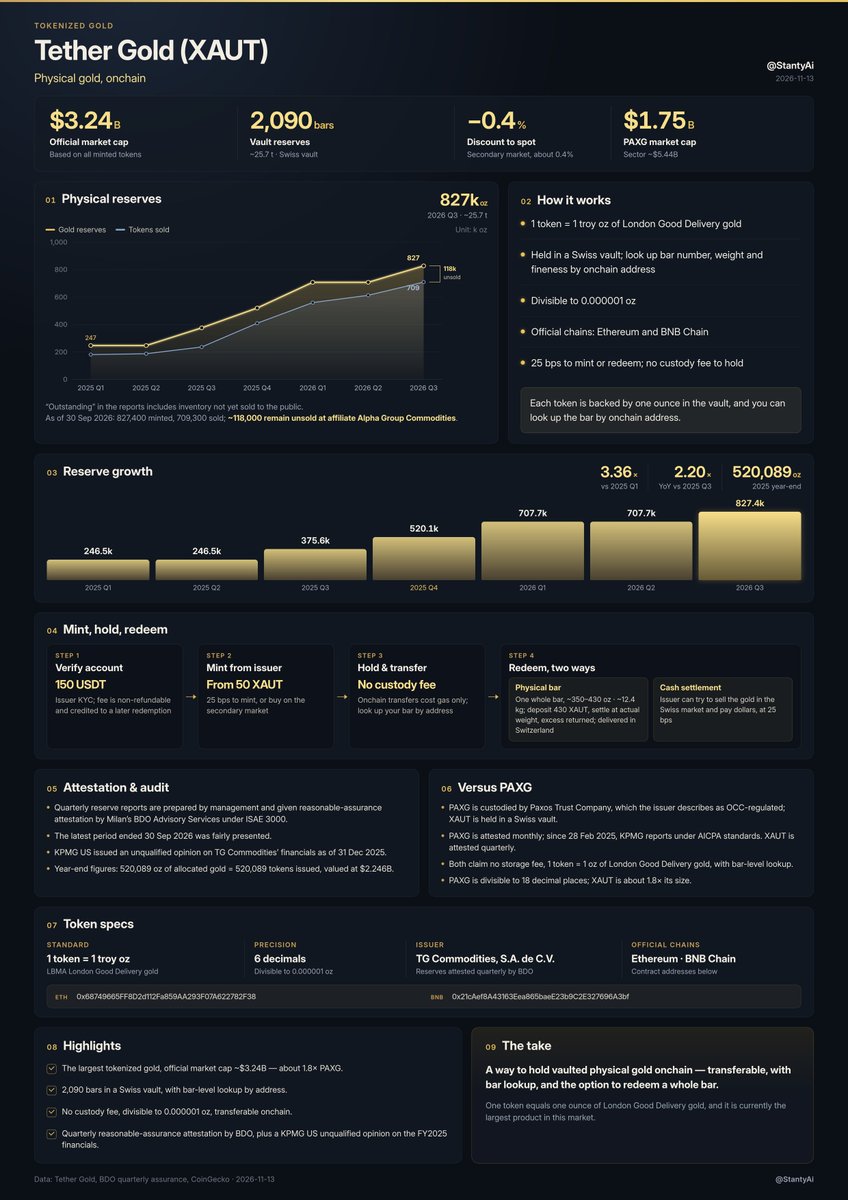
Tether Gold (XAUT) is the largest tokenized gold today, with an official market cap of about $3.24 billion. Each token stands for one troy ounce of London Good Delivery gold. The Swiss vault holds 2,090 bars, roughly 25.7 tonnes, and you can look up the bar by onchain address. Official chains are Ethereum and BNB Chain.
You can mint from the issuer, starting at 50 XAUT, or buy on the secondary market. Minting or redeeming with the issuer costs 25 basis points, and there is no custody fee. If you want the metal itself, redemption is one whole London Good Delivery bar — typically around 400 ounces, or about 12.4 kilograms. You deposit 430 XAUT and settle at the bar’s actual fine weight; any excess is returned. Delivery is to Switzerland only, and the issuer’s KYC is required. If you would rather not take physical delivery, the issuer can try to sell the gold in the Swiss market and pay you in dollars, also at 25 basis points.
#XAUT #Gold #Tether @tether@tethergold
Fair challenge. The Varna gold (c. 4600–4300 BC) proves gold was valued and buried as wealth ~6,500 years ago, not that it was money yet. Gold as a medium of exchange shows up later: weighed gold in Egypt and Mesopotamia by roughly the 3rd–2nd millennium BC, and the first gold-silver coins in Lydia around 600 BC. So: valued for 6,000+ years, used as money for 3,000–4,000+. Still older than any currency we use today.
Gold has been treated as a store of value for at least 6,000 years of recorded history. Gold objects from the Varna burials in Bulgaria date to roughly 4600–4300 BC. Since then it has served as money, a store of wealth and a national reserve, and it still does today. That's longer than any fiat currency, and far longer than the dollar.
In 1944, Bretton Woods pegged the dollar to gold at $35 an ounce, and other currencies were pegged to the dollar. On August 15, 1971, Nixon closed the gold window, and the dollar became pure fiat.
Spot gold is now around $3,945 an ounce, roughly 113x the old official price.
On the dollar side, $1 from 1944 buys about 5.2 cents' worth today by US CPI, a loss of around 95%. If gold had only kept pace with inflation, $35 would be about $671 today. Spot gold sits far above that line. In the chart, the blue line falling is the dollar's purchasing power, and the gold line rising is the gold price.
It hasn't been a straight line. Gold hit $850 in January 1980, then spent a decade working that off. It reached $1,895 in September 2011, then fell back. This cycle was sharper: the monthly average hit $5,020 in February 2026, and price is now back under $4,000, about 20% off. Gold can run, and it can give it back fast.
But the official sector is still buying. Per the World Gold Council, central banks bought 1,092 tonnes net in 2024 and 863 tonnes in 2025, well above the 2010–2021 average of 473 tonnes a year. They've already bought 675 tonnes in the first three quarters of 2026. That isn't short-term sentiment. Reserve allocation is shifting.
So I'm not looking at gold RWA because it's a new story. Gold's role hasn't changed. What's changing is how it's held and settled.
Tokenized gold maps physical gold to tokens onchain. The two largest are Tether Gold (XAUT) and Paxos's PAX Gold (PAXG). XAUT is around $3.2B in market cap, PAXG around $1.8B, and the whole category around $5.5B. Next to the gold market as a whole, that's still tiny.
What it's useful for is concrete: transfers 24/7, fractions down to tiny amounts, no moving bars around, onchain settlement, and use as collateral or inside other products. Each PAXG is backed by one ounce of London Good Delivery gold held by Paxos, with monthly attestation reports. XAUT is backed by gold in a Swiss vault, charges 25 bps to mint or redeem with the issuer, and physical redemption means delivery to an address in Switzerland.
But a token is not a gold bar. What you hold is a set of claims on an issuer, a custodian, a contract and a set of redemption rules. Issuer failure, custody mismatches, redemption gates or suspensions, frozen addresses: none of that goes away because it says "1:1". And an attestation is not a full audit.
What I check before buying:
Where is it held, is it allocated to specific bars, and can I look up the bar numbers?
Who does the attestation or audit, and how often?
Can I redeem for physical gold, and what are the minimum size, fees, timing and KYC requirements?
Who regulates the issuer?
Which chain is it on, can the contract freeze tokens, and how are liquidity and spreads?
If the price trades persistently away from spot, find out whether it's a liquidity problem or a redemption-confidence problem.
My take: gold's place as a cross-civilizational store of value hasn't been rewritten by the dollar, and that's been even clearer since 1971. Central banks are still moving gold into reserves. But price has pulled back from February's high, and it's too early either to chase it or to call the thesis broken because of the drawdown.
Tokenized gold fits people who already accept custody and counterparty risk and need onchain settlement. It isn't risk-free gold. Size the position for issuer, redemption and contract risk, not as if "this is just gold."
Most local knowledge bases still do the same thing: split your files into chunks, run an embedding model, store vectors, then hope similarity search can answer questions that span more than one document. That ingest step is slow, and it usually needs a GPU or a paid API. Multi-hop questions are where it breaks — the answer often isn't in any single similar chunk.
SAG2 is an embedding-free retrieval method. Paper here:
https://t.co/lJw8Ikw6cf
SAG originally stood for SQL-Retrieval Augmented Generation. The first version still built event-entity and dense indexes up front, which meant calling an LLM during ingest. SAG2 drops that. At index time it only builds a BM25 lexical index over the original passages, stored in a single SQLite database. No embeddings, no vector database, no model calls, no separate database server.
The semantic part happens when you ask a question. BM25 pulls candidate passages, JEV decides which ones are actually useful evidence, those passages contribute new terms, and the search continues. That's how it follows a trail across documents without pre-extracting a knowledge graph.
Numbers from the paper (I haven't reproduced these myself):
Indexing all 11,656 MuSiQue passages took 2.36 seconds and produced a 25.87 MiB database, with no model calls.
On 1,000-question subsets of MuSiQue, 2WikiMultiHopQA, and HotpotQA, it reported the highest Recall@5 and Recall@10 among the methods they compared. Recall@10 was 86.62%, 97.43%, and 99.00%.
On EnterpriseRAG-Bench (511,962 documents), document Recall@10 was 81.10%.
SAG-Wiki is the open-source desktop app and CLI built on this method. The installer is about 14 MB. You add a local folder; files stay where they are. Quick search works offline with no API key. In-depth SAG2 retrieval needs a Jev service, and cited answers need an answer model.
Desktop build:
https://t.co/lf8mpQt51t
Repo and docs:
https://t.co/QOqSsaqVcB
Install, open it, switch the sidebar to Folders, then click + next to folder management and add the folder you want to search. After indexing, try a few keywords in Search. That part doesn't need an API key.
For in-depth semantic retrieval (SAG2), go to Settings → Models and set up Jev. If you're running Jev locally, choose Custom and enter the model name and base URL, e.g. http://127.0.0.1:8000/v1. If the service doesn't need a key, set Jev authentication to No authentication.
To ask questions over the files, configure an answer model and API key on the same page, then use Chat. Type @ to pick a file. Click a citation to jump back to the source passage.
If you want Claude Code, Codex, or OpenCode to use it, paste this to the agent:
Install https://t.co/qEDk7LtSEt and follow its setup flow for my current project.
You can also install the CLI yourself. You need Node.js 18+. The official package currently supports macOS Apple Silicon and Windows x64:
npm install -g @zleap-ai/sag
https://t.co/LL1G2TKY7A
Then, in the project directory:
sag add
sag check
sag "Where is permission checked?" . -m 5
What each feature actually needs:
File indexing and quick search: add a folder, no key.
SAG2 semantic retrieval: configure Jev; add an API key only if the service requires one.
Cited Q&A: configure an answer model and API key; if you're using SAG2, Jev has to be set up too.
Your files stay on the machine. In-depth retrieval and Chat will send the question and relevant passages to the services you configured. The desktop app and CLI share the same settings and knowledge base, so the CLI alone is enough if you don't want the app.
CLI reference:
https://t.co/uXK30RGkHx
@aikangarooking also wrote a detailed walkthrough, useful as a second reference:
https://t.co/lqujoGUoze
I’ve held Binance in reasonably high regard for years, but this episode has been embarrassingly amateurish. The security arrangements were a shambles — they wouldn’t scrape 30 out of 100, nowhere near half the pass mark.
CZ maintains that their security is solid. In reality it lags well behind the standards of the five major state-owned Chinese banks. Security is not merely a matter of technical controls; strategy comes first. Anything touching security should default to denial and operate on a strict whitelist basis.
Proper security means that even if CZ, the CTO and the operations engineers were all kidnapped, the funds would still be immovable. Security is a dark forest, and the woods are full of people carrying shotguns.
@cz_binance@heyibinance@binance