Official account for StarDate, the public education & outreach arm of McDonald Observatory, a research unit of @UTAustin. New podcasts & print issues regularly!
StarDate Radio produces short, daily podcasts covering all things astronomy. Subscribe to get them the day they’re posted, or wait a day and listen for free! As always, StarDate appreciates your support!
The constellation Serpens consists of two disconnected parts, a head and a tail. They wrap behind Ophiuchus the serpent bearer.
Serpens is in view in the east and southeast by early evening. The half that represents the head is highest, above Ophiuchus.
Venus and Jupiter are staging one of the top skywatching events of the year—an especially close encounter of the two brightest points of light in the night sky. It plays out in the west over the next few evenings.
The Omega Centauri star cluster puts in a late-evening appearance.
It stands highest above the southern horizon around 10 p.m. CT and looks like a faint smudge of light.
It is about 17,000 light-years away, and contains a million stars or more.
Hercules and Ophiuchus stand almost head to head in the east and southeast this evening. Each has a star with an Arabic name that means “the head.”
In Hercules, it’s Ras Algethi (head of the kneeler); in Ophiuchus, Rasalhague (head of the serpent bearer).
From the southern latitudes of the United States, the upper half of Centaurus the centaur stands in the southern sky at nightfall. The brightest star in that part of the constellation is Menkent, the centaur’s shoulder.
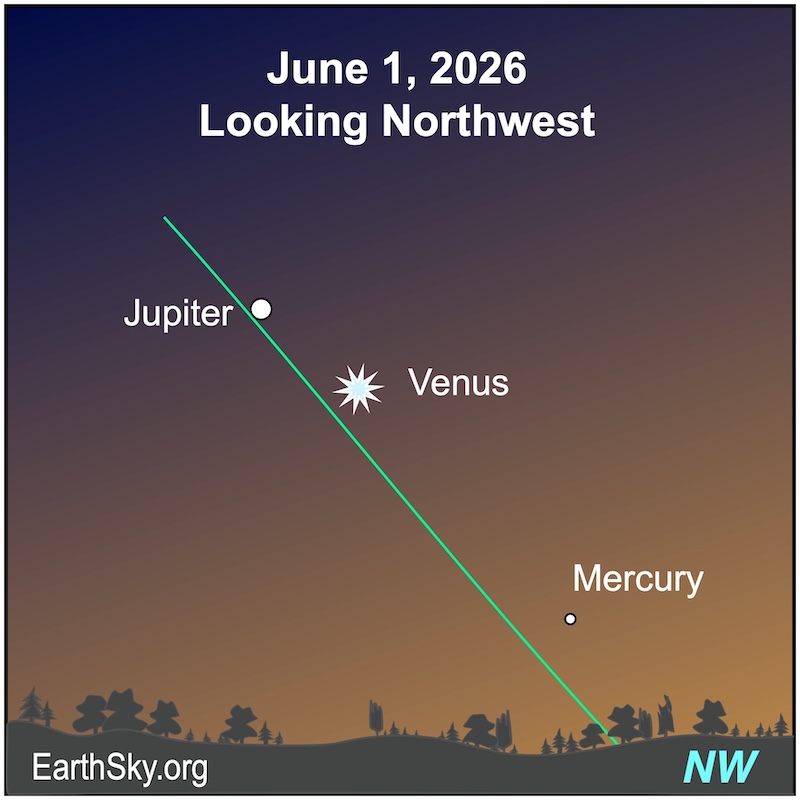
Pollux and Castor, the twins of Gemini, have a front-row seat for a planetary waltz this month. Venus, Jupiter, and Mercury are fairly close to the twins now, and will bunch up even closer during June. The group is in the west as evening twilight fades.
The Sun has been especially active the past couple of years, creating some exceptionally bright and colorful auroras.
We’ll talk about the colors, and about some ancient tales of what they mean, this week — on StarDate!
https://t.co/STRMysrt7n
Four stars in the constellation Corvus, the crow, form a small lopsided box that resembles a sail. It’s in the south at nightfall.
The star at the top left corner of the sail is Delta Corvi. Clockwise from there, the others are Gamma, Epsilon, and Beta Corvi.
🌕 The Moon is full late tonight - As the second full Moon of the calendar month, it’s known as a Blue Moon!
After major volcanic eruptions or large forest fires, the Moon CAN actually appear somewhat blue but it's quite rare.
For most American skywatchers, the star Capella is just peeking into view in the morning twilight. It’s bright, but it’s quite low as the sky brightens. You need precise timing and a clear north-northeastern horizon to spot it.
[Image credit: Daniel Johnson via Sky & Telescope]
Cygnus, the swan, is a signpost for charting Earth’s path through the galaxy.
As you face Cygnus as it rises in the northeast, you’re looking forward in our orbit around the Milky Way - The center of the galaxy is to the right, in Sagittarius.
Vega, one of the brightest stars of summer nights, is low in the east-northeast at nightfall and soars high overhead later on. It is about 25 light-years away.
It’s a bit bigger, brighter, and heavier than the Sun, but just 10 percent the Sun’s age.
[NASA/ A. Fujii/ ESA]
Spica, the brightest star of the constellation Virgo, is close to the Moon tonight.
Spica is actually two stars that are locked in a tight orbit around one another - So close together that they're impossible to see as individual stars!
New Yorkers will see some special sunsets this week, as the descending Sun lines up along the urban canyons of Manhattan, and we’ll have details!
Join us for Manhattanhenge and more, this week — on StarDate!
https://t.co/ytg5KTnCv7
[istockphoto via secretNYC dot com]
Zubeneschamali and Zubenelgenubi skitter across the southern sky on May evenings. They are far above Antares, the bright heart of the scorpion, which climbs into view by about 10 p.m.
Although they're in Libra, they represent the claws of the scorpion.
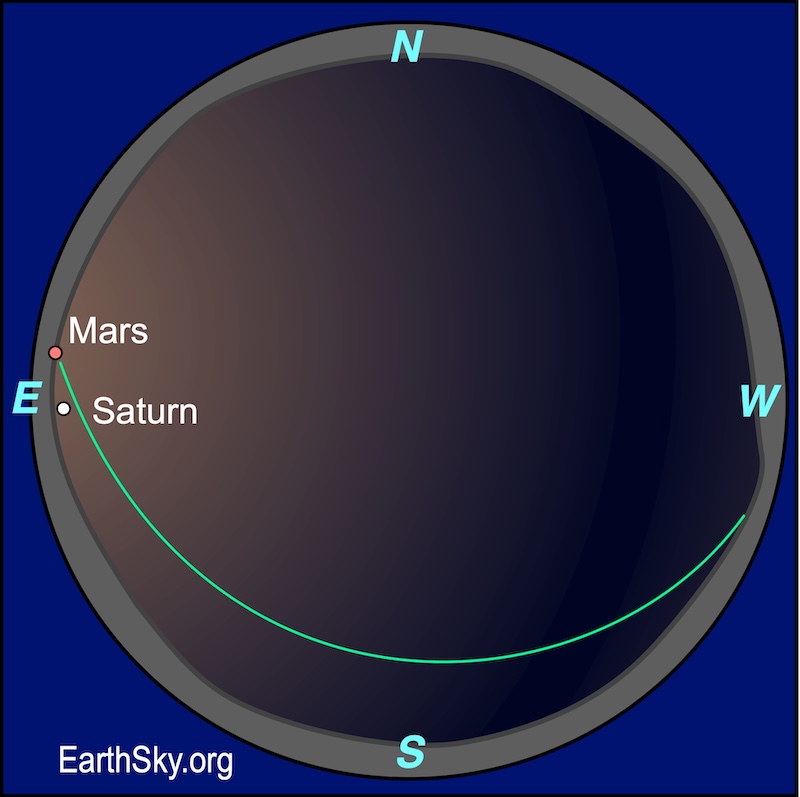
Mars is working its way into the morning sky. The planet is quite low in the east during dawn twilight. It will climb a little higher day by day, however, and will be in good view this summer.
The Moon creeps up on the heart of Leo tonight, the star Regulus. Regulus is close to the upper left of the Moon at nightfall. The Moon will move closer before they set, around 2 a.m. They will be closest together as seen from the West Coast.
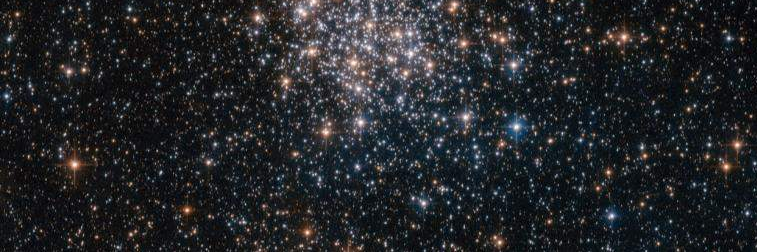
About 160 known globular clusters orbit the center of the Milky Way galaxy. The biggest and brightest is Omega Centauri, which is low in the south this evening.
It may be the stripped core of a smaller galaxy that the Milky Way took over long ago.
[NASA/JPL-Caltech/UCLA]
The Moon lines up with the twins of Gemini this evening -- the stars Pollux and Castor. Pollux is the brighter twin and is closer to the Moon.
The brilliant planet Jupiter is to the lower right of the Moon.
Jupiter stands to the upper left of the Moon this evening. The Sun’s largest planet looks like a brilliant star. The twins of Gemini stand above the Moon. Castor, on the left, is the brighter of the two.









![stardate's tweet photo. For most American skywatchers, the star Capella is just peeking into view in the morning twilight. It’s bright, but it’s quite low as the sky brightens. You need precise timing and a clear north-northeastern horizon to spot it.
[Image credit: Daniel Johnson via Sky & Telescope] https://t.co/vyLB1TM2dt](https://pbs.twimg.com/media/HJgWKtZWoAUa9ix.jpg)

![stardate's tweet photo. Vega, one of the brightest stars of summer nights, is low in the east-northeast at nightfall and soars high overhead later on. It is about 25 light-years away.
It’s a bit bigger, brighter, and heavier than the Sun, but just 10 percent the Sun’s age.
[NASA/ A. Fujii/ ESA] https://t.co/HPzyH0E45m](https://pbs.twimg.com/media/HJWeacCWcAA6lav.jpg)

![stardate's tweet photo. New Yorkers will see some special sunsets this week, as the descending Sun lines up along the urban canyons of Manhattan, and we’ll have details!
Join us for Manhattanhenge and more, this week — on StarDate!
https://t.co/ytg5KTnCv7
[istockphoto via secretNYC dot com] https://t.co/gLvKp4cZcc](https://pbs.twimg.com/media/HJQmIIBXgAATz5q.jpg)


![stardate's tweet photo. About 160 known globular clusters orbit the center of the Milky Way galaxy. The biggest and brightest is Omega Centauri, which is low in the south this evening.
It may be the stripped core of a smaller galaxy that the Milky Way took over long ago.
[NASA/JPL-Caltech/UCLA] https://t.co/170QLZ5DxL](https://pbs.twimg.com/media/HI3k7BUWIAAiN_y.jpg)


