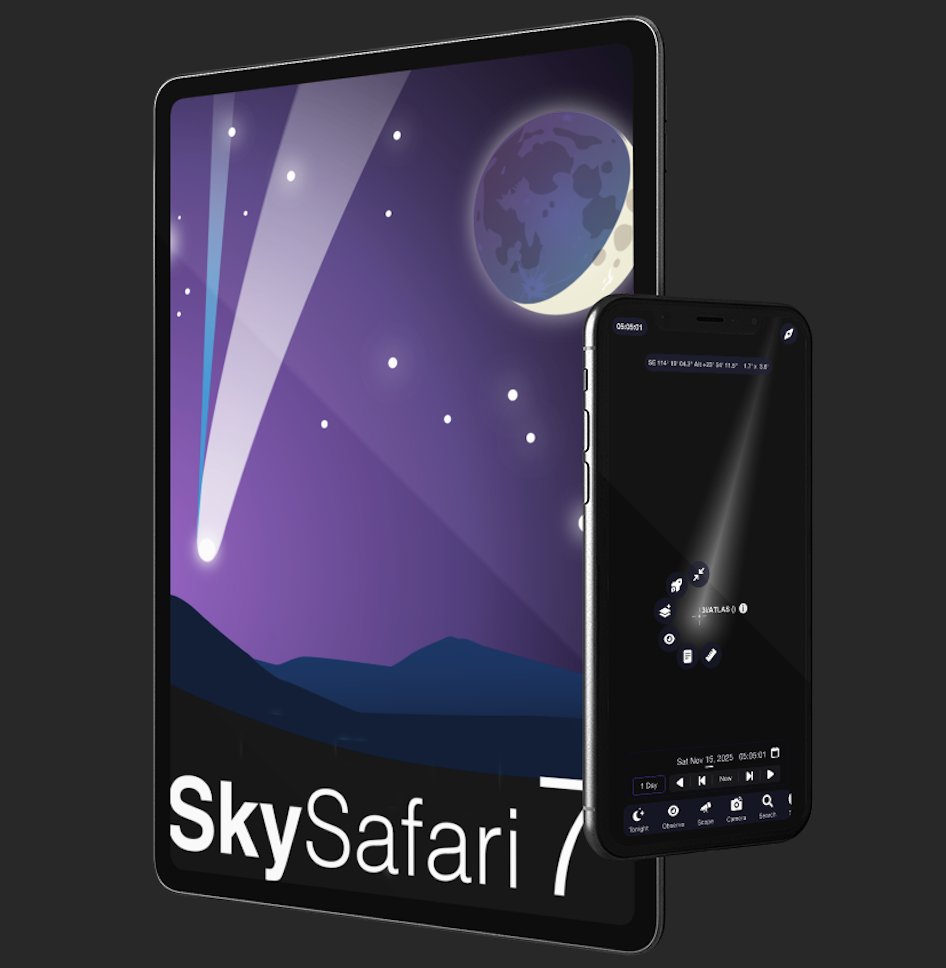
The leader in simulating the Universe & controlling scopes on Windows & macOS. Also featuring world class astronomy curriculum solutions for K-12 & Higher Ed.
SkySafari 8 Pro is live on iOS!
Fresh features. Deeper skies. Fewer reasons to sleep.
Have fun this weekend, folks....Clear skies & clear
your calendar.
https://t.co/t44xp5xPs6
Atrapé al cometa ☄️
Hoy en la madrugada logré captar al cometa C/2025 A6 Lemmon desde Caguas, P.R
Tip: Si descargas la aplicación @skysafariastro , podrás encontrar este y muchos otros objetos celestes. Solo entra al menú, selecciónalo, apunta tu equipo al cielo y ¡listo!
Comet C/2025 A6 (Lemmon) deserves your attention. Simulate, track, orbit and more in SkySafari today!
#CometChaos@LateNightAstro
https://t.co/BYNG6oLhJt
This comet hunting season is Powered By SkySafari more than any other! Checkout the SmartEye Digital Eyepiece capturing C/2025 R2 (SWAN)!
#PegasusAstro#CometChaos
📸 darkskyhill YT Shorts
Top Five Summer Sky Objects
By @JoeRaoWeather (SkySafari Premium)
Summertime is that time of year which probably affords the best opportunity for people to become acquainted with the night sky. One reason is that this is the main vacation season, so many city dwellers are able to go to relatively unspoiled, pollution-free observing sites such as national parks, campsites, and shoreline communities.
From my own personal experience of over 50 years of skywatching, I’ve found that the general public can be captivated by the starry sky, if it is described in an interesting and stimulating manner. One of my astronomy mentors was Dr. Fred Hess (1920-2007), for many years a lecturer at New York’s Hayden Planetarium. Fred was a gifted storyteller and in describing the sky, he always found it useful to introduce the leading stars and constellations as useful celestial landmarks.
For our current sky, I’ve chosen five objects that can be accessed either with the naked eye, or with a pair of binoculars or a small telescope. 👇
SmartEye Digital Eyepiece: 3 Amazing Star Parties Upcoming!
Rocky Mountain Star Stare: June 25-29 near Gardner, CO
ASTROCON: June 25-28 at Bryce Canyon National Park in Utah
Grand Canyon Star Party: June 21-28 at Grand Canyon National Park in Arizona
https://t.co/3j2ltOI0ey
#4 of the Top 10 Celestial Sights of the Year is Near!
Totality Over America: The Lunar Edition (March 13-14)
All of the Americas see this eclipse...On Thursday night March 13-14, the Full Moon will turn deep red for 66 minutes, with the Moon high in the sky with the eclipse in the middle of the night. This is the first opportunity to view a total lunar eclipse since 2022. Don't miss it!
Get your timing right for your location in SkySafari.
See the rest of the top 10 events in SkySafari 7 -> Tonight -> Featured Stories -> View All
Premium Content from Alan Dyer @amazingskyguy
"Keep your eyes on the stars and your feet on the ground." - Theodore Roosevelt 🌟
But what if our feet were on #Mars? 👀🚀
This #PresidentsDay, we celebrate pioneers—past, present & future. From #MountRushmore to the #Moon to #OlympusMons…the next frontier is calling. 🌌
🔭 60% OFF SkySafari Pro: Explore the universe for just $19.99!
👉 https://t.co/CBTeDc4byw
One small step for savings...one giant leap for the #stargazing kind on iOS & Android. 🔥🔥
The Ultimate Astro App on Valentine's Day Sale! Save 50% on SkySafari 7 Plus for iOS & Android through the 14th. #space#astronomy#telescope
https://t.co/Km3OCnmFAY
Moon Menaces Mars (all night)
In the eastern sky after dusk on Sunday evening, February 9, the bright, nearly full moon will be shining a short distance to the lower left (or celestial east) of the bright reddish planet Mars – close enough for them to share the view in binoculars (orange circle).
Gemini’s bright stars Castor and Pollux will twinkle to their left (or celestial northeast). The grouping will climb high in the southern sky around 10:30 p.m. local time and then set in the west before dawn on Monday. By then the orbital motion of the moon and the diurnal rotation of the sky will shift the moon farther from and above Mars.
Hours before it rises in the Eastern Time zone, the moon will occult Mars for observers located in the Canadian Arctic, Greenland, Iceland, most of Scandinavia, most of Russia, eastern Kazakhstan, Mongolia, and most of China. Lunar occultations of planets are safe to observe with unaided eyes, binoculars, and telescopes.
Use an app like SkySafari or Starry Night to look up the timings where you live.
Enjoy Venus At Its Best
By Alan Dyer (@amazingskyguy) - SkySafari Premium Preview
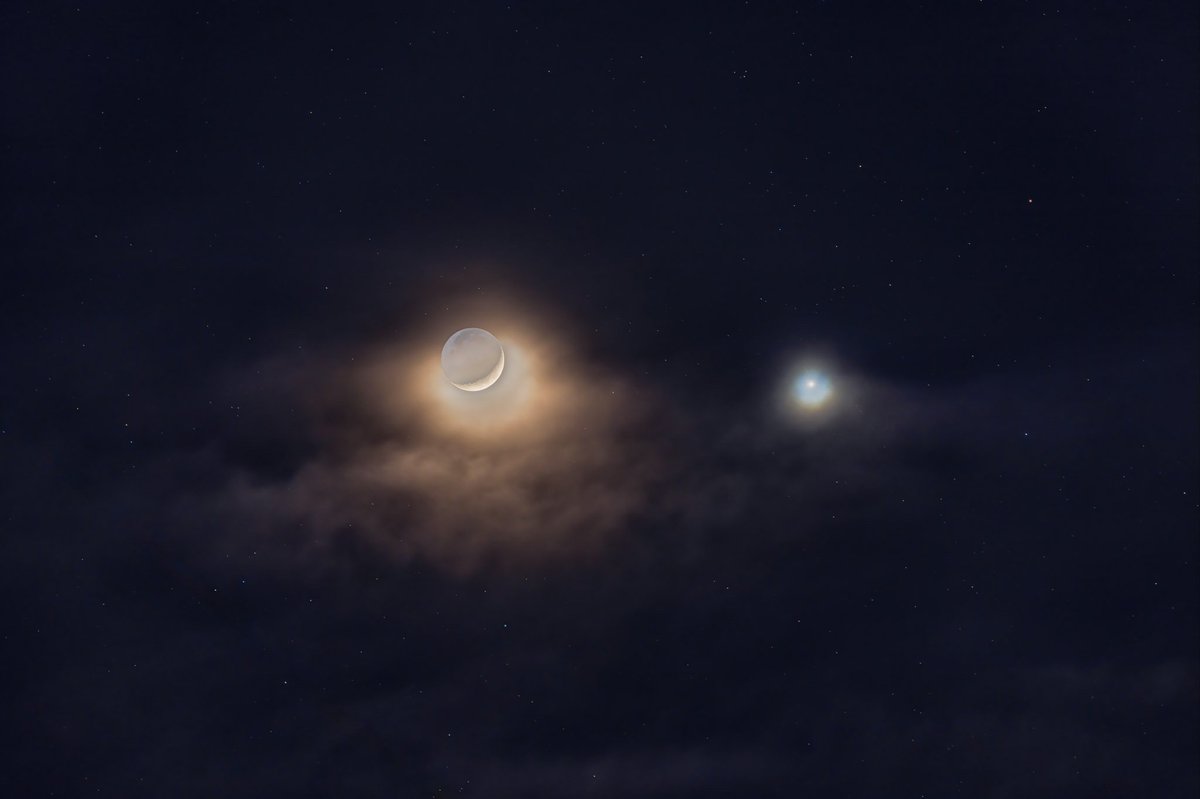
If you had clear skies you could not have missed the close conjunction of the crescent Moon near Venus on February 1 (when I shot the opening image). That conjunction marked the start of a fine month of Venus watching.
However, Venus has been prominent in our evening sky for the last few months. The steep angle of the ecliptic – the line along which we find the planets – has swung Venus up unusually high into the dusk sky this winter, at least for observers in the northern hemisphere.
As a result, Venus has been setting late enough to shine in a dark sky, making it especially obvious to even the most casual #skygazer.
If you’ve aimed a telescope at Venus you’ve seen it as a white disk, with a phase like a waxing Moon.
Over the next few weeks, Venus will approach closer to the Sun, placing it a little lower in the west each night, signaling the end of its evening appearance — but not before it puts on a peak performance.
As Venus begins its descent toward the Sun, it will brighten even more! Its disk will also grow in size as Venus gets closer to Earth, but its phase will shrink from a wide crescent to a razor thin crescent.
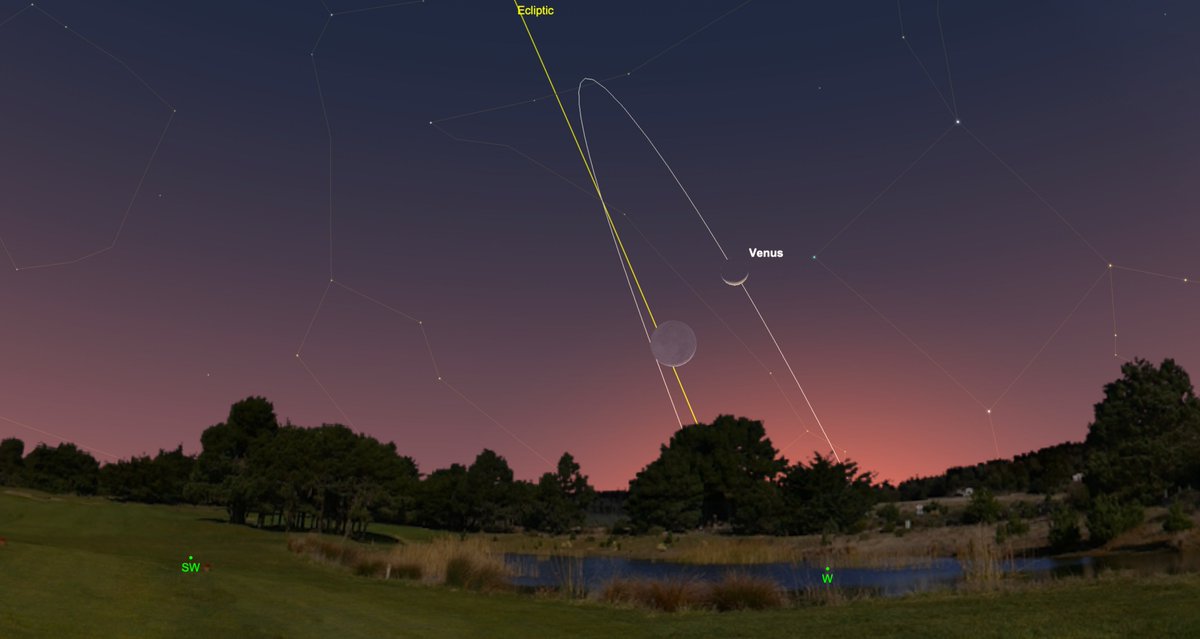
In this illustration for February 1, 2025 I have used #SkySafari to magnify the disk of Venus by 150x and the Moon by 6x. The scene is for a mid-northern latitude.
On February 1 the waxing Moon sat just 2° below Venus for a striking pairing in the evening sky.
Look at Venus through a telescope and you’ll now see it is also a crescent, but wider than the Moon’s phase that night. At the start of February the Venusian disk is 32 arc seconds across and is 37% lit.
On February 14 (#ValentinesDay, appropriate for the planet named for the #goddess of love) Venus peaks at maximum brilliance, at magnitude -4.9, far brighter than any other #planet can ever shine — or star for that matter, unless it’s a supernova!
The Venusian disk has now grown to 39 arc seconds across, but its phase has thinned to 27% lit.
Even though less of the disk is sunlit, the portion that is lit is now larger. The two factors — growing size but decreasing phase — combine to peak Venus at its maximum brightness (or “greatest illuminated extent,” to use the formal term) in mid-February.
By March 1, as shown above, the waxing crescent Moon is back near Venus for a wider conjunction.
But the disk of Venus has now grown to 49 arc seconds across, larger than any other planet can appear, and is now just 14% lit. That’s thin, though the Moon this night is an even thinner 5% phase.
The evening show ends in early March when Venus, which has been so obvious for the last few months, drops rapidly out of sight toward the Sun, to disappear from view as the planet comes between Earth and Sun (called “inferior conjunction) on March 22.
To watch #SkySafari simulate the motion and phases of Venus, (open this story in "Tonight" -> "Featured Story" of any #SkySafari 7 app) and click the link to set the sky for February 1, 2025. You can also download the .skyset file below:
https://t.co/OOoWmVkJcr
Then step ahead in time at one-day increments to watch Venus descend toward the Sun, grow in size, but shrink in phase, with its disk magnified by 150 times.
Or better yet, get outside every clear evening with a telescope to watch as #Venus performs at its best and most brilliant. #astro #space
Moon Shines above Jupiter (Feb. 6 - evening)
As the sky darkens after sunset on Thursday evening, February 6, the bright planet Jupiter will shine less than a palm’s width below (or 5 degrees to the celestial south of) the waxing gibbous moon high in the southern sky – close enough to share the view in binoculars (orange circle).
By early evening, the bright stars of winter will appear around them, particularly yellowish Capella well to their upper left (or celestial north) and reddish Aldebaran just to their lower right (celestial south). Those stars are part of the huge winter hexagon asterism.
The moon and Jupiter will culminate due south around 8 p.m. local time and set in the west in the wee hours of Friday morning.
The M16 Eagle Nebula Viewed in SmartEye Digital Eyepiece
The slam dunk #observing experience that will pull friends and family into the hobby has arrived. Every traditional observer will need to see the truly transformative, completely immersive view that the #SmartEye digital eyepiece provides.
https://t.co/hCHYdAiwB2 - Powered by SkySafari - https://t.co/cs3I1PDf1S
#astronomy #deepsky #imaging