"Some blogger who doesn’t even write a single paper in a decade."
#Cosmology Science writer, astrophysicist, author, communicator. He/him or they/them.
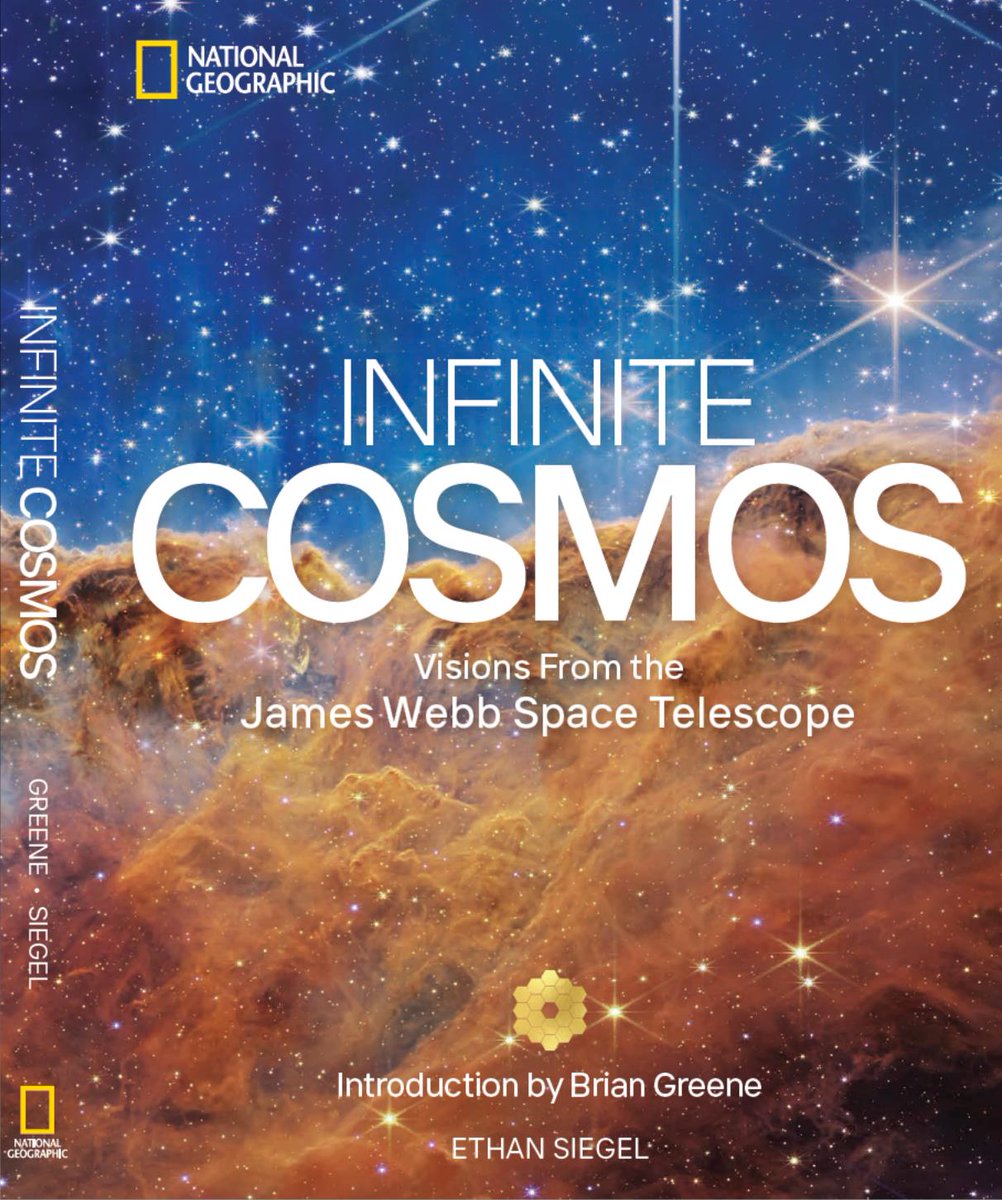
"Where can I buy Infinite Cosmos?"
Yes!! Everywhere!
Amazon: https://t.co/YNFhRYJECN
Barnes & Noble: https://t.co/ZK59LnOpOp
Disney: https://t.co/6a7PpNScMH
Penguin/Random House: https://t.co/xBk0a2trVV
Powell's city of books: https://t.co/KV6af2ZNjD
@AhmetTahirMat One of the things that frustrates me is that when humans used to solve problems such as this, the steps that were taken along the way raised a bunch of interesting follow up questions.
"Next steps" sorts of things.
When AI solves it, it's just... Ok, now what?
AI proved a major quantum complexity conjecture. What does it mean?
An AI-driven proof of the Aaronson-Ambainis conjecture has just arrived.
It doesn't challenge quantum supremacy, but it does rule out one major pathway to getting there.
https://t.co/iX2uNcL7CH
Earth is only 99.57% spherical: it bulges at the equator and flattens at the poles. So what’s the roundest natural object in the Universe? Astrophysicist Ethan Siegel (@StartsWithABang) says the record now belongs to the slowest-rotating neutron star known. Read it here: https://t.co/ZZOZNb7D2W
5 big astronomy “facts” that changed in the 21st century
From how type Ia supernovae worked to how black holes were formed, we thought we had many astrophysics facts figured out at the century's turn.
These 5 have since changed drastically.
https://t.co/GIJ2Xa9Wys
@alemelk How difficult do you think it would be to do the calculation in such a way that kSZ + tau observations would be able to tell MOND theories from LCDM?
Are we far off from it?
I know you're no MOND enthusiast, so how high is the barrier to doing it correctly and convincingly?
Dark matter passes a new cosmic test, while MOND fails
A new cosmic test has finally, with CMB and large-scale structure data, become realistic: using the kinetic Sunyaev-Zel'dovich effect to test dark matter vs. MOND.
Guess who wins?
https://t.co/jja8ObZ5OQ
@alemelk So in the original letter, they talk about how they "ignore the EFE," and are you basically saying that by ignoring the EFE, they cannot conduct a meaningful test?
And is that because the equivalent of the EFE is exactly what you need for accelerations?
@alemelk Are you saying that there is NO WAY to disentangle the "force law" part from the tau part even given arbitrarily good independent data under this formalism?
That you need to (somehow?) derive a first-principles MOND prediction for this to test it?
That's a strong statement!
@alemelk What do you think?
Have I parsed your paper correctly, and the differences between what you're asserting and how you're approaching it from what the original team did?
I know you are a longtime fan of "different ways to get the same answer" since before we ever even met!
@alemelk This should also significantly vary as a function of redshift.
In the original paper, the shape of the kSZ curve is altered by the theory of gravity, as well as its amplitude.
In yours, only the amplitude is altered.
So I think we'll be able to test this in the future!
In a big star-forming nebula, JWST finds the smallest failed stars
Brown dwarfs were supposed to have between 13 and 80 times the mass of Jupiter.
In the nebula IC 248, JWST found one with two Jupiter masses: the lowest-mass one ever.
But how?
https://t.co/lBMtPL8NUw
In 1933, Fritz Zwicky presented evidence for “dark matter” and coined the term, but most astronomers dismissed it until Vera Rubin’s work in the 1970s. Astrophysicist Ethan Siegel (@StartsWithABang) asks which of them, if either, really discovered it. Read it here: https://t.co/UwmcopBFI0
Ask Ethan: Can you explain the Higgs boson in depth?
People usually gloss over the Higgs mechanism and the "how" of how symmetries get broken when talking about the Higgs boson.
This in-depth explanation doesn't require math!
https://t.co/gK3tY5tsgK
(I tried, @MattStrassler!)
3 original methods for measuring the distance to the stars
Since ancient times, it was an unfulfilled challenge to determine the distance to the stars.
Hooke, Huygens, and Newton all gave it a go.
So guess who's method we still use today?
https://t.co/ZORieYcaTJ
Accelerate at a steady 1g and you’d reach Mars in about a day, Proxima Centauri in 2 years and 4 months, and the Andromeda galaxy in 15 years. Astrophysicist Ethan Siegel (@StartsWithABang) runs the numbers on crossing the Universe. Read it here: https://t.co/QG5nHV4KqV