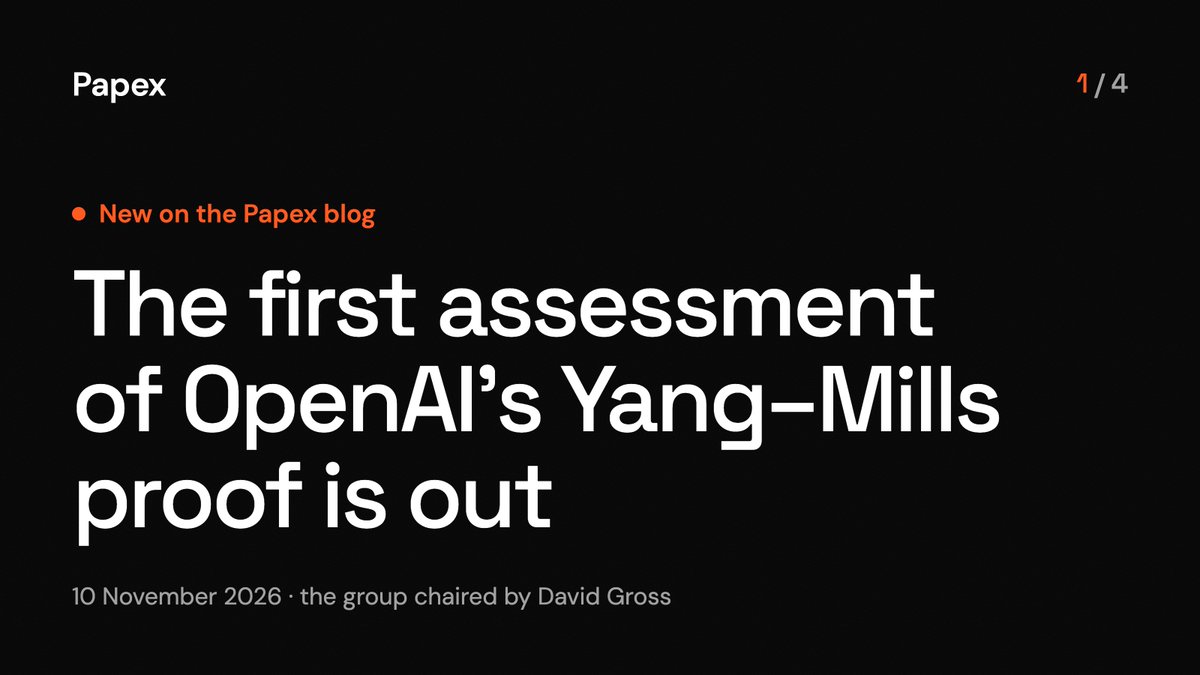
The first assessment of OpenAI's Yang–Mills proof is out.
On 10 November the group chaired by David Gross published the Lean code OpenAI sent it, with a 35-page report. Short version: a real result in their judgment, and the prize problem is still open.
@cowenconvos Can't wait to hear his take on whether the paper stays the basic unit of math. If proofs get abundant, picking which ones matter might become the real work.
@StartsWithABang Totally agree. I'd love proofs that come back with the questions they ran into along the way, not just the answer. That would help the next AI run as much as the next human.
@jiegaosophia I think I understand. Human curiosity, desire, and perhaps the ability to connect with different and unrelated fields, have the power to guide a problem toward a solution. This power can then guide artificial intelligence. Thank you very much, that makes perfect sense.
@jiegaosophia Does it matter who solves a problem, or only whether the solution holds up? Should science care about credentials, or about whether the answer works?
Introducing Claude Fable 5.2 and Claude Mythos 5.2, designed to tackle the most daunting technical challenges.
They’re capable collaborators on ambitious projects in many fields, and show improvements in areas like coding, reasoning, and vision.
I believe that anyone can solve scientific problems; it doesn't matter who solves them or who has expertise in the field.
It shouldn't matter who solves a problem. It should matter whether the solution holds up. Anyone who invests resources, thinks about the problem, tries to understand it, and can solve it should be able to. Science doesn't belong only to scientists, those with doctorates, professors, or those at the world's best universities.
Science exists for all of humanity, and it is the most important element in advancing our civilization. Anyone with curiosity should be able to enter through that door.