Introducing Papex.
AI is starting to make discoveries.
Who contributed what. Which parts involved AI, and which models were used. What evidence supports the claim.
Papex connects that history to the exact version a human reviews and signs.
Start your record at https://t.co/PpPJlVfOlA
@QualiaQuanta@AltRealityGameX@ClayInstitute@OpenAI@Anthropic read the Lean zip at commit bd4b835, didn't compile it. Main.lean says "The Lean code does NOT verify the manuscript axioms themselves." The second of the three results in the final theorem is one of them, ProofII.lean line 59:
axiom RH_provable_in_LCAC : ZFCLCACProv RH_sent
We went through the report and the two repositories, quote by quote:
https://t.co/7sQnSko2A9
A second OpenAI submission, dated 4 November, is listed as work in progress. We'll cover it when the group reports on it.
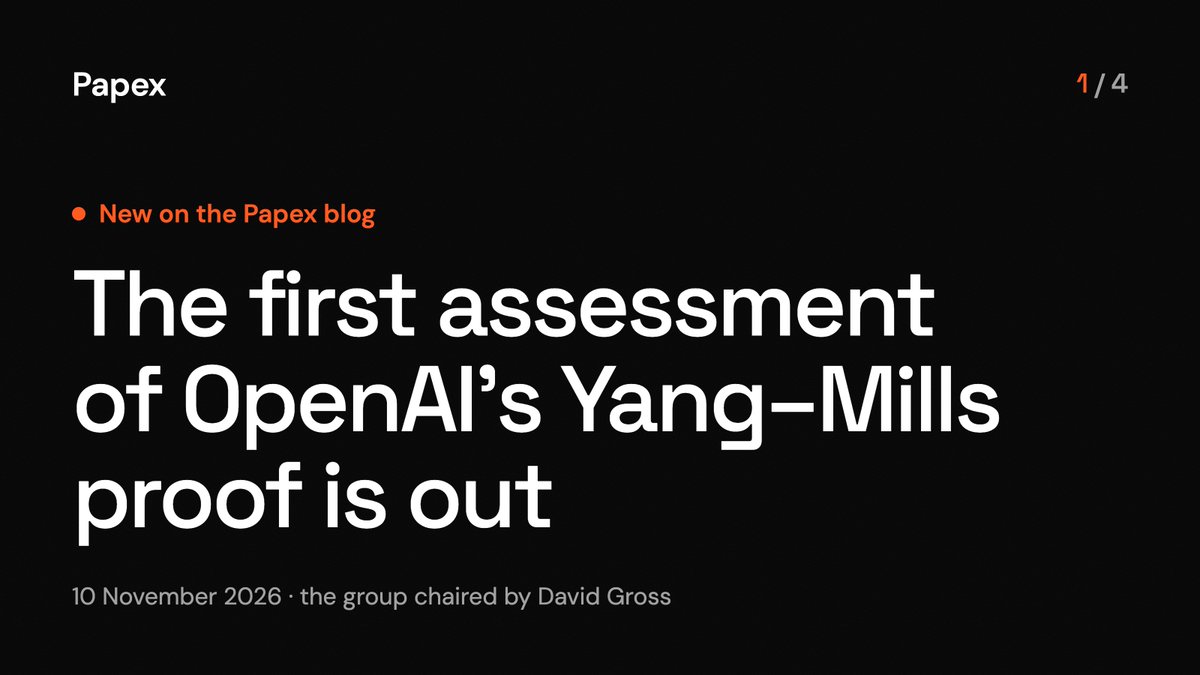
The first assessment of OpenAI's Yang–Mills proof is out.
On 10 November the group chaired by David Gross published the Lean code OpenAI sent it, with a 35-page report. Short version: a real result in their judgment, and the prize problem is still open.
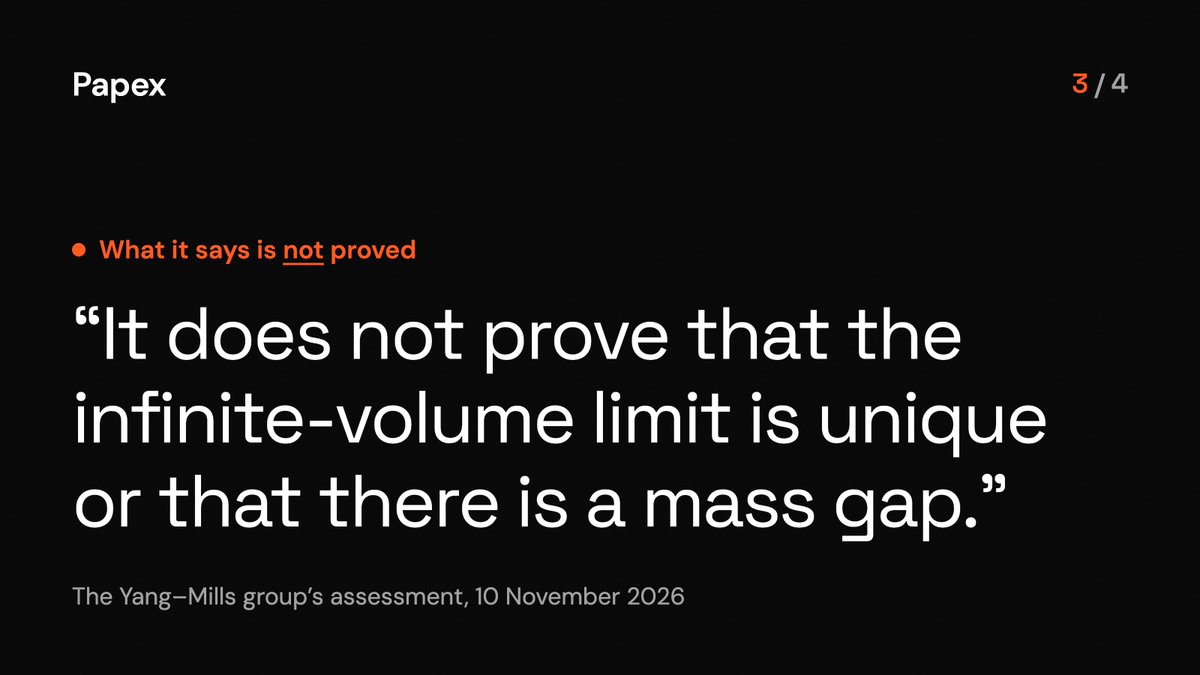
What they say is not: "It does not prove that the infinite-volume limit is unique or that there is a mass gap."
They also write "We do not claim to fully understand the proof yet." The review rests on the Lean code alone; the 1,147-page written proof has not been released.
[Yang-Mills Working Group]
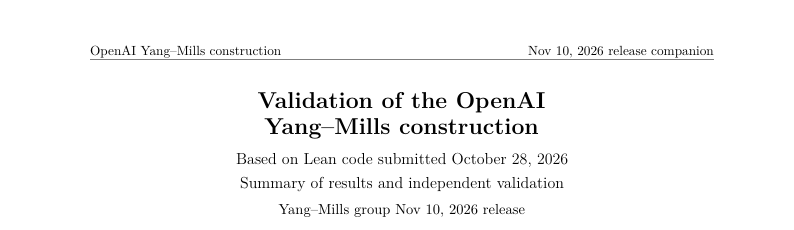
Validation of the OpenAI Yang–Mills construction
(November 10, 2026)
OpenAI-YM-20261028: https://t.co/znUeZnqmpz
https://t.co/2mexFCQXEF
Overall science numbers are strong too:
~75% on Terminal-Bench-Science (agentic scientific research)
30% faster generation
Cheaper ($8 / $40 per million tokens)
Clearer communication and fewer unnecessary safety blocks
Anthropic just dropped Claude Fable 5.2.
It’s not just another coding model. The science results are wild — black holes, Fermat’s Last Theorem, gene therapy design, and robotics.
Here’s what actually matters 🧵
Hardware engineering
Given a one-paragraph prompt, it designed three fully working electronic devices from scratch:
Home voice assistant hub
USB speakerphone
Handheld virtual pet
Circuit boards, 3D-printed enclosures, and software — all done by the model. All three worked after manufacturing with almost no electrical fixes.
opus stalling at 26% while fable finishes with the same setup is the part i keep thinking about. one run per model so i wouldn't lean on the exact number, but that's a big gap, amazing!
A team of 1,000 Fable 5.2 agents fully formalized Fermat’s Last Theorem in 30 hours, translating the proof into a language a computer can check step by step.
With the same setup, Opus 5.5 completed only 26% in 18 hours, and barely made any more progress after 30 hours.
@scottnarmstrong A detector guesses. A record states.
Yesterday: R(7) ≤ 46. Claude Opus 5.5 wrote the code, the Lean and the draft. The human picked the problem, required two proof checkers, and signed. The model is not an author.
https://t.co/PYOjN3MPpx
The second kind. New bound: R(7) ≤ 46. The previous bound was 47.
Claude Opus 5.5: every line of code, the Lean project, the draft, and the jobs through 15 spot interruptions.
Human: chose the problem, the budget, a full redo with two independent proof checkers, and the signature.
The model is not an author. Compute was about $127.
Record: https://t.co/WOZjUmzBOy
Code: https://t.co/ptMlRxlj4t
"We used AI" is about to be the most useless sentence in science.
It can mean the model fixed a comma.
Or that it wrote the code, the Lean project and the draft, and a human signed it.
Those are not the same paper.
A disclosure that hides the difference isn't a disclosure.