xit. test.skip. it.todo.
Three annotations agent-generated test suites lean on when the agent could not get the test to pass on the first try. The suite reports green. The behavior is uncovered, and you find out the Friday somebody exercises the code path on a customer.
Grep your test files for those three tokens. The number is usually larger than you expect, and the oldest one is older than the engineer who would be the natural person to ask about it.
A long context window is a permission, not a strategy. The model can hold a hundred thousand tokens. That does not mean a hundred thousand of your tokens belong there, and most of them, on most days, are landfill.
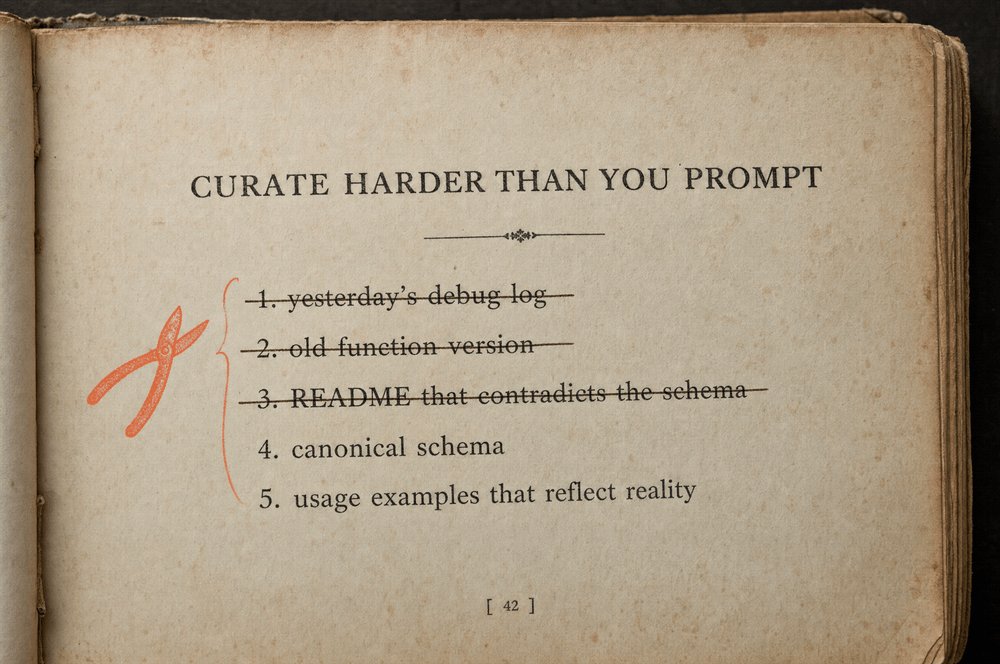
The teams shipping the best agent-assisted code this year are quietly building the opposite skill: choosing what to keep out. Stale logs from yesterday's debug session. Old versions of a function the codebase no longer uses. A README that contradicts the current schema. All readable. All pollution.
The work is unglamorous. Prune the chat. Restart a fresh session for a new task. Move resolved decisions out of context and into a file the agent can fetch when it needs them.
In practice the output-quality jump from this is larger than the jump from most model upgrades.
Curate harder than you prompt.
When was the last time you rolled back a deploy on purpose, just to make sure the button still works?
For most teams the honest answer is we have not. The runbook page exists. There is a screenshot of where to click. Nobody has actually clicked it since the platform team migrated to a new CI provider last spring.
Press it this week. Find out which assumption broke.
Run the failing test before you read the fix.
The agent hands you the fix and the test in the same change. The temptation is to read the fix first because it is shorter and you are tired and it is 4pm.
Read the test first. It tells you what the agent thought the bug was. Sometimes the agent was wrong about the bug, and the fix lands in a perfectly correct way, on a problem you did not actually have.
Documentation that lives next to the code, reviewed in the same pull request, dies less often than documentation in a wiki nobody has logged into since the last reorg.
A wiki drifts the moment nobody is forced to read it. Six months in, half the pages still describe the service that got renamed last quarter. A README that has to pass code review every time it changes stays honest as long as the repo does.
Move the docs into the repo.
The bottleneck in agentic workflows is not the agent.
It is the layer above the agent: which agent runs which task, with which tools, on which window of the codebase, with which permissions, and who notices at 2am when one of them silently starts writing to the wrong branch.
That layer is engineering work now, not a config file.
A one-page index of every directory in your repo, written in plain sentences, beats most prompt-engineering tricks for agent code quality.
It tells the agent what lives where, what is generated, what the runtime owns. The agent stops guessing, stops dropping new files into /src when the convention is /app, stops re-implementing a helper that has sat in /lib/format.ts since 2024.
Write it once. Update it the week the shape changes, not six weeks later when somebody notices.
When the first number a buyer hears is yours, that number anchors the whole conversation.
Most early-stage shops let the buyer name the budget first, then negotiate down from the polite silence. The price they end up with is downstream of someone else's procurement template.
Name the number first. Hold it for an awkward second.
Every model switch resets the context window you spent weeks tuning.
The CLAUDE.md, the repo map, the prompts that learned which specific lies a particular model tells (the off-by-one in date math, the imagined library function), none of it carries over. You pay the curation tax again from scratch.
The API bill is the visible part of the switching cost. The buried part is the months of small corrections you walk away from.
We spend more time in CLAUDE.md than in the chat box.
That file is the workspace the agent reads before any prompt. As it grew, our prompts shrank to four words. The output stopped being almost-right.
Context engineering is the work. Prompt cleverness was the warmup.
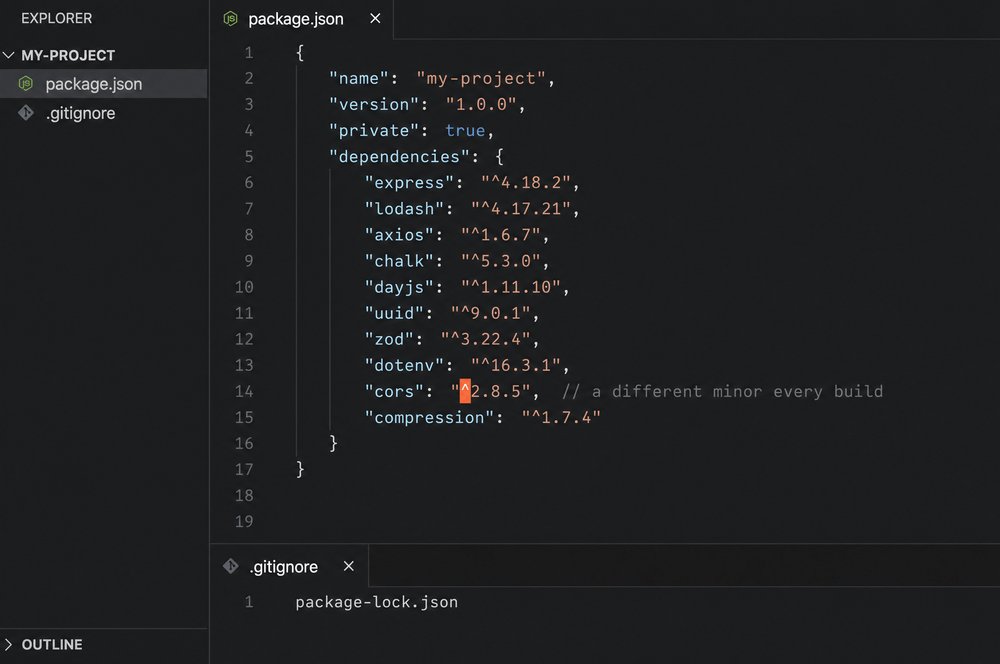
A recurring pattern in agent-generated package.json files: carets in front of every version, as if it is still 2018.
A caret means anything compatible up to the next major. It is a polite suggestion to your build server about what to install today and a different version tomorrow.
If the lockfile is committed, harmless. If the lockfile is in .gitignore because someone copied an old starter template, the build machine resolves a different minor on every push.
The bugs are slow to find. A transitive dependency lands a new validator and silently coerces empty strings to null. A required field becomes optional. The signup flow stops sending the welcome email. Nothing about your code changed.
The agent did not introduce this. The agent inherited it. The fix is four characters: delete the caret, commit the lockfile, move on.
Read your own gitignore.
Congrats on the V3 plans 🚀
It’s cool that they’re putting cameras on the satellites to check the heat shield during the flight itself. As these next-gen birds get deployed in bigger numbers, keeping everything running smoothly and safely is going to become a bigger part of the job. There’s a simple open-source mission control that works with real orbital data and can be self-hosted if someone wants to play around with it.
Demo: https://t.co/ssnt3OVuKD
A pattern in agent-generated webhook handlers: parse the payload, skip the signature check.
Stripe documents the check on the first page. The agent reads the example snippet, which omits the verify step for brevity. The handler runs green in dev. The endpoint accepts a refund event from anyone who guessed the URL.
You usually see it first in a finance reconciliation report, two months after the agent shipped it.
Yeah, that 2.8 days figure is pretty brutal. The fact that the window has shrunk so much already shows how tight things are getting with these big constellations.
Been building OrbitOps as an open-source tool to help with exactly this — real SGP4 propagation, conjunction screening and maneuver planning, all with a human still in the loop and everything logged. The self-hosted version feels way more useful once you plug in your own data.
Demo’s here if you want to check it out: https://t.co/ssnt3OVuKD
This is exactly why transparent tools for conjunction assessment and maneuver planning matter so much. There’s a fully open-source browser mission control called OrbitOps that does real SGP4 propagation, validated collision probability and has a human-in-the-loop AI layer with complete audit trail.
You can try the demo at https://t.co/9iqyWMJN6D or run it locally with npm create orbitops@latest.
Self-host and customize with your own data — becomes significantly more powerful.
MIT licensed.
Hey, this really hits the core operational pain.
Ground station coordination and operator bottlenecks are huge when scaling constellations. I’ve been building an open-source browser-based mission control that runs real SGP4 propagation from CelesTrak, has validated conjunction analysis, maneuver planning, telemetry handling and a human-in-the-loop AI co-pilot with full tamper-evident audit log.
The standalone demo is already useful, but the self-hosted version becomes much more powerful once you plug in your own fleet data and keys.
MIT license, completely free.
Demo: https://t.co/ssnt3OVuKD
GitHub: https://t.co/zLBRr5Zoa3
Would love any feedback from people who actually run ops.
The senior engineer's edge this year shows up in the second hour with the same model, not the first hour with a new one.
Most people stop at the first plausible output. The second hour is where you catch the thing it always gets wrong about your codebase. Write it down once and you stop relearning it every Monday.
That document is the moat.
Whose velocity, exactly?
The dashboard shows pull requests merged per week. The chart is going up. Nobody is asking which of those merges held up in production at the end of the quarter.