27 years ago tonight, Pedro Martínez pitched 2 innings in the 1999 MLB All-Star Game in Boston. Starting for the American League, he faced the required minimum six batters and struck out five of them.
Joe Buck on FOX Sports call.
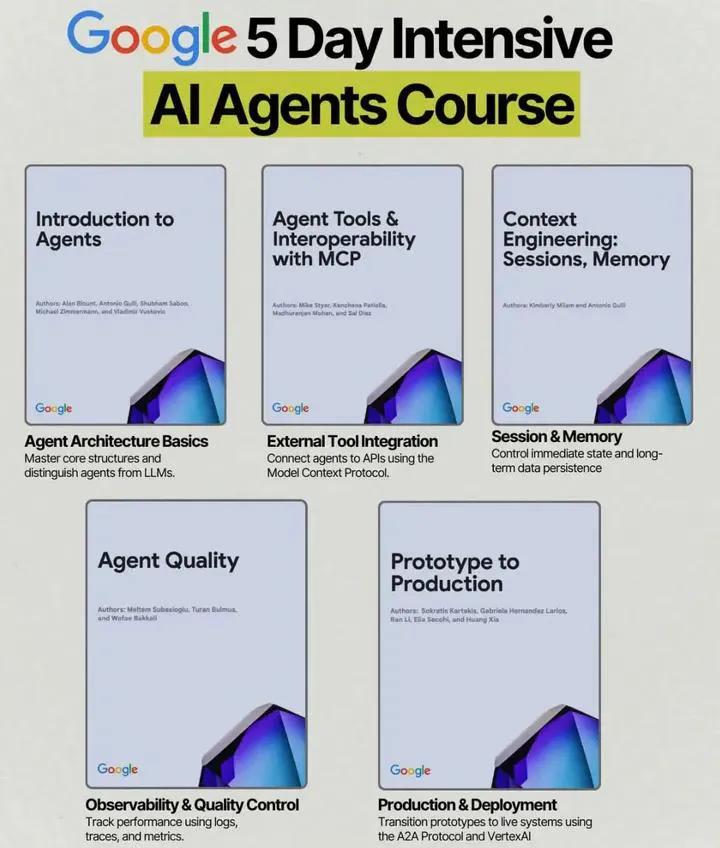
TIL Google did a 5 day Ai agents course covering
Day 1 - Introduction to Agents:.
Day 2 - Agent Tools & Interoperability with Model Context Protocol (MCP):
Day 3 - Context Engineering: Sessions & Memory
Day 4 - Agent Quality: Learn to build
Day 5 - Prototype to Production
Terence Tao put it plainly: there is no evidence that LLMs exhibit genuine creativity.
Yes, they have solved some Erdős problems. But these are low-hanging fruit, questions that attracted little attention and that yield once the right existing techniques are applied. That is not creativity. That is search plus recombination.
Yes, LLM outputs can look impressive. But look at who is impressed: typically non-experts. Experts know very well that LLM performance gets terrible when you approach the frontier of human knowledge.
And this is not a temporary gap. It reflects a structural limitation.
We do not fully understand human creativity. But we do know a key property:
Conceptual leaps: the ability to generate new representations, not just recombine existing ones.
LLMs do not do this. They interpolate in representation space. They operate within existing conceptual frameworks; they do not create new ones.
This is why we haven’t “yet seen them take the next step”.
Introducing the Google Workspace CLI: https://t.co/8yWtbxiVPp - built for humans and agents.
Google Drive, Gmail, Calendar, and every Workspace API. 40+ agent skills included.
I've just released a new version of typeagent, a Python library I've been working on since mid last year --more and more using Claude-- that implements memory for agents.
Not originally my idea, I mostly ported the TypeScript version by Steve Lucco and Umesh Madan. This release was improved a lot by Bernhard Merkle.
To install, use "pip install typeagent". Changelog: https://t.co/5tuMTxthTd
I feel like back in the day you had thick pepperoni. Anyway, Tony's is the bomb! Bumped into you getting take out one time. Now you're even more big time Mr. Ice, sir.
Microsoft killed the GPU mafia 🤯
They finally open-sourced their 1-bit LLM inference framework called bitnet.cpp. It lets you run 100B parameter models on your local CPU without GPUs.
- 6.17x faster inference
- 82.2% less energy on CPUs
100% Open Source.
The lifecycle of a pure math theorem:
- 1997: my PhD advisor asks me to work on one of his conjectures
- 2000: I solve the simplest case and dream of generalizing my approach
- 2003: after years of struggle, I come to the conclusion that my approach *cannot* generalize
- 2006: after reading a paper by Daan Krammer, I have a lighting bulb moment and realize that my approach works in full generality *up to equivalence of categories*... this enables me to solve my advisor's conjecture... I then use it as an ingredient in the proof of a much older and more famous conjecture (the "K(π,1) conjecture for finite complex reflection groups")
- 2007: I submit my article for publication
- 2009: referee #1 gives up
- 2010: 2 more referees have now given up, complaining that the paper is too hard to read
- 2012: referee #4 is finally able to produce a report, the revision work starts
- 2014: the paper is accepted for publication
- 2015: the paper is published
- 2007-2025: because the older conjecture overshadows the lesser known conjecture by my advisor, and because my paper is too difficult, virtually no-one asks any question about the "lighting bulb" categorical idea at the core of the proof
- Jan 22, 2026: I received an inbound email from a mathematician from another hemisphere, inquiring about the categorical aspects
- Jan 26, 2026: I have my first ever videocall discussing the specifics of this core component of my proof
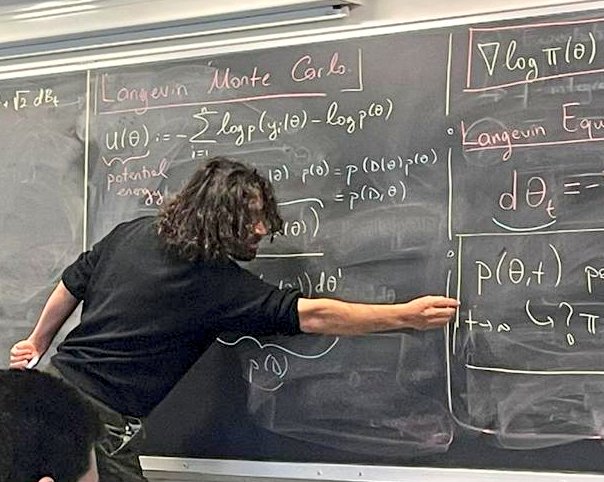
Umut Şimşekli is a prominent researcher at the intersection of probability theory, statistics, and modern machine learning, best known for revealing the role of heavy-tailed phenomena in learning algorithms. His work showed that the noise in stochastic gradient descent (SGD) is often not Gaussian, as traditionally assumed, but heavy-tailed and better modeled by Lévy processes. This insight fundamentally changed how researchers understand optimization, generalization, and robustness in deep learning. By connecting SGD to stochastic differential equations driven by stable laws, Şimşekli provided a probabilistic explanation for why deep networks can escape sharp minima and generalize well. He has also contributed to Bayesian nonparametrics, PAC-Bayesian theory, and information-theoretic learning principles. These ideas now influence optimization design, uncertainty quantification, and robustness analysis in deep learning. His work bridges classical probability with practical AI, showing how subtle statistical properties of noise shape the success of modern learning systems.
Create Python packages instantly with uv init --package 📦
Python packages turn your code into reusable modules you can share across projects.
But building them requires complex setup with setuptools, managing build systems, and understanding distribution mechanics.
UV, a fast Python package installer and resolver, reduces the entire process to 2 simple commands:
• uv init --package sets up your package structure instantly
• uv build and uv publish to create and distribute to PyPI
🚀 Full article: https://t.co/wPvtxDmXyH
📚 This topic is covered in Production-Ready Data Science: https://t.co/7gEtqgoVOP
#Python #UV #PyPI #DataScience
Software development will never be the same.
I want you to watch this video:
This is a spec-driven development environment.
100% of your time goes to writing specs and managing agents.
0% goes to writing the code.