The CPTPP is a trade agreement between 11 "Pacific Rim” nations – including Japan, Canada, Australia and New Zealand, plus Mexico and Peru.
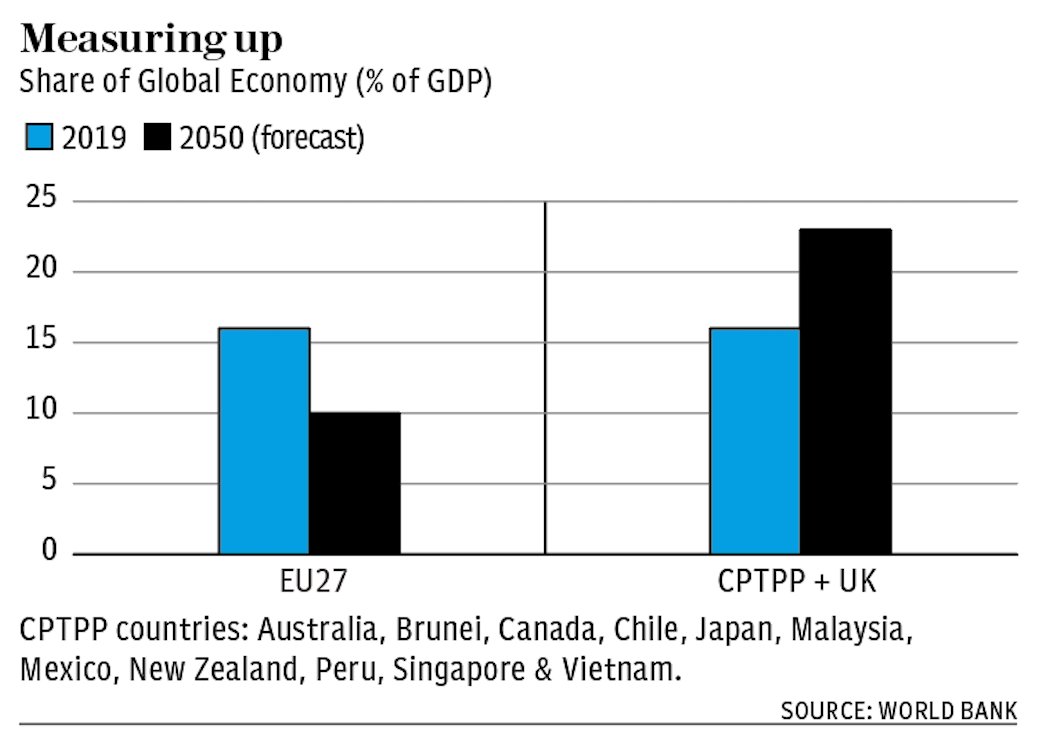
With Britain joining, CPTPPP will account for 16% of global GDP, same as EU 27.
By 2050 though, on World Bank forecasts, CPTPP will account for almost a quarter of the world economy, the EU27 just a tenth.
Makes a lot of sense for a huge service-sector exporter like the UK to be part of a bloc primed for fast growth.
@BritainUnbound@LyddonConsult I suggest you get someone who knows what they're talking about because that is garbage, e.g. EIB and ESM are capitalised financial entities, the EFSF guarantees ARE included in members' debt, and central banks have balance sheet assets which offset their liabilities.
@nigethugrug@anandMenon1@IGMansfield@julianHjessop How is it part of a bigger trade bloc?
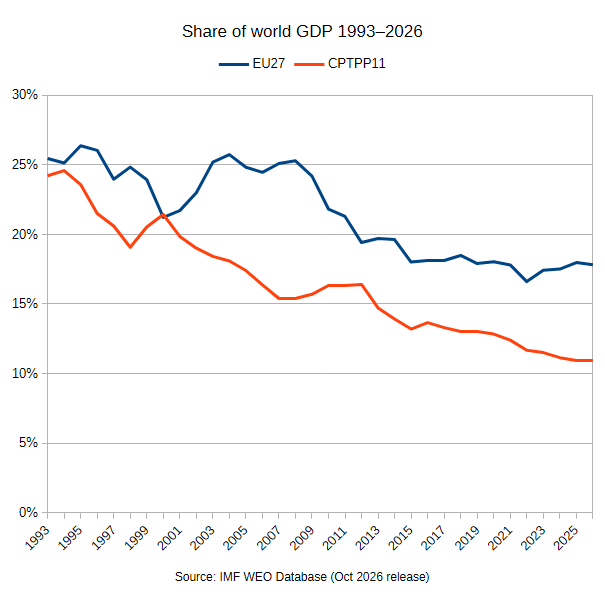
EU: 18% of global GDP next to UK, 45% of UK trade
CPTPP11: 11% of global GDP scattered about further away, 8% of UK trade
@nigethugrug@afneil@anandMenon1@TerraOrBust@SKinnock How is it part of a bigger trade bloc?
EU: 18% of global GDP next to UK, 45% of UK trade
CPTPP11: 11% of global GDP scattered about further away, 8% of UK trade
@RobertJudd4@donjovi2@WasAcop There's no one stopping UK lowering its taxes if it wishes.
EU hasn't blocked Ireland having 12.5% corp tax because it can't because direct taxation is a national competency.
@Personoftalent@Ruislip4EU@TerraOrBust They are three different revenue streams that make up a single budget contribution.
customs contribution +
VAT-based contribution +
GNI-based contribution =
budget contribution
@Personoftalent@Ruislip4EU@TerraOrBust As I told you then it’s not an “extra payment” as you claimed. It literally forms part of every member’s budget contribution.
Budget contribution =
customs component +
VAT-based component +
GNI-based component
@Personoftalent@Ruislip4EU@TerraOrBust I just told you! There are no RoO requirements intra-EU but UK-EU trade is now extra-EU so RoO apply, and UK can no longer include EU27 content as domestic content in trade with others like it could before meaning meeting RoO where required harder.
https://t.co/b7N8OVIXsb
@Personoftalent@Ruislip4EU@TerraOrBust There are more of them because of Brexit. They apply UK-EU where they didn’t before and the amount of content UK manufactures can count in trade with other FTA partners can no longer include content from EU. All this adds to tariffs if rules of origin content cannot be met.
@romfordgeeza@swedetaxedermy@TerraOrBust@HoggarthJan Of course it's more income for the exchequer but that's not the consumer saving like you claimed is it?
You're assuming there's a domestic alternative or the import can be substituted elsewhere cheaper to cancel it out. UK import data and customs data suggests neither.
@Personoftalent@Ruislip4EU@TerraOrBust It's calculated the same for everyone:
EU budget contribution =
75% of customs duties +
0.3% of VAT base +
x% of GNI (x varies annually but same for everyone)
@romfordgeeza@swedetaxedermy@TerraOrBust@HoggarthJan But you're not as UK's effective import tariff (customs ÷ imports) is up by half for 5 years straight now.
And what are you talking about services and exports for now when your point was about tariffs on goods imports.
https://t.co/seUAreEMYN