@Alex_Kozora The Browns are building by accumulating extra draft picks and nailing more of their picks in recent years. This worries me as a Steeler fan.
My coworker and I were talking about capitalism, and he said, “The Earth is a resort for like 500 rich people, and the rest of us are just the staff.” Now I can’t unsee it.
Introducing Claude Opus 4.7, our most capable Opus model yet.
It handles long-running tasks with more rigor, follows instructions more precisely, and verifies its own outputs before reporting back.
You can hand off your hardest work with less supervision.
You need to understand one fact about OpenClaw
People are biased and incentivized to spread disinformation about OpenClaw. That is because OpenClaw IS NOT PUMPING ANYONE’S BAGS, unlike most other projects
Literally every other for-profit agent product is incentivized to trash OpenClaw, BECAUSE OpenClaw is a neutral third party across the industry and geopolitical scene. They MAKE MONEY when OpenClaw loses
OpenClaw does not worry about making money for some investors. Its founder @steipete is a successful exited founder. He is motivated by having fun and democratizing AI, literally. That is why he is suddenly so loved by everyone. He cares about PEOPLE, not MONEY
“OpenClaw is bloated”
-> Since beginning of March, OpenClaw is thinning its core and putting functionality in plugins behind a plugin SDK. Having numerous plugins to choose from does not mean bloat. This was already copied by others and is still a work in progress
“OpenClaw is not secure”
-> OpenClaw has the most eyeballs and immediately addresses any security advisories as soon as they come. It is the most secure agent, by sheer pressure
“OpenClaw is bought by OpenAI”
-> Then why is my bank account so empty bro??? All maintainers are literally unpaid and working DOUBLE beside their dayjobs to ship features to you. Do you think VC money can buy that kind of commitment?
Once you understand these facts, you’ll like OpenClaw even more. Because OpenClaw is your AI, People’s AI
And you can join us too. OpenClaw is the easiest-to-join project in AI right now. You just need to start using it, and start making good contributions. If you are competent, you can become a maintainer, and join the rest of the team making history!
Claude Mythos is like Hiroshima for software.
everything you own online, your bank, your email, your photos, your identity, is now dangerously exposed in ways that didn't exist 48 hours ago
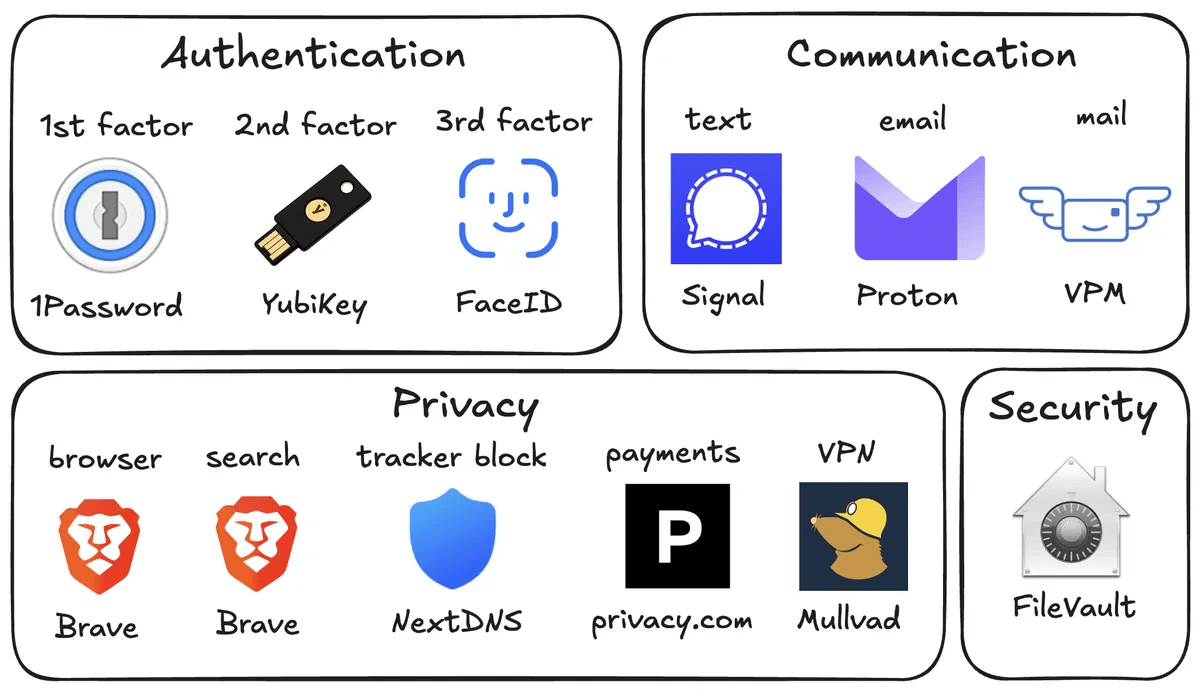
that's why Karpathy's digital hygiene guide is probably the most important thing you can read this week
here's every step to protect yourself in these uncharted times:
> use a password manager for every account
> set up physical security keys so attackers can't log in
> enable face id and fingerprint everywhere
> randomize your security question answers
> encrypt your hard drive
> get rid of unnecessary smart home devices
> switch to signal for private messaging
> use brave instead of chrome
> switch to brave search instead of google
> mint virtual credit cards for every purchase
> get a virtual mailing address
> never click links inside emails
> use a vpn on public wifi
> block ads and trackers at the dns level
> install a network monitor to see which apps are spying on you
full breakdown of each step below:
An American president threatening the death of an ancient civilization is in some ways the end of the 250-year moral experiment of a constitutional republic that the framers saw as a model for all mankind.
The only skill that matters now is agency
If you are high agency, you will figure out how to utilize AI tools to make yourself more productive and valuable
If you need to be told what to do, good luck surviving in a world where someone can just ask an LLM instead
⚡️This is the moment the model gets hands.
That is the real threshold.
Once an AI can see the screen, move the cursor, type, navigate software, and execute workflows across arbitrary apps, the whole game changes. The limiting factor stops being language quality. The limiting factor becomes agency. Can the model actually do the work, not just describe it.
That is why this matters so much. The modern office is already a robot environment. Buttons, forms, dashboards, tabs, permissions, drop-downs, inboxes, calendars, CRMs, spreadsheets, admin portals. Humans were the temporary glue holding all that fragmented software together. The moment an AI can operate the same interfaces, a huge amount of white collar labor becomes directly attackable without waiting for every company in the world to rebuild its stack.
A lot of “knowledge work” was never pure insight. It was operational stitching. Open this. Copy that. Check this field. Schedule that meeting. Move this information between systems. Generate the draft. Update the CRM. Reconcile the report. Upload the file. Follow the workflow. Escalate the exception. Once the model can touch the interface, the human integration layer starts getting erased.
The desktop is becoming the first real robot body for AI.
People keep imagining humanoids as the big labor shock. The real labor shock arrives sooner through screens. The average office worker already lives inside a digital box. If the model can act inside that box, it has entered the worker’s physical domain. That is enough to trigger a major compression wave.
The first wave will be supervised agency. One human overseeing multiple agentic processes. One operator managing ten machine clerks. One analyst managing five machine researchers. One coordinator managing twenty machine admins. That still destroys labor demand because the firm no longer needs one human per workflow. It needs one human per cluster of workflows.
That is where the real cull begins.
The next layer is organizational. Middle management, operations teams, chiefs of staff, coordinators, assistants, junior analysts, support staff, back-office processors, internal service functions, all the roles built around moving information through software become vulnerable. Once the CEO, VP, or manager can directly deploy agentic systems into the stack, the argument for multiple relay layers gets weaker fast.
And deep down, this is how bureaucracy starts dying. Through hundreds of micro-automations that remove the need for human routing, human clicking, human follow-up, human translation, human glue.
The deepest part is that capability is no longer the hardest problem.
Trust is.
Who gets permission.
Who watches the model.
Who is liable when it clicks the wrong button.
Who audits what it did.
Who controls the credentials.
Who stops the model from becoming a security breach with a smile on its face.
That is the next battlefield. The winning AI platform will not just be the one that can act. It will be the one enterprises trust enough to let act at scale. Reliability, auditability, security, permissions, rollback, human override, those become more important than one more bump in benchmark intelligence.
So my real view is simple.
This is one of the most important threshold crossings so far.
AI is moving from cognition into execution.
The computer is becoming its robot body.
The office stack is becoming automatable in place.
A massive slice of white collar labor is now in the blast zone.
Once the model can operate the software, the countdown starts.
Anthropic co-founder, Jack Clark:
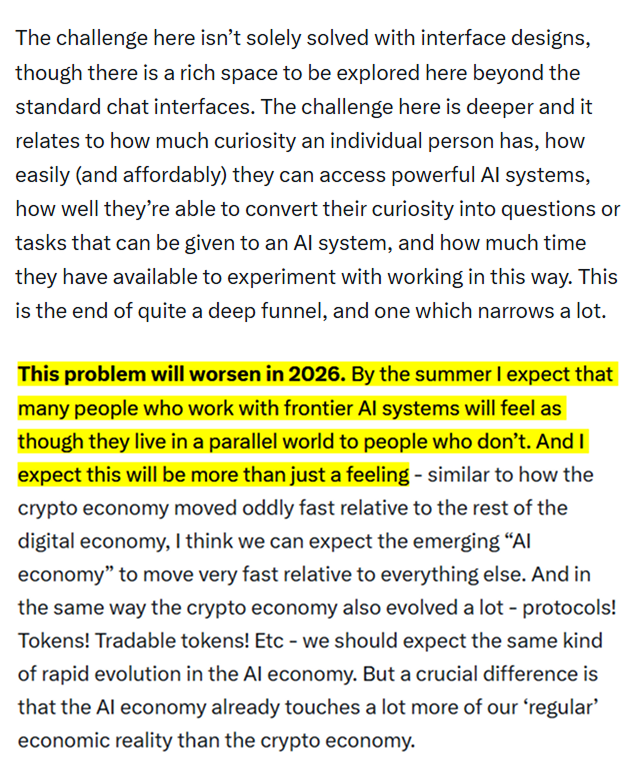
by summer 2026, the AI economy may move so fast that people using frontier systems feel like they live in a parallel world to everyone else
most of the real activity will happen invisibly in digital, AI-to-AI spaces, with only surface signs showing up in everyday life (datacenters, compute/power constraints, and the startup ecosystem)
The one brain structure that literally grows when you do things you HATE doing — and shrinks the moment you get comfortable.
Stanford neuroscientist Andrew Huberman dropped what he calls “one of the most important discoveries in the history of neuroscience” in a conversation with David Goggins.
It’s called the anterior mid-cingulate cortex (aMCC).
Recent human studies (not mice) show:
- It’s smaller in people with obesity → grows when they successfully diet
- Super-athletes have an unusually large aMCC
- People who live the longest keep this area big their entire life
- It enlarges every single time you force yourself to do something you genuinely do NOT want to do
- It shrinks almost immediately if you stop or if the same task becomes enjoyable
Huberman: “This isn’t the seat of intelligence or memory. This might actually be the seat of the WILL TO LIVE.”
The rule is brutal but simple:
If you love your ice bath → no growth
If you’re terrified of cold water but get in anyway → aMCC gets bigger
Skip a day or start liking it → it shrinks again tomorrow
Huberman waited years to tell David Goggins about this because Goggins has been unconsciously training his aMCC harder than almost anyone alive.
Watch the full clip below — it will permanently change how you think about discomfort, willpower, and longevity.
What’s one thing you really don’t want to do today… that you’re going to do anyway?
Drop it in the comments. Let’s build that aMCC together.