Here’s a cool talk from GPC 2025 on the architecture of Blender’s Cycles renderer. There is no one right answer to designing a renderer; as a rendering engineer, I really like seeing how different renderers choose different tradeoffs to meet user needs:
https://t.co/yPqsw2gP4u
Damn, stumbled upon this really exciting NVIDIA research paper that talks about a perf speed-up of up to 3x in the ReSTIR real-time path tracing algorithm —which powers all path-traced games on PC — while also making it look better! Source: https://t.co/EOPD2NiPSs
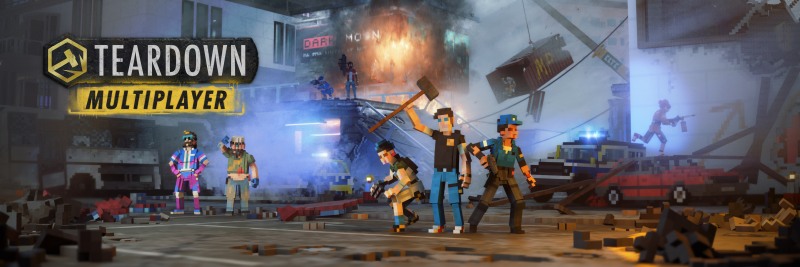
At long last, the Teardown talk from the 2025 Graphics Programming Conference has been posted 🎉
https://t.co/Z7tZP1frXQ
(as well as another drop of some other great-looking stuff, check the channel)
Thanks to @gast1101 , I came across an article from PCGH explaining how Ray Tracing is implemented in #CrimsonDesert, which sheds light on why RT is so performant in this game, as well as some of the flaws we’re seeing.
It seems the game is not using a conventional approach for RTGI, instead it relies on a surfel-based radiance cache system.
Think of surfels (surface elements) as small sample points that represent surfaces and define how they should receive/reflect light. these surfels are combined with Radiance Caches, which act as lighting storage units placed strategically throughout the scene, You can pull lighting info from them and extrapolate it to light up the rest of it. These radiance caches are not "filled" with pre-calculated lighting information, instead they are updated dynamically in real time using ray tracing. This means only a handful of pixels or sample points get ‘real’ ray tracing. For everything else, the engine pulls lighting from nearby radiance caches and applies it to those pixels.
Caching itself isn’t new in real-time RTGI, but what’s different here is the use of surfel-based sampling and how aggressively the system relies on it, which saves performance by reducing the number of rays, but at the expense of more visual artifacts.
I recommend checking PCGH article for more details: https://t.co/4bHzvWgajh
The blog post "Virtual Memory Tricks" by Niklas Gray explores clever, underutilized ways to leverage operating system virtual memory features (via APIs like VirtualAlloc or mmap) to solve common programming problems efficiently.
Some of the key techniques discussed are ..
• reserving extremely large virtual address spaces for arrays (e.g., billions of elements) without consuming physical RAM until pages are actually accessed, enabling simple, fast fixed-size data structures like global game object arrays or huge lookup tables.
• using virtual memory reservations to generate guaranteed-unique application-wide IDs (by returning pointers from reserved blocks)
• implementing an "end-of-page allocator" that places allocations at page boundaries to catch out-of-bounds or use-after-free bugs via immediate access violations, and avoiding fragmentation issues since virtual memory allows non-contiguous physical pages.
• implementing a gapless ring buffer that uses shared mappings to handle wraparound seamlessly without extra boundary logic.
Overall, the author argues that directly controlling virtual memory unlocks powerful, scalable, and safer memory management patterns beyond conventional malloc usage.
link to the blog post: https://t.co/XI8GkoU2fO
My MLPZen project comes with a sample showing a simple neural texture compression (NTC). You don't need a complex vendor-locked SDK with proprietary extensions to start experimenting with NTC for your game. This project is pure DirectX 12/HLSL. Github: https://t.co/mmoVTA6LlG
The Teardown Multiplayer project was a tricky one. It's finally out, and I wrote up the technical details on what we went through to get there: https://t.co/17YhNKnef5
Visibility Buffer and Deferred Rendering in DOOM: The Dark Ages
https://t.co/aGukZJSEoo
Great talk by idSoftware mentioning:
"ShaderPrintF, ShaderAsserts and ShaderPrimitive Drawing"
You can have similar functionality in any engine using HLSL/GLSL:
https://t.co/MgH18XegiD
Great to see renewed interest in #AssassinsCreedUnity following the new 60fps patch.
If you’re curious about some of the tech behind it— global illumination and early GPU-driven pipeline —I shared a few details in my GDC talk. https://t.co/ValKwUF4tB
#AssassinsCreed
Watched a brilliant presentation from @idSoftware guys at GPC on @DOOM "The Dark Ages".
11 out of 12 pixels are fake.
Say your screen is 4k (3840 x 2160), here's what the game does:
DLSS/FSR in "Balanced" mode upscales from:
2227 x 1253 -> 3840 x 2160 (your full 4k)
Before DLSS gets the image, it is upscaled by DRS (Dynamic Resolution Scaling) internally from, say 75% resolution:
1670 x 939 -> 2227 x 1253
Before that, the image is rendered with VRCS (Variable Rate Shading) with ~43% of pixels actually rendered and the rest just filled in.
So in total we go from 674k pixels actually rendered by the engine,
to 1,568k after VRS
to 2,790k after DRS
to 8,294k after DLSS
For a grand total of about 1 in 12 pixels actually being rendered, the rest? - they are fake.
source: https://t.co/gcznzrGFt3
as for me - I'm not against the fake pixels, bring them on I say, as long as it's done well.
Our Neural Irradiance Volume (Eurographics 2026) permits real-time rendering of large scenes with dynamic objects and moving lights, while providing a higher quality at a given memory budget (10x improvement over probe grids!). Project page: https://t.co/IHI1URC0WU.
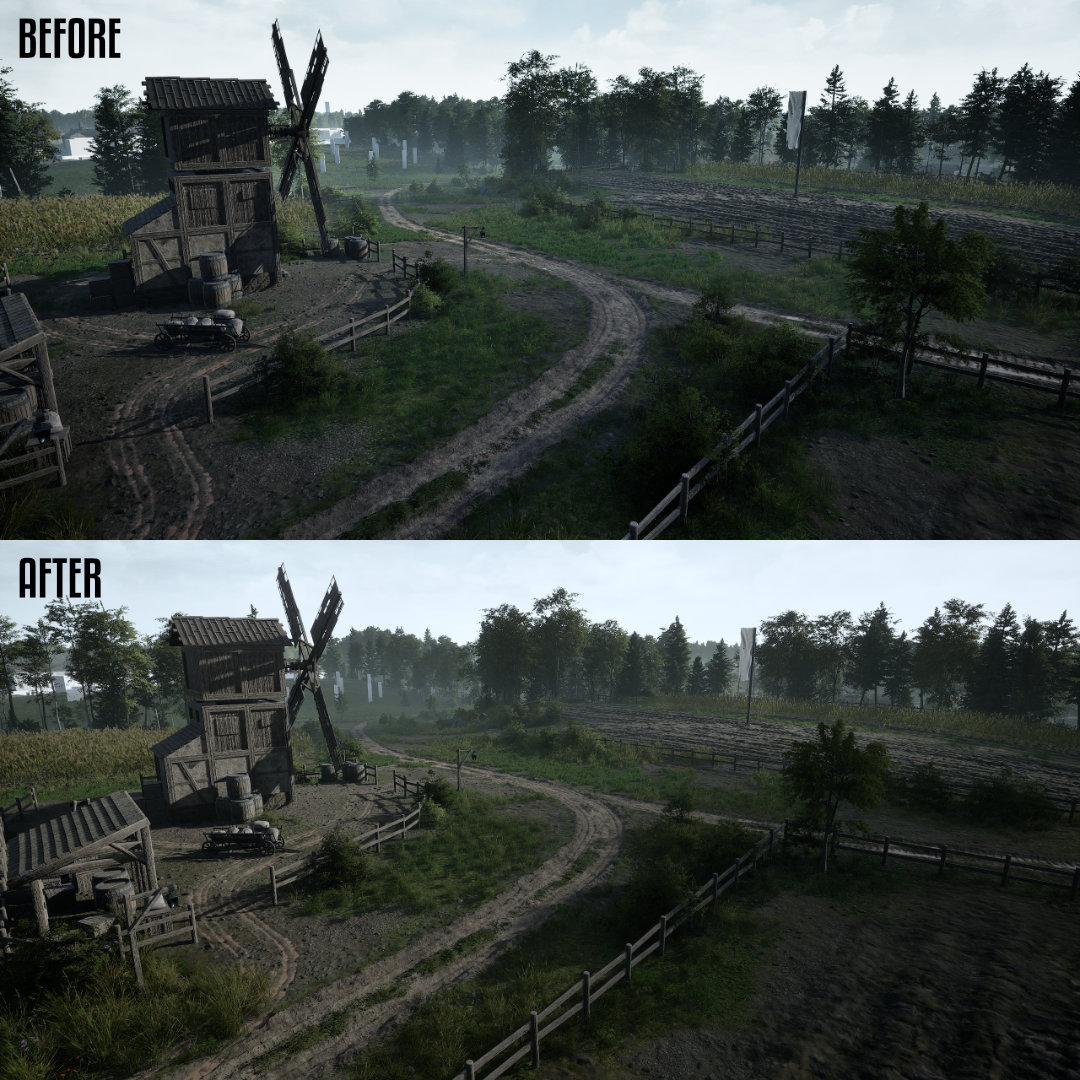
We replaced Unreal's standard ACES tone mapping with AgX and can finally achieve the grim and rainy lighting atmosphere we were aiming for. The constant battle against unnatural colors, washed-out highlights, and crushed blacks, especially in forests, is finally over!
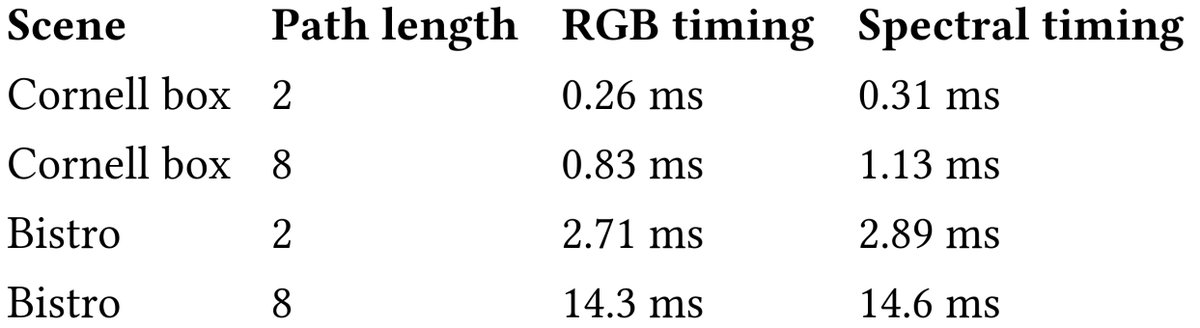
My second blog post on spectral rendering is out. This one explains how to use wavelength importance sampling to minimize color noise while limiting the overhead to 0.3 ms and how to make BRDFs spectral.
https://t.co/rgYGWdegwG
RGB rendering is founded on lies and perpetuated by misconceptions about the practicality of spectral rendering. My new blog post series describes a spectral GPU path tracer. Part 1 focuses on how to make it work with existing RGB assets.
https://t.co/N3t1BEaT3u
I ran into this presentation about how @Guerrilla does rendering of their Decima Editor. https://t.co/mjwRoRQahD Great and interesting stuff! You can also find the Powerpoint https://t.co/cKzm6sOgOJ