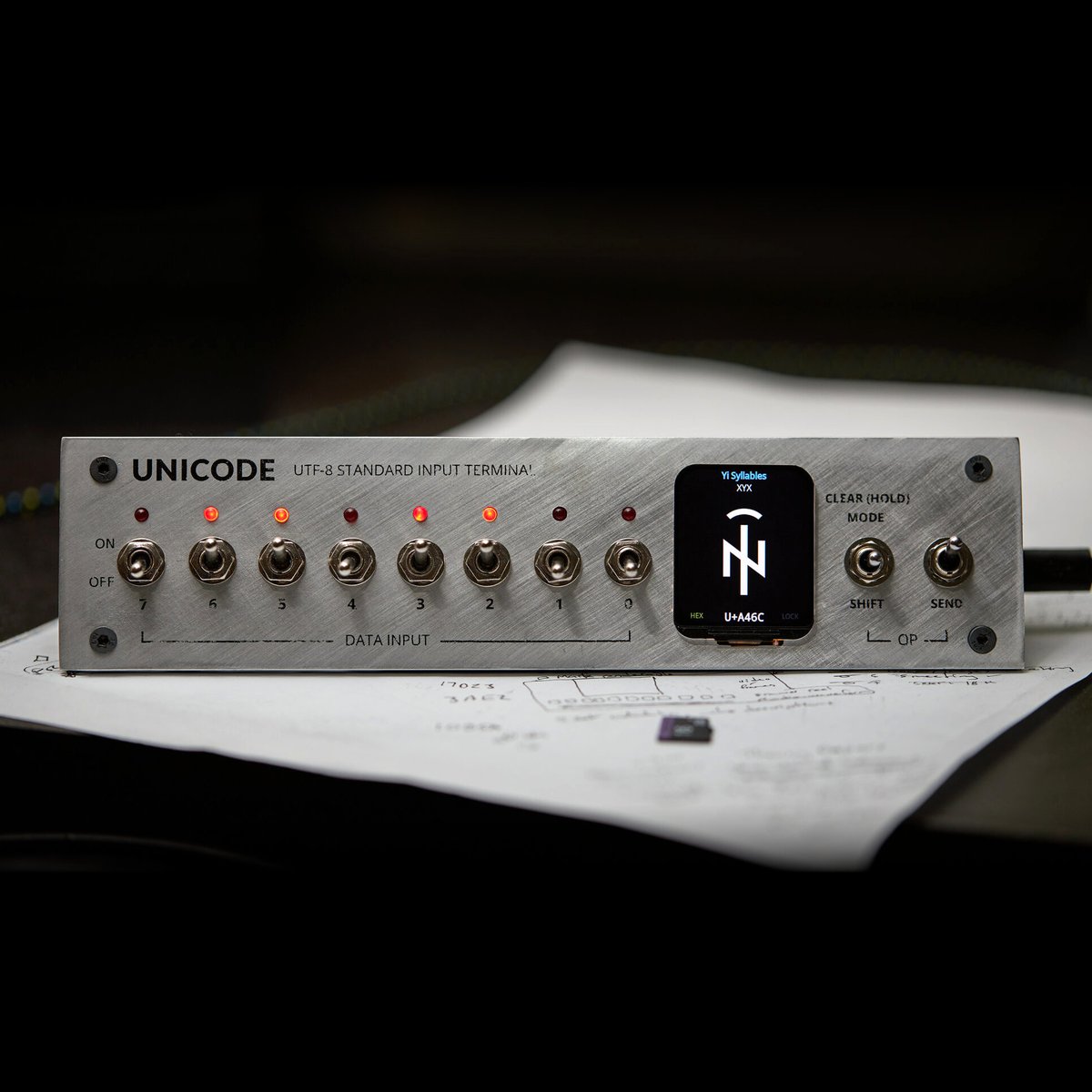
@fullmoon6661 @matthewvenn Yeah, it's done with sand paper (sand flat, then in uniform directions). Gets harder to do by hand as the stock gets bigger though - worked better on the tiny piece from my last post
Just missed the Hackaday odd inputs contest deadline by ...uh... 12 months, but I stand by the result:
A human interface device to enter all of Unicode, with character previews rendered onboard the Pi Pico.
@PeterQuirk Yeah I used WT up until a few weeks ago - always found it had some weird behaviours around rendering and copying blocks of text, particularly using vim over ssh. I spend a ton of time in native Linux, so inconsistencies really stick out
WSLg sounds like a big improvement!
@goretsky Just looked it up - neat. It'd be possible to apply the same idea to SATA, but M.2 would be taking that to a whole other level of pain 😄
Did you ever find out what happens if you change the drive selection while the system is running?
@NashPL Code updated to build for the stm32f103 by default 👍
There are no external parts - any switch and any STM32 F0 or F1 chip with USB support should work. Other STM32 series will work with some code additions
@heinz_hjo@geoObserver_ You could achieve the same thing by physically switching between two flash drives with different values in the files - no firmware required 😀
Only caveat is the switch would need to be in the desired position when the bios does it's drive detection and not changed
@nicolas_noble I used a spare custom board from another project, but any STM32* or SAMD* with USB support should work with minor tweaks to the firmware, since this uses libopencm3. I'm adding stm32f103 ("blue pill") support in the next few hours
@saltless_pickle I did compile a custom Grub module early on, but building ad-hoc and dumping in the modules seemed like a recipe for future ABI issues. In-source build would mean maintaining my own Grub install 🤔
Love the idea of rebooting gracefully when the switch is changed inside each OS
@Codenamegamma There's no actual storage media behind this, so writes are ignored by the custom USB device. The switch is connected to an input that's tested when the fake/virtual files are read, so you can flip to your heart's content without any adverse affects
@NashPL It's using libopencm3, so should be compatible with a large number of chips with a minor modifications in main.c. I'm planning to add stm32f103 (blue pill) build support in the next 24h, which should make it a bit more accessible
@mudumat A big, clunking rotary switch would be nice for more than two options - the input can really be anything you like with some tweaks to the device code
@booldown My X570 motherboard does have an serial port header for some reason, which I haven't put to use yet ..I did consider using it for this, but the USB storage trick worked out to be a cleaner solution
@bast__scho @Foone Yeah I've had that happen in the past a few times, but not for 2 or 3 years now. Probably depends on the particular hardware configuration though