New essay on the economics of structural change and the post-commodity future of work.
1. Almost any question about the impact of advanced AI on the economy needs to start at the same place: what is still scarce? Answer that, and the analysis becomes pretty straightforward. This essay explores what becomes scarce if AI really can replicate most of what humans do in production, and what this mean for the future of jobs.
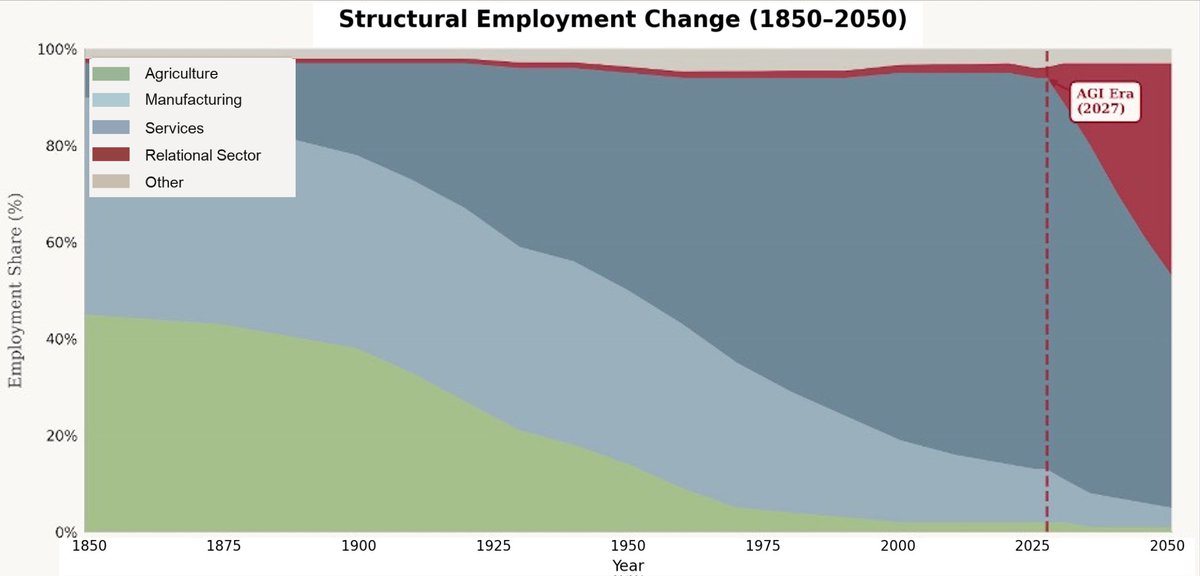
2. My conjecture, working through the economics: labor reallocates across sectors, and the sector it reallocates to has properties that keep labor a meaningful share of the economy. Ultimately this is about the structure of demand itself. For this, we have to go back to Girard, Augustine and Rousseau: once people's base needs are met, their preferences shift to comparative motives (e.g., status, exclusivity, social desirability). This motive is inherently non-satiated.
4. The key paper is Comin, Lashkari, and Mestieri (Econometrica 2021). As people get richer, they don't buy proportionally more of everything. They shift spending toward sectors with higher income elasticity. They estimate income effects account for 75%+ of observed structural change.
5. The ironic consequence: the sector that gets automated becomes a smaller share of the economy, not a larger one. Agriculture got massively more productive and its share of employment collapsed. Manufacturing too. The "stagnant" sectors absorb the spending and the jobs.
6. So the question is: which sectors have high income elasticity in a post-AGI world? I argue it's what I call the relational sector. Categories where the human isn't just an input into production, it is part of the value.
7. Why does the relational sector have high income elasticity? Because human desire has a mimetic, relational dimension. We don't just want things for their intrinsic properties. We want what others want, and we want it more when others can't have it. Girard, Rousseau, Augustine, and Hobbes all saw this.
8. In work with Kristóf Madarász, we showed this experimentally: WTP roughly doubles when a random subset of others is excluded from the good. And in new work with Graelin Mandel, AI involvement kills the premium. Human-made art gains 44% from exclusivity; AI-made art only 21%.
9. This all comes together for the core argument. The sector that absorbs spending as AI makes commodity production cheap is one where human provenance is part of the value, and demand for it grows faster than income. Exactly the profile that keeps labor meaningful.
10. To be clear about the claim: I'm NOT saying aggregate labor share must rise. It may fall. The claim is about sectoral composition, i.e., where expenditure and employment go once commodities get cheap, and the fact that the sector that will absorb reallocated labor maps to a substantial component of human preferences and desire.
11. If you're interested in the formal model, a linked companion technical note works out all the economics.
Read the essay here: https://t.co/NcjVgn2o8g
The Pentagon just blacklisted one of America’s most valuable AI companies.
For refusing to build surveillance tools aimed at American citizens.
Hours later, its biggest rival OpenAI quietly signed the deal of the decade.
Here’s what just happened and why it changes everything.
This week, the US Department of War gave Anthropic an ultimatum.
Drop your safety restrictions and let us use your AI for anything we want.
The deadline was 5:01 PM today and Anthropic said no.
Their CEO, Dario Amodei, drew two red lines.
No mass surveillance of Americans.
No fully autonomous weapons without a human pulling the trigger.
The Pentagon called this “woke AI.”
Anthropic called it a conscience.
The Pentagon’s response was swift and brutal.
Defense Secretary Pete Hegseth branded Anthropic a “supply chain risk”, a designation normally reserved for Chinese and Russian companies.
President Trump ordered every federal agency to stop using Anthropic immediately.
But here’s where the story turns.
That same night, Sam Altman, CEO of OpenAI, Anthropic’s biggest competitor posted a message.
“Tonight, we reached an agreement with the Department of War to deploy our models in their classified network.”
The twist? OpenAI’s deal includes the exact same red lines Anthropic was just destroyed for demanding.
No mass surveillance and no autonomous weapons.
Human control over the use of force.
The Pentagon punished one company for demanding protections it then gave to another company the same day.
Altman even defended Anthropic on live television hours earlier.
“For all the differences I have with Anthropic, I mostly trust them as a company and I think they really do care about safety.”
Then he signed the deal Anthropic couldn’t get.
Anthropic was the first and only, AI model deployed on the Pentagon’s classified networks.
Replacing it will take months.
OpenAI just positioned itself to fill the most powerful AI vacancy in the U.S. military.
The stakes are staggering.
Anthropic just raised $30 billion and it was preparing for an IPO.
Now over 300,000 enterprise clients may be forced to cut ties.
Not because the technology failed.
Because the company refused to remove a guardrail that said “don’t spy on Americans.”
But here’s the real question no one’s asking:
If the Pentagon never intended to use AI for mass surveillance as they claim, why was this the hill they chose to die on?
Why blacklist a $380 billion American company over a clause the government says doesn’t even matter?
Sam Altman called for de-escalation.
He asked the Pentagon to offer these same terms to every AI company.
Including Anthropic.
The world just watched a company get punished for saying “no” to surveillance and a competitor rewarded for saying “yes, but with the same conditions.”
Bookmark and share this.
As great powers abandon rules and values for their own interests, middle powers like Canada have a choice: compete with each other for favour or act together with impact.
Must watch: NYT just released a damning forensic analysis of the ICE shooting in Minneapolis.
It flatly refutes Trump administration claims — confirming the motorist was driving away, not toward the officer, and the officer was not hit by the vehicle.
https://t.co/n8opkxbtmU
🔴 Attentato nella notte a Pomezia: un ordigno ha fatto saltare in aria le automobili del giornalista #Rai Sigfrido #Ranucci e di sua figlia, davanti la loro casa. Nessun ferito, il conduttore di #Report è stato oggetto di minacce in passato
#SigfridoRanucci
Appello per Fatena Mohanna e Al Hassan Selmi, bloccati a Gaza: il Consolato italiano non può rilasciare il visto. L’Archivio Disarmo chiede al ministro Tajani di attivarsi per farli arrivare a Roma il 18 ottobre per il Premio Colombe d’Oro per la Pace.
#PresaDiretta
This camera should be exhibited one day in the Genocide Memorial built in memory of the innumerable victims of Israel's genocide in Gaza.
Shame on all journalists not raising their voice against the massacre of their brave Palestinian colleagues while documenting the genocide.
Pediatric intensive care doctor Tanya Haj-Hassan (@Tanyaalih), who spent months in Gaza during the genocide, addressed the European Parliament. She shared her firsthand account and an urgent plea:
“It’s too late for many—but not too late for the rest. So I urge you, I implore you, no more words—please act!”
“While Meta moves on to other things, those of us left in the redoubt will keep doing what we do best: checking the facts.” Fergus McIntosh, the head of our fact-checking department, writes about Meta’s decision to phase out its fact-checking program. https://t.co/NMbWPyGhRz
Italian journalist Cecilia Sala, detained in Iran for three weeks, has been freed and is flying home, office of Prime Minister Meloni says
https://t.co/GSwMbyLeVh
It has now been eight years without updates regarding American reporter #AutinTice, who was detained in #Syria on this day in 2012. He has not been heard from since.
It is time to #FreeAustinTice.
I 22 migliori vini del vitigno Nebbiolo dal territorio di Langhe in Italia con il sistema di 100 punti Falstaff.
@falstaff#angelogaja#barbaresco https://t.co/rBHoniSWiY