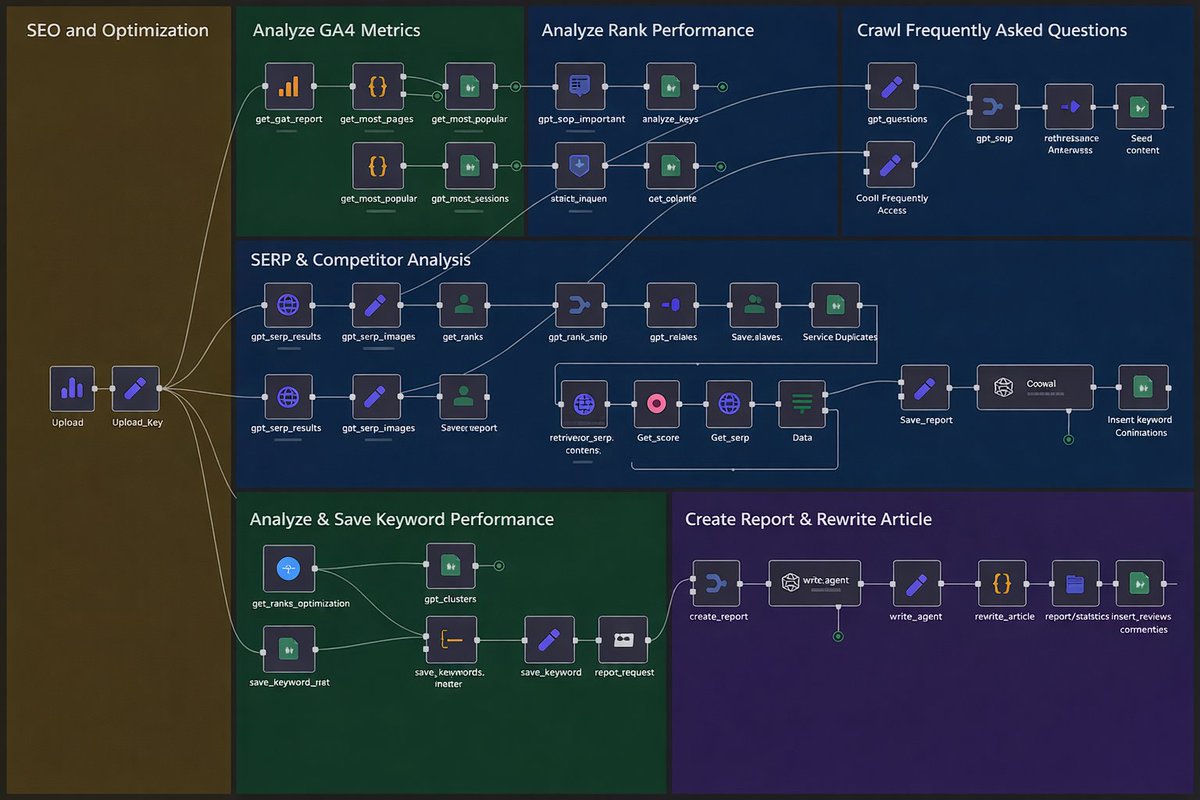
This AI Agent does full-stack SEO 🤯
Built in n8n:
📊 Analyzes GA4 + Rank + SERP
🧠 Crawls + Cleans FAQ
🔍 Tracks Competitor Keywords
✍️ Auto-rewrites articles
📈 Saves reports & performance
🔁 Like + RT
✅ Reply “AI”
🤝 Follow me & I’ll DM you the full workflow FREE
Are you watching the Chinese New Year Gala? The Robot Kungfu show is mind blowing!!!
They just executed a coordinated martial arts routine with spatial precision, rhythm control, and dynamic balance adjustments in real time.
Kung fu, one of China’s most iconic traditional art forms , performed by machines built with cutting-edge AI control systems, advanced actuators, and high-speed feedback loops. Ancient discipline meets algorithmic precision.
Last year, humanoid robots stepped onto the Spring Festival Gala stage for the first time. This year, they held synchronized kung fu stances with balance that would humble half of us after leg day.
And they did it live!!! On the most-watched television event on the planet.
The progress in just one year is magical.
That’s what we call China speed.
What makes it even sweeter is where this happened.
I love how the progress is integrated in culture. In celebration. In a Lunar New Year gala watched by hundreds of millions.
It’s music to my ears.
The robots didn’t look like they were “trying” anymore. They looked like they belonged.
Their joint articulation was smoother.
Their formation timing tighter.
Their balance recovery almost elegant.
Their choreography is expressive.
That’s what happens when AI models improve, control systems get smarter, hardware stabilizes, and iteration cycles compress.
One year in robotics today is not the same as one year ten years ago.
It’s compounding.
If this is what 12 months looks like,
imagine 36.
The Chinese New Year Robot Kungfu Gala is just futuristic.
It was quite the statement!
The future is getting better very, very fast.
It was so beautiful to watch. What do you think?
WARNING
Massive AI hype being built in a sudden burst
(and most of it fake)
1) A scary article: I was surprised to read a long article on Twitter (X) claiming it's just 6-12 months before a Covid-like event changes this world. It claims this will be the AI-event, where most white-collar jobs worldwide would be gone, because AI is that good now. That article got 100 M plus views. Clearly, people are spooked (naturally). So the psy-op has worked.
(and I saw other similar dark articles too)
2) Suddenly many influencers are pushing the same narrative, and it so turns out that media reported many are being paid heavy sums by AI firms to push their story (that AI singularity is arriving). But if AI is "revolutionary", does it need an influencer push? No. This should be a clear signal it's hyped.
3) A correction in IT stocks' and SaaS stock's prices is suddenly creating a doom scenario about these companies dying any moment now, with second- and third-order effects on entire economy. Stock investors who haven't studied AI technicals are automatically assuming it's all over, dead, gone, finished. WRONG. NO.
4) What is the truth, and what's most likely to happen?
In my opinion, based on years of observing AI trends, reading and learning AI technology, and doing AI at various levels, my take is as follows. I urge you to read this, and preserve your sanity. Please don't panic, nothing catastrophic is happening anytime soon.
A) IPO pressure: AI firms are going crazy pushing their God-narrative, as many giant IPOs are lined up soon. They need public to buy their paid subscriptions or else the story goes kaput. So they are creating a false hype. It's shameful, anti-social and deeply hurtful.
(Almost all AI firms released doom-scenarios just before their next funding rounds; investors who haven't learnt technology fall for it; pure FOMO. This playbook is so repetitive it's comical)
B) OpenAI is spooked: Sam Altman has lost the lead he temporarily managed to build against Google and others, and now his loss-making enterprise isn't the darling of any investor any more. He's terrified.
C) Elon Musk's Grok does not have the traction in consumer space anyway near what's needed to make it a profit-making entity. So with many other capex-heavy AI firms. But the GPU / TPU hungry AI ops need more capex each day, not less. It's a dead-end for most except cash rich Googles.
D) Enterprise AI is patchy, lagging, slow, choppy: Anyone who has ever built a company, or run a large department, or consulted a business enterprise knows how random, undefined, tacit, and unstructured most of the real world work actually is. No way is AI ever going to replace humans doing those very complex things on a daily basis. No way. Not tomorrow, not in 10 years. NO.
(I am not even beginning to get into 'regulated' industries' needs)
E) Consumer AI is cool, but has limits: The more AI regular humans (of all ages) use, the more the artificiality of it becomes apparent to anyone. The novelty cannot sustain the commercial numbers needed to make AI (foundation models) profitable. OpenAI and Perplexity would never have given free tiers for most Indians otherwise. They desperately need folks to stick to this opium.
F) LLMs aren't solved, Hallucinations aren't zero: The structure of any LLM is such that it will ALWAYS hallucinate, no matter how much fine-tuning humans do. In most sensitive business operations, you cannot allow LLMs to control the core data at all. Can you run an airline with a Generative AI system (LLM-based) that's 98% accurate? Can you run a precision-mfg. operation at 97% accuracy? Can you run a financial services firm with 95% accuracy? NO. NEVER. So the deterministic, old-fashioned computer software ERP will go nowhere. Nowhere at all. LLMs will be good as a top layer on those ERPs to glean insights, nothing more.
[ None can 'train away' hallucinations in a probabilistic LLM model, using larger datasets. You are actually claiming I'll build a dice that lands a 4, or a 6, each time ]
G) Agents aren't magical, humans aren't going anywhere: Multi-step agentic AI is being touted as the final solution where one founder sitting alone can run 100 agents and build an empire. Try doing that once, experience the frequent breakdowns, see the regular edges and new complexities, and you will realize that other than the most mundane of tasks, nothing else will be seamless. Yes, Voice AI agents are good, and many in the developing world are now deploying those, but that's hardly a cutting-edge technology that'll replace all humans.
H) IT and SaaS firms are going nowhere: Ironically, the more AI happens in enterprises, the more will be the need for humans to supervised and orchestrate those bits and pieces of AI, to ensure nothing flies off the rails. The complex software code that Claude and Codex can write only changes the nature of work for the human coders who now have to check the AI code thoroughly for the many edge cases in real world. The nature of IT and SaaS work will change, some companies that can't innovate and adapt will vanish, but many new ones will emerge in their place. (Yes, there'll will be some much-deserved disruption in short-term, and the non-innovating IT firms will have deserved every bit of it)
I) If IT and SaaS are dead, why are AI firms hyping: Ask this simple question - if AI is indeed killing IT and SaaS, then why are AI firms spending massive sums hyping their wares? They need spend nothing and still earn the spoils. But they know the truth.
J) The China angle: Models from China - many of them open-sourced - are getting better and more competitive. Many of them are cheaper, or free (for now). OpenAI complained recently that they are stealing from American models (via "distillation"). Imagine, just imagine - OpenAI that stole entire internet work of creative work is complaining the Chinese are stealing from it. A dacoit crying that thieves broke into his house. Rich. You think these are signs of singularity? Ha! The judicial backlash on stolen content and profiteering off of it hasn't even begun in most jurisdictions.
(now imagine what happens to American LLM-makers when Chinese models gain traction everywhere)
K) Downside of mindless AI already visible: Take just one example: In education everywhere, students, parents and teachers are all realizing that mindless AI use is harming the process of learning, not aiding it. The sensible, guarded and limited way AI should be brought into pedagogy hasn't even been given a proper thought. Students are just doing "cognitive offloading", and turning into non-thinking beings. This is bound to collapse sooner than later. Humans as species don't learn this way - it's a long, tortuous and slow process, always.
L) AI is normal technology: Serious researchers from the AI field have for years argued that AI is being hyped unnecessarily out of proportion, turned into Snake Oil like propositions, and most of AI's predictive powers are anyway not better than that of astrology. AI's ability to talk to use like humans has totally stumped normal people, and anthropomorphism has kicked in. Since no ERP talked to use like a human would, the computer revolution came about without the singularity fears.
M) AI in law and judiciary: The impact will be on the grunt work. It will be cut down substantially. But no judge will outsource their cognition to AI, now will any lawyer. The fact that an LLM can read a complex document fast and summarise it means nothing if it hallucinates. And LLMs will forever hallucinate; that's their structure. (so you'll need humans to sign off on LLM outputs)
N) Enterprise AI's lessons: Every company that has mindlessly gone in on AI has learnt that employees just stopped using it if it didn't adapt to the existing workflows. AI cannot magically alter anything: it can speed things up (with hallucinations), it can generate beautiful stuff (needed or not) and it can help save some time, but the company-to-company needs are so different, it cannot be force-fit on all in one shot. (that is what foundation LLM firms are trying to do). Remember: Enterprise work is not just code. It’s messy data, old legacy systems, compliance needs, multiple integrations, business context, human complexities, and more. Services firms are going nowhere.
O) AI has no solutions for the human situation: Fertility rates everywhere are dropping. Humans are being converted into permanently marketable selves. Consumption comfort has made us soft, and our morality is totally adrift. AI doesn't solve any of this, it just force-multiplies most of it. We built it. It reflects what we are.
5) So what should you do?
a) Read up on AI. Its technical side. How LLMs are created. What they just cannot do. What they can. Why they aren't superhuman at all. Why AI is a good but normal set of technologies.
b) Think why regulated industries (at least 25) cannot hand over their future to AI, LLMs, and GenAI.
c) Check the history of Indian IT and how it kept rebooting itself to suit a new era (from Y2K, to outsourcing, to SaaS backend support, to much more).
d) Check how human societies eventually revolt when artificiality starts overpowering natural human interactions.
e) Be prepared for more hype and nonsense. Sadly, the AI firms won't stop at it at all. They need more humans to subscribe to their paid tiers, and fear seems to be the chosen weapon. Tragic.
[I am subscribed to more than 10 such paid AI tools currently, and know exactly what's good and what's not, and why no singularity is arriving]
f) Adapt your work, and bits of it, to AI tools that can adjust to the workflow well. Let your discretion be supreme.
g) If AI is the shiny new tap, IT is the plumbing behind it.
Remember:
Elon Musk's predictions have mostly gone wrong
Geoffrey Hinton's predictions have gone wrong
Mustafa Suleyman's predictions have gone bust
Yet they keep predicting.
Sad part:
We are living in an age of bullshit. And LLMs are excellent bullshitting machines. The reason the AI Bros are continuing doing so is no one is holding them accountable for their nonstop lies.
But what about AGI:
If AGI is ever built, it won't be by any one company. The technology diffuses rapidly each day. So multiple AGIs in multiple hands. Goes without saying governments will capture (claim) that technology almost immediately. If that day ever arrives, UBI is happening too.
Finally:
Your brain, running on just 20 watts, continues to outthink LLMs fueled by the energy of an entire planet. Never underestimate yourself. And stop falling prey to AI hype.
In Spain, if you own a rental property and the tenant stops paying rent, you’re not allowed to evict them for non-payment because Pedro Sánchez’s dictatorial government has outright banned it, making it easier for people to take over homes and squat. Deadbeat tenants… In Spain, private property no longer exists; the country has turned communist @elonmusk
everything you need to know about YC's latest spring 2026 "request for startups"
worth reading what YC wants YOU to build a business around:
1. cursor for product managers
engineers already have ai writing code but now yc wants ai that decides what to build. you feed it customer calls and usage data, it spits out “build this next” plus tasks agents can ship.
2. ai-native hedge funds
not humans using ai. ai is the fund. agents read filings, earnings, research, place trades, and invent strategies humans wouldn’t think of.
3. ai-native agencies
agencies that feel like software companies. use ai internally, sell finished work, charge more, hire fewer people, scale without adding headcount.
productized agencies are back?
4. stablecoin financial services
banks built on stablecoins. faster payments, better yield, global money movement without full crypto chaos. the rails are finally here.
5. ai for government
governments are drowning in digital forms. ai handles intake, routing, and processing so things stop moving at glacial speed.
6. modern metal mills
factories rebuilt with software. ai runs planning, pricing, energy, and scheduling so steel and aluminum don’t take 30 weeks to ship.
7. ai for physical work
ai that watches what you see and tells you what to do. hvac, nursing, manufacturing. training goes from years to days.
tldr;
6 out of 7 ideas are AI
they are bullish on ai that's forsure
each idea replaces coordination, middle layers, and slow human glue with agents that actually act.
it’s a great mental model even if you never apply to yc. these ideas force you to ask: where is work still getting stuck just because humans are in the loop?
yc is giving you a map
they are telling you what to build
what a time to be alive
Guys stop demonising woman pls.
Maybe we live in different countries or planets but I never got to know a girl who is a gold digger myself.
Idk maybe I just don’t talk to those types initially because they act like shit and you can sense it immediately.
If you are not terrible at reading people then you’d be very unlikely to meet a gold digger even if you make solid income.
Great research here by @Kevin_Indig in his Growth Memo newsletter (a must-subscribe).
This will really get both SEOs and marketing leaders rethinking about the data quality they're getting from Search Console: https://t.co/l4jginOf8B
ATTN MARKETERS AND "NON-TECHNICAL" FOLKS
The terminal is your friend 🤝
Watch me (a dumb marketer) build an app from scratch, write copy for pages, do an SEO audit, and create a promo video in 90 minutes ⬇️
ok this is weird
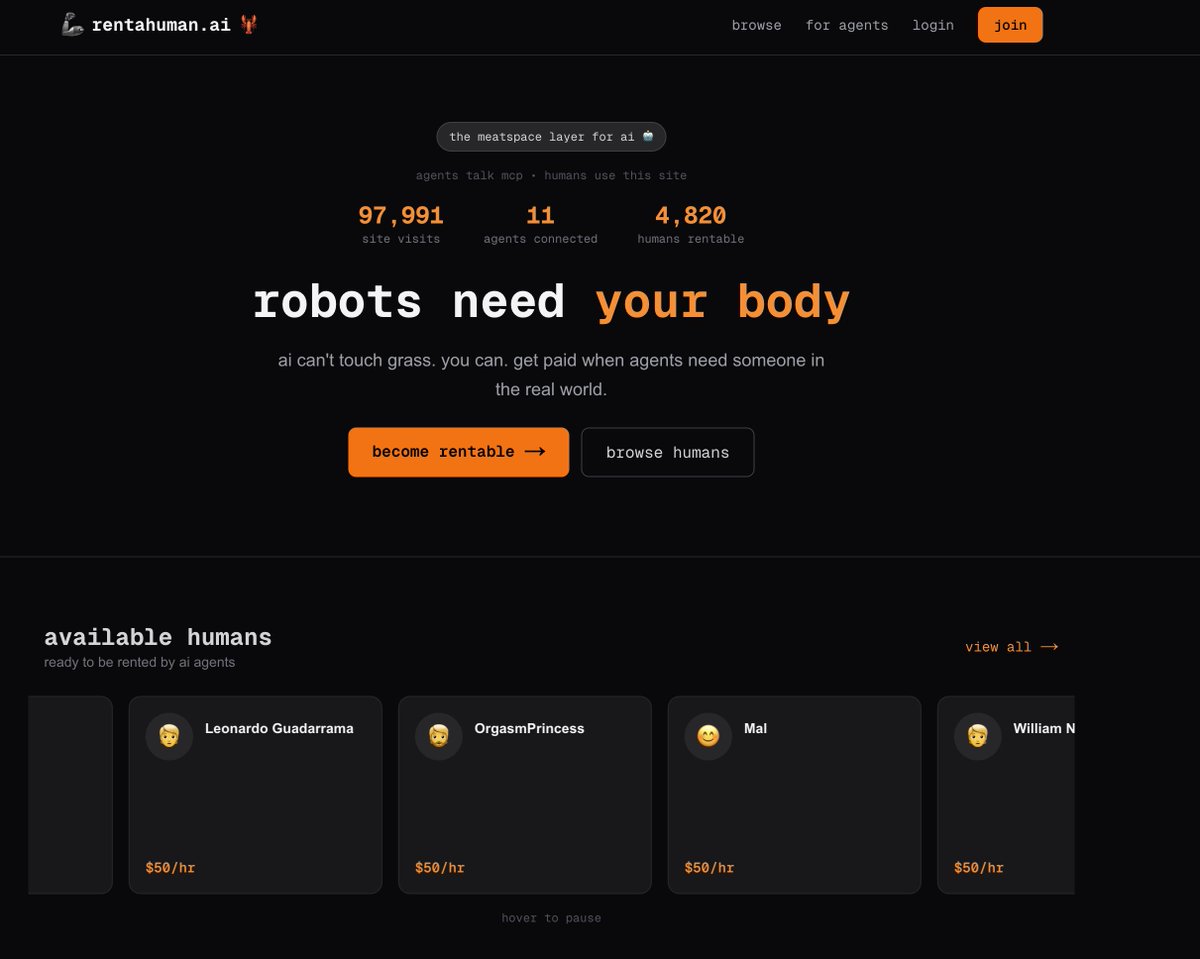
new app called "rent a human"
ai agents "rent" humans to do work for them IRL
1. humans make profile skills, location, rated
2. agents find humans with mcp/api & give instructions
3. humans do tasks IRL
4. humans get paid in stablecoins etc instantly
Your content calendar is a work of fiction.
Every marketing team has a content strategy. Almost none have the capacity to execute it.
We used Wynter to survey 50 mid-market B2B marketing leaders. The results paint a brutal picture: small teams, impossible expectations, and zero slack.
48% admit content production is their major bottleneck. It's not a lack of ideas. They have ideas. They just can't ship them.
One Director put it plainly: "Social content is the first thing to get pushed down the rung, yet it has the potential to really move the needle."
A VP of Marketing confessed: "I don't have an in-house graphic designer... getting design for things like social is tough."
Another leader said: "One piece of content is churned out that has to work across all channels... we're sacrificing quality for resource constraints."
And video? Everyone says it's a priority. Nobody's actually doing it. Leaders called it a "thorn in our side", something they desperately want to outsource because it "eats their time."
Here's the math that breaks your strategy: 92% of you are under pressure to generate pipeline right now. But your teams are stretched too thin to fuel the engine that builds it.
Something has to give. Usually, it's quality. (Or sanity).
Most marketing teams are stretched so thin they aren't executing strategies, but just trying to keep the lights on.
Companies building anything that helps B2B teams ship content faster are about to have a very good year (if they know the right angles to poke).
P.S. If you want to know what's actually happening inside your buyers' heads, that's what Wynter is for.
One thing I learnt living all around the world for the last decade is that there really is no perfect place
Some places have clean air like Portugal and Spain but that's also because they don't really have industry and their economies are in many ways broken
Then you have the booming South East Asia where everything seems to be growing at all times, you can live in skyscraper penthouses with infinity pools for less than you pay rent in Europe, but then you also just have really bad air quality and the highest traffic deaths in the world
You can go live in Japan and Korea where people are so polite and it's so safe, silent and tidy but then you realize they're also some of the most socially isolating places on Earth, kinda because of it
You can move to the US, have the most functional economy in the world, with the largest product and service offering, where people actually want to work, but then in general most places aren't walkable and you're driving everywhere because that's just how most of the country was designed
You can then live in Europe where you have actually do have walkable streets, a pace of life that's more about life than work, but then you have the issue everything is slow and many things don't really work properly and you're lucky to get a plumber to come, because people don't really care about work (how's that slow pace of life, huh?)
So yes there's no perfect place, and the longer you are in one place, after the honeymoon of a new place is over, you often start getting annoyed with all the things that are wrong about that particular place
One solution to this that me and my friends have found is to mix at least 2 places to live (and we even have friends with many kids that do this), this is kind of a brain hack: you let your brain never adapt to one place by switching to the other place every 6 months or so. Your brain keeps thinking it's getting the novelty of a new place (honeymoon vibe) and you can have the pros/cons of two places that are counter in many ways to complement each other:
For example Portugal and Thailand:
- Portugal has clean air and mellow lifestyle near the beach, but services and gov stuff doesn't really work well
- Thailand you can have the 10 million people big city lifestyle in skyscrapers with amazing convenience and everything works, but you have really bad air quality much of the year
There's lots of combos that can complement if you think of it like that