Appreciator of the little things in life. Primarily good news about the progress of medicine and science, typically drowned in oceans of negative news.
It’s now clear that the @realDonaldTrump Administration computed reciprocal tariffs without using tariff data. This is to economics what creationism is to biology, astrology is to astronomy, or RFK thought is to vaccine science. The Trump tariff policy makes little sense EVEN if you believe in protectionist mercantilist economics.
A 33-year-old woman at MIT wrote the code that ran inside the Apollo 11 lunar lander, and 20 seconds before Neil Armstrong touched the moon, her program made a decision the astronauts didn't know was happening that was the only reason the mission didn't crash.
Her name was Margaret Hamilton.
She led the team writing every line of code that would fly humans to the moon and back. The part almost nobody knows is that she had to fight to be allowed to do the work at all.
Code in 1965 was not treated as real work.
Rockets were serious. Circuits were serious. Writing code was something the men at NASA thought secretaries could do on the side. Hamilton was told this to her face more than once.
So she started calling what her team did "software engineering."
She used the phrase on purpose. In meetings. In memos. To force people to treat it as a discipline instead of a chore. Colleagues laughed at her the first few times she said it out loud.
That phrase is now the name of the biggest engineering profession on earth.
The story of what her code did on July 20, 1969 is the one every kid should be taught.
Neil Armstrong and Buzz Aldrin were 3 minutes from touching down when the computer inside the lunar module started flashing an alarm.
1202.
Then again. Then 1201. Five alarms in four minutes. The computer was telling the astronauts it could not finish everything it had been asked to do.
The computer they were flying with had less memory than a modern microwave.
Someone on the checklist had left a switch in the wrong position, and a radar the astronauts did not even need right then was flooding the computer with data. It was eating around 13% of the machine's brain at the exact moment every second mattered.
In almost any other system, that overload would have frozen the machine.
A frozen machine 30,000 feet above the moon means a crash. It means two dead astronauts and a third one orbiting alone above them, waiting for a signal that would never come.
Hamilton's code did something else.
She had built the software with a rule almost nobody in her field was using at the time. When the machine ran out of room, it would not treat every task as equally important. It would look at the list of jobs it had been asked to do, throw out the ones that could wait, and keep running only the ones keeping the crew alive.
The radar was the low priority job.
The landing was the highest.
So the computer did what she had told it to do. It dumped the radar. It kept flying. The alarm was not a failure. It was the machine reporting that it was handling the overload exactly the way she had designed it to.
Down in Houston, a 24-year-old engineer named Jack Garman recognized the alarm from a test his team had run months earlier. He shouted "Go" to the flight controller. The controller shouted it up to the crew. The landing kept going.
Armstrong touched the surface with 25 seconds of fuel left.
The part that gets lost in every retelling is why Hamilton had built that safety net in the first place.
NASA had not asked for it.
She had added it on her own, years earlier, because her 4-year-old daughter Lauren had once crashed the simulator by pressing a button during a test. The button was one the astronauts had been told they would never press.
Hamilton wanted the code to survive that button press anyway.
Her bosses told her it was a waste of time. Astronauts do not make mistakes.
She insisted. The safety net went in.
Two years later, on the way to the moon, an astronaut left a switch in the wrong position. The exact class of mistake she had been told would never happen.
There is a photograph of her from that period.
She is standing next to a stack of paper as tall as she is. Every page in that stack is the code her team wrote for the mission. She is smiling at the camera like she knows something the rest of the aerospace industry has not figured out yet.
In 2016, Barack Obama put the Presidential Medal of Freedom around her neck and said the astronauts did not have much time, but thankfully, they had Margaret Hamilton.
Every autopilot in every plane you have ever flown on uses a version of what she invented. Every pacemaker. Every self driving car. Every satellite in orbit.
The idea that a machine should know which job matters most and drop the rest when it runs out of room is now the foundation of almost every safety system on the planet.
She wrote it because a 4 year old crashed a simulator and nobody else thought it was worth fixing.
The men in the room laughed at her for calling it engineering.
Then her code was the only thing in the sky that did not fail.
To everyone celebrating the first flight on Qatar Force One today, understand what you are actually applauding.
A foreign government handed the sitting President of the United States a $400 million plane. American taxpayers then paid to retrofit it, with an estimated cost of at least another $400 million (some estimates far higher), for security and communications work in a Texas hangar since last September.
When Trump leaves office, the plane does not stay with the government. Ownership transfers to his presidential library foundation. In other words, he keeps it.
You are being asked to treat pure corruption as normal, to shrug at a President personally profiting from a foreign gift the taxpayers paid to upgrade.
In any other administration this would be the scandal that ends a presidency.
With Trump, it’s Wednesday.
https://t.co/qAfVUp8KBd
Our hero journalist Katie Phang is about to break the Trump pedophilia case of a 13-year-old raped by him.
The judge sided with Katie, demanding that Todd Blanche release the remaining FBI files on Trump’s rape allegation by July 2nd.
This may be Trump’s worst 4th of July.
Prominent US war hawk John Bolton has pled guilty to violating the Espionage Act after previously demanding execution for whistleblowers Edward Snowden & Chelsea Manning and 176 years in prison for publisher Julian Assange.
As part of a plea agreement, Bolton admitted to unlawfully retaining sensitive national security information. He now faces up to 5 years in prison, up to 3 years of supervised release, a $2.25 million fine, forfeiture of his pension, and is due to be sentenced on 28 October.
"Happy birthday, kiddo." 👩🚀
The Last of Us Part II was released six years ago today on June 19, 2020. A big thank you to every fan who's experienced Ellie and Abby's eventful journeys.
Boris Cherny, Head of Claude Code (Anthropic):
"A year ago it was a Slack demo that got just two reactions. Today auto mode saves me hours every single day — I never write code without it anymore."
in an 18-minute interview, Boris breaks down his daily setup.
auto mode + verification + context minimalism
Worth more than a week of expensive AI consulting.
Watch it and bookmark it now.
"I still love building with AI—I'm just doing it a bit more cautiously these days." 💻
Recent package hacks have exposed real vulnerabilities in how we build with code. This article breaks down what happened with the Mini Shai-Hulud worm, how malicious software typically works, and what you need to know about staying safe while using tools like Cowork.
Here's what you'll learn:
🔓 How malicious software gains entry to your device, searches for sensitive data, and sends it to attackers' servers
🛡️ Common scenarios that expose you to risk—from downloading third-party skills to running code with agents
🔒 How Cowork protects you through isolation and limited network traffic—and where its safety gaps are
⚠️ Your responsibility when using Cowork: keep sensitive data and credentials outside the virtual machine
🎯 Why the Code tab in Claude Desktop is riskier than Cowork, and when each tool is appropriate to use
Read the article: https://t.co/SfOijGlpVV
🤔 When you're using AI tools to write and run code, how do you currently think about what data and folders to share with them? Share your thoughts in the comments below.
@_Jadranka_Kosor To vi sad kažete jer ne želite priznati da ste se udružili sa Milanovićem. 🤣 Ma on je skroz izgubio orijentir i počeo je pričati stvarno svašta.
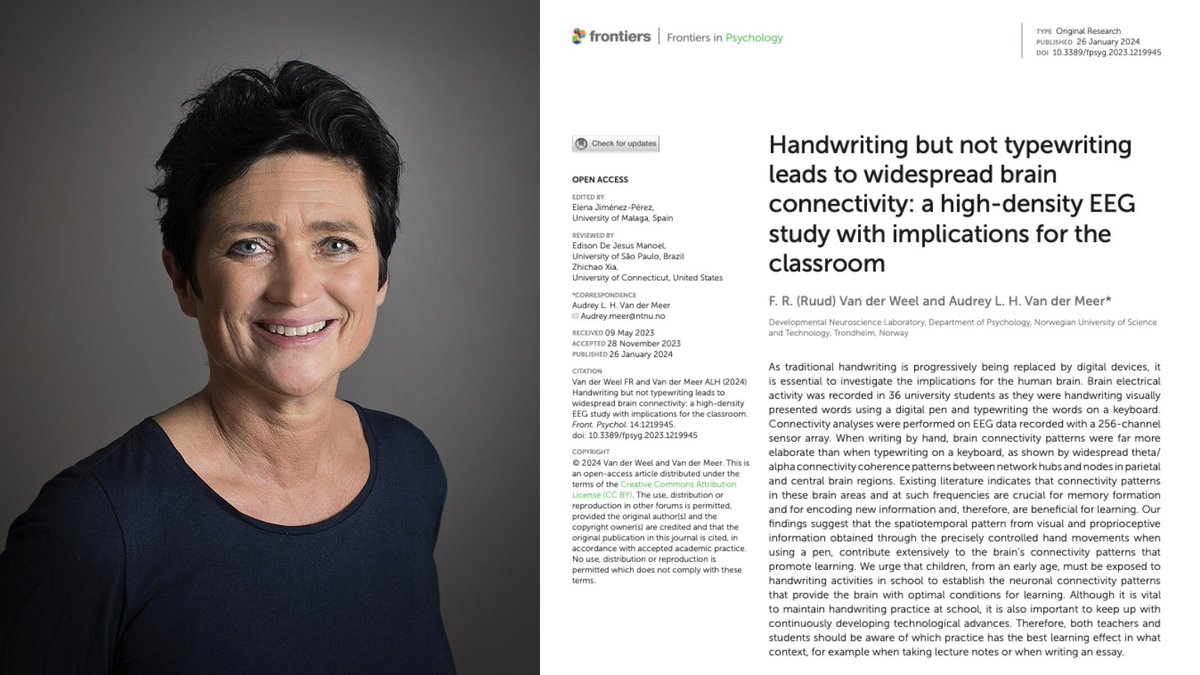
A Norwegian neuroscientist spent 20 years proving that the act of writing by hand changes the human brain in ways typing physically cannot, and almost nobody outside her field has read the paper.
Her name is Audrey van der Meer.
She runs a brain research lab in Trondheim, and the paper that closed the argument was published in 2024 in a journal called Frontiers in Psychology. The finding is brutal enough that it should have changed every classroom on Earth.
The experiment was simple. She recruited 36 university students and put each one in a cap with 256 sensors pressed against their scalp to record brain activity. Words flashed on a screen one at a time.
Sometimes the students wrote the word by hand on a touchscreen using a digital pen, and sometimes they typed the same word on a keyboard. Every neural response was recorded for the full five seconds the word stayed on screen.
Then her team looked at the part of the data most researchers had ignored for years, which is how different parts of the brain were communicating with each other during the task.
When the students wrote by hand, the brain lit up everywhere at once.
The regions responsible for memory, sensory integration, and the encoding of new information were all firing together in a coordinated pattern that spread across the entire cortex. The whole network was awake and connected.
When the same students typed the same word, that pattern collapsed almost completely.
Most of the brain went quiet, and the connections between regions that had been alive seconds earlier were nowhere to be found on the EEG.
Same word, same brain, same person, and two completely different neurological events.
The reason turned out to be something nobody had really paid attention to before her work. Writing by hand is not one motion but a sequence of thousands of tiny micro-movements coordinated with your eyes in real time, where each letter is a different shape that requires the brain to solve a slightly different spatial problem.
Your fingers, wrist, vision, and the parts of your brain that track position in space are all working together to produce one letter, then the next, then the next.
Typing throws all of that away. Every key on a keyboard requires the exact same finger motion regardless of which letter you are pressing, which means the brain has almost nothing to integrate and almost no problem to solve.
Van der Meer said it plainly in her interviews.
Pressing the same key with the same finger over and over does not stimulate the brain in any meaningful way, and she pointed out something that should scare every parent who handed their kid an iPad.
Children who learn to read and write on tablets often cannot tell letters like b and d apart, because they have never physically felt with their bodies what it takes to actually produce those letters on a page.
A decade before her, two researchers at Princeton ran the same fight using a completely different method and ended up at the same answer. Pam Mueller and Daniel Oppenheimer tested 327 students across three experiments, where half took notes on laptops with the internet disabled and half took notes by hand, before testing everyone on what they actually understood from the lectures they had watched.
The handwriting group won by a wide margin on every question that required real understanding rather than surface recall.
The reason was hiding in the transcripts of what the two groups had actually written down.
The laptop students typed almost word for word, capturing more total content but processing almost none of it as they went, while the handwriting students physically could not write fast enough to transcribe a lecture in real time, which forced them to listen carefully, decide what actually mattered, and put it in their own words on the page.
That single act of choosing what to keep was the learning itself, and the keyboard had quietly skipped the choosing and skipped the learning along with it.
Two studies. Two countries. Same answer.
Handwriting makes the brain work. Typing lets it coast.
Every note you have ever typed instead of written went into your brain through a thinner pipe. Every meeting, every book highlight, every idea you captured on your phone instead of on paper was processed at half depth.
You did not forget those things because your memory is bad. You forgot them because typing never woke the part of the brain that would have made them stick.
The fix is the thing your grandmother already knew.
Pick up a pen. Write the thing down. The slower road is the faster one.