Checked out @voicehavefun and I get why people are paying attention.
Simple idea, but it feels engaging — not just scrolling, actually participating and enjoying the experience.
Still early, but projects that make interaction feel natural usually stand out 👀
Checked out @voicehavefun and I get why people are paying attention.
Simple idea, but it feels engaging — not just scrolling, actually participating and enjoying the experience.
Still early, but projects that make interaction feel natural usually stand out 👀
stopped caring about roadmaps and whitepapers
started asking one question about @dagama_world, dango, RumiLabs_io, inference_labs, and dgrid_ai
"where's the actual revenue?"
results were... eye-opening 🧵
THE QUESTION NOBODY ASKS:
everyone debates tech, tokenomics, team
but I want to know: is anyone paying money for this?
not tokens, not incentives, actual revenue
@dagama_world REVENUE MODEL:
talked to merchant using their platform
asked: "do you pay dagama anything?"
answer: "not yet, but they mentioned business panel subscription coming"
so current revenue: $0 from merchants
360K wallets connected, 700+ merchants, zero direct revenue currently
BUT WAIT:
they did ChainGPT launchdrop: $50K raised
token sales: some revenue from listings
so technically making money, just not from product usage yet
plan: merchant subscriptions, targeted ads, premium features
timeline: rolling out Q1 2026
@dango REVENUE:
testnet phase, 166K users, 5M transactions
asked community: "how does dango make money?"
answer: "transaction fees on mainnet"
current revenue: $0 (testnet is free)
future model: tiny fee per transaction (sub-cent)
math: if 5M transactions monthly at $0.0001 fee = $500/month
needs massive scale to work
CONCERN:
fee must stay low (that's the point)
but low fee × volume = need billions of transactions for real revenue
can they get there?
@RumiLabs_io REVENUE:
I literally paid them $19 for compute
that's revenue, real money exchanged
checked more: other users renting GPUs, paying per use
this one has actual revenue from actual usage
not huge amounts (early stage)
but real business model working today
VALIDATION:
saved me $41 vs alternatives
I paid for value received
that's a functioning business
@inference_labs REVENUE:
tested their API, made 300 requests
checked pricing: they charge per API call
so yes, generating revenue from usage
asked community member: "are you paying?"
answer: "yeah $9 last month, saved me from $24 on OpenAI"
real revenue from real users today
MODEL MAKES SENSE:
take cut from cost savings
users happy (still saving money)
they make money
sustainable
@dgrid_ai REVENUE:
not launched, can't have revenue yet
whitepaper mentions: node operators pay network fees
users pay for compute access
makes sense on paper
execution: TBD 2026
REVENUE SCORECARD:
dagama: $50K+ (fundraising), $0 (product usage)
dango: $0 (testnet), TBD (mainnet Q1 2026)
RumiLabs: $ unknown amount (compute rentals)
Inference: $ unknown amount (API usage)
DGrid: $0 (not launched)
only 2 out of 5 have product revenue today
WHY THIS MATTERS:
projects with revenue = validated business model
projects without revenue = still proving product-market fit
both can succeed, but risk profiles totally different
THE LUNA LESSON:
Luna had massive TVL, no real revenue
just tokens moving around ecosystem
looked successful until it wasn't
revenue = external money coming in, not internal token shuffling
DAGAMA CASE STUDY:
no product revenue yet, but 360K users, 700+ merchants
that's real traction, real usage
revenue coming soon (merchant subscriptions)
question: will merchants actually pay?
TESTED THIS:
asked merchant: "would you pay $20/month for dagama business dashboard?"
answer: "depends on customers it brings, need to see ROI"
so revenue timing = dependent on proving value first
makes sense but adds uncertainty
DANGO MATH:
5M transactions testnet (free)
mainnet: $0.0001 per transaction
monthly revenue: $500
annual: $6,000
not enough to sustain company
need 100x transaction volume for real business
APPLYING TO THESE 5:
dagama: no revenue yet, model makes sense, timeline clear ✅
dango: no revenue yet, model needs scale, uncertain ⚠️
RumiLabs: has revenue, model validated, sustainable ✅
Inference: has revenue, model validated, sustainable ✅
DGrid: no revenue yet, model makes sense, unproven ⚠️
do you care about revenue or just token price? honest question 👇
#Revenue #BuildInPublic #RealBusiness
DGrid is partnering with @dechat_io to power AI-driven social for Web3.
As Dechat scales open social communication, @dgrid_ai provides the verifiable AI inference layer behind agent interactions.
Interface meets trustless intelligence for the next standard decentralized social.
Inference Labs is rapidly becoming a cornerstone for DeFi risk-forecasting and automated hedging assurance by turning AI signals into cryptographically verifiable evidence that decentralized financial systems can trust a breakthrough in an industry where opaque prediction logic has long undermined fairness and capital safety.
In decentralized lending markets, automated hedging strategies, and complex derivatives pricing, protocols increasingly depend on machine learning models to predict future states of the market, signal risk exposures, or trigger protective actions. Yet traditional AI outputs are opaque by design; there has never been a way for a protocol, smart contract, or investor to independently verify that a specific model generated a prediction honestly on the data it claims to have seen, without exposing the model or sensitive inputs.
Inference Labs solves this critical transparency gap with Proof of Inference, a zero-knowledge cryptographic system that transforms AI outputs into provable artifacts that any consuming DeFi contract or participant can verify before acting on them. This shift from assumed correctness to mathematically certain inference fundamentally strengthens how automated risk decisions are made in decentralized finance, improving capital efficiency and reducing hidden systemic vulnerabilities.
At the core of this transformation is the integration of zero-knowledge proofs into AI inference itself. Proof of Inference certifies that an AI model was indeed executed on specific input data and produced the claimed output without tampering or substitution, while preserving the confidentiality of proprietary logic and sensitive information.
In the context of DeFi risk forecasting and hedging, this means a protocol can verify before executing a hedge, adjusting collateral requirements, or rebalancing an exposure that the AI’s risk score or future price expectation is authentic. Without this cryptographic attestation, automated systems must trust off-chain signals or centralized oracles whose integrity cannot be audited, leaving capital vulnerable to subtle errors or malicious manipulation.
With verifiable evidence attached to AI outputs, automated risk engines can operate with provable certainty, enabling more sophisticated risk controls and hedging algorithms to be safely coded into financial logic.
The practical backbone for this verifiable AI layer is Subnet 2 on the Bittensor network, a decentralized marketplace and universal verification layer where AI inference tasks are computed and each result is paired with its proof and independently checked by validators before delivery.
This capability directly impacts automated hedging and liquidity risk management in decentralized finance because it reduces the asymmetric information problem inherent in AI models. Instead of relying on unverifiable forecasts that might be wrong, manipulated, or misaligned with on-chain conditions, protocols can require every risk signal, hedge recommendation, or forecasted outcome to come with proof that it was computed faithfully.
This makes automated hedging strategies more resilient and transparent, encouraging institutional participation and improving confidence among market makers, liquidity providers, and DAO treasuries that funds are being protected based on provably correct intelligence rather than unverified assumptions.
Inference Labs has also expanded the reach and robustness of its verifiable AI ecosystem through partnerships like the integration of DeepProve, a zkML library that enhances AI verification standards and enables models to operate with cryptographic guarantees across decentralized environments.
Confidence grows in small moments. daGama’s micro-design adds subtle confirmations, gentle reinforcement, and frictionless feedback so every action feels right, users feel supported, and trust builds cumulatively at every step with quiet precision always.
@dagama_world
Creators struggle to reach real demand.
Users can’t verify what actually ran behind the scenes.
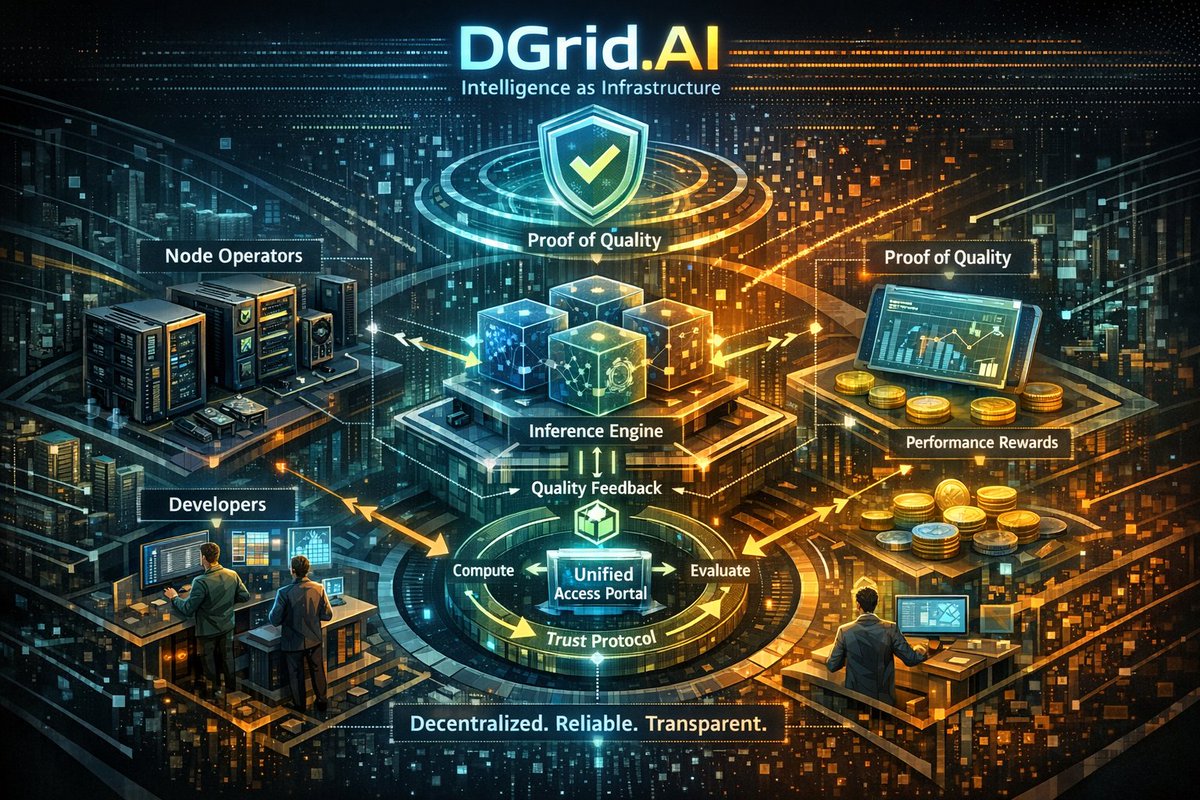
@dgrid_ai approaches this from the infrastructure level.
By connecting routing, verification, and open markets in one system, it reduces friction without central control.
As AI becomes part of everyday products, the conversation is shifting.
It’s no longer just about how powerful AI is it’s about whether it’s reliable, affordable, and verifiable at scale.
That’s where @dgrid_ai positions itself.
DGrid AI is building a decentralized AI smart network focused on making AI workloads more efficient while maintaining trust. Instead of relying on centralized systems that can become expensive or opaque, it explores a distributed approach that prioritizes cost control and verification.
This feels important as AI outputs increasingly influence decisions, automation, and real-world outcomes. Infrastructure matters more than hype at this stage.
If AI is becoming core infrastructure, shouldn’t its foundation be transparent and resilient?
inference_labs
Most people think AI progress comes from bigger models.
Inference Labs shows that the real leverage is somewhere else.
The moment a model leaves training and enters production, inference becomes the real test.
Speed, cost, reliability, and control determine whether intelligence is useful or wasteful.
Inference Labs matters because it focuses on execution, not spectacle.
A powerful model that responds slowly or unpredictably is not intelligence.
It is friction.
What stands out is the attention to real world constraints.
Optimizing inference is not glamorous, but it is decisive.
This is similar to electricity.
Generation mattered, but distribution changed society.
Inference is the distribution layer of AI.
Key signals of maturity:
•Treating deployment as a core problem
•Reducing cost without sacrificing reliability
•Designing systems meant to operate continuously, not impress briefly
This approach moves AI from experiments to infrastructure.
From demos to dependable systems.
Inference Labs is not chasing attention.
It is building the layer that makes intelligence usable at scale.
That is where lasting value is created.
AstroloLogy
Astrology is often dismissed because people expect prediction instead of understanding.
That misunderstanding hides its real function.
Astrology is not about telling the future.
It is about recognizing patterns in behavior, timing, and internal cycles.
Human decisions are rarely random.
They follow rhythms shaped by emotion, habit, and environment.
Astrology provides a structured way to observe those rhythms.
Not certainty, but context.
Like a weather forecast, it does not control outcomes.
It improves preparation.
The problem appears when astrology is used to avoid responsibility.
That turns reflection into dependency.
Used correctly, it asks better questions:
•Why do the same reactions repeat
•What timing consistently triggers resistance or clarity
•Where awareness can replace impulse
This matters because awareness creates choice.
Choice creates direction.
Astrology earns value when it sharpens self judgment, not replaces it.
It is a mirror, not a command.
⸻
dagama_world
Most platforms compete for attention.
Dagama competes for alignment.
That difference defines its value.
Dagama is not designed to overwhelm users with options.
It is designed to reduce noise so meaningful paths stand out.
People rarely fail from lack of opportunity.
They fail from scattered focus.
Dagama matters because it treats discovery as a responsibility.
Not everything should be equally visible.
Relevance matters more than volume.
What stands out is the emphasis on guided exploration.
Exposure based on context, not hype.
This approach encourages depth over distraction.
Key observations:
•Discovery shaped by relevance
•Less randomness, more intention
•Focus on sustained participation rather than short attention cycles
Dagama acts like a compass.
It does not decide for you.
It helps you stop moving in the wrong direction.
Platforms that help people choose better build trust.
Dagama is clearly designed with that understanding.
Good Afternoon web 3
https://t.co/p6YUgu0hhP
is setting a new standard for decentralized intelligence. Instead of relying on centralized AI providers, DGrid connects a global network of inference nodes into one seamless gateway. The result? Faster execution, lower costs, and full transparency all without sacrificing performance. 🧠🌍
What truly stands out is Proof of Quality (PoQ). Every AI response is evaluated and verified, ensuring that only high-quality outputs are rewarded. This creates a fair, performance-based ecosystem where contributors are recognized for real value not hype.
With $DGAI at the center, users, builders, and node operators are perfectly aligned. Governance, incentives, and growth all flow through the community. DGrid isn’t chasing trends — it’s building infrastructure that will power the next generation of AI applications.
Decentralized AI isn’t coming. It’s already here and it’s called DGrid. 🚀
🔥 Why https://t.co/p6YUgu0hhP matters: it puts AI ownership back into the hands of the people. Centralized AI platforms decide pricing, access, and rules. DGrid flips that model completely by enabling a permissionless AI inference marketplace powered by Web3 principles.
Developers can access multiple LLMs through a single endpoint, creators can deploy models freely, and node operators earn based on real usage and performance. No favoritism. No closed doors. Just open competition and transparent rewards. 🌐
The ecosystem thrives on collaboration, where each participant strengthens the network. With decentralized governance and on-chain accountability, DGrid ensures long-term sustainability and fairness.
This isn’t just an AI tool it’s economic infrastructure for intelligent systems. If you believe AI should be open, composable, and community-driven, DGrid is exactly where you belong. 💎