Entonces! This week’s MEGATHREAD is a very simple affair. It talks of a lifelong love affair with THE FUNK.
I am as obsessed with it today as I was back when I was a kid listening to my Mum and Dads records.
Earth Wind and Fire were my Gods.
MEGATHREAD 🧵🧵🧵
Worth the 6 minutes.
Just listen.
This man spoke perfectly for every single person who voted against MAGA.
He spoke for everyone who voted against Trump.
The reason why mid and small clubs are closing is that 2 years of COVID closure broke the pipeline for young people finding club culture and increased the influence of corporate entertainment via streams. When the clubs reopened the newest generation mainly 1/9
On this day, in 1955 Frankie Knuckles was born.
Hailed as the "Godfather of House Music," he left an indelible mark on music becoming a pioneering figure in the development of house music, a genre that originated in the underground clubs of Chicago.
RIP Frankie
The coolest conductor on the planet running off stage to pay tribute to the late great Maxi Jazz at @IbizaClassics_ , what a moment 🔥
We’re back in December 2024… register now at https://t.co/fDW2VPqFdK for early access to tickets.
#Insomnia#IbizaClassics#MaxiJazz🖤
🎥 @tagmixme
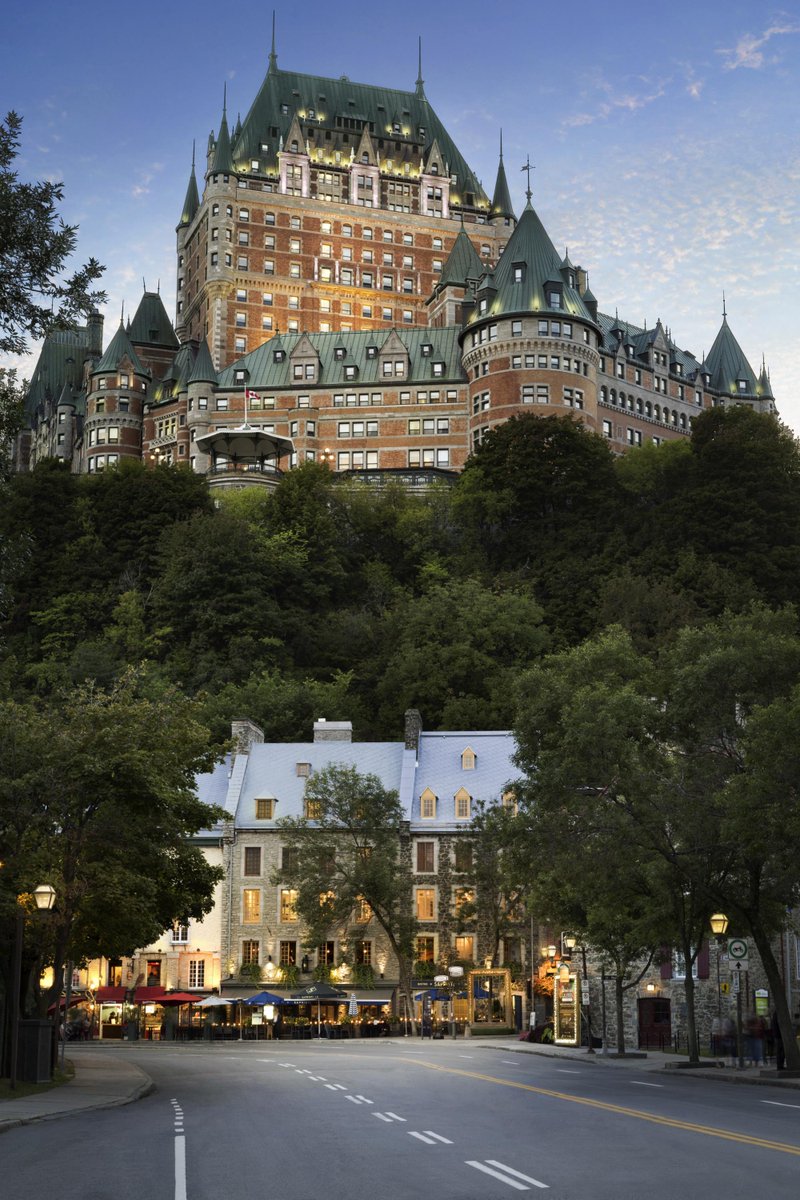
This is the Château Frontenac in Quebec, towering more than 130 metres above the city streets below and inspired by the castles of Medieval France.
But style alone isn't what makes it so impressive.
Architecture isn't just about what you build — it's also about where you build.
There's no single way to design a beautiful building or city, but there is one surefire way to make an individual building or whole town more interesting. And that is by designing it around the local environment: a river, valley, rockface, forest, or some other prominent feature.
Venice is built on one hundred islands in a shallow lagoon and Mont Saint-Michel on a tidal island. Regardless of the style or age of their architecture, it is partly their location and how they have adapted that makes them innately *interesting* to us.
For most of history it wasn't an aesthetic choice to build in "interesting" locations, but a necessity. Bagnoregio in Italy, Constantine in Algeria, Castellfollit de la Roca in Spain, Ganvie in Benin, Al Hajarayn in Yemen, Petra in Jordan... the list goes on. All of these towns were built out of necessity, whether defensive, because it was the only source of water, the only available land for construction, in the interests of seclusion, or proximity to the coast.
People say modern architecture is boring, and that may well be true, but this is at least in part because it is usually used to build cities of repetitive, identical structures in incredibly uninteresting locations. Being boring, in such circumstances, is hard to avoid.
So why does adapting buildings and cities to the local environment make them interesting?
Too much of one thing — of anything — is boring. This rule applies to everything: food, music, films... as humans we are inherently drawn to variation, variation being a law of nature. For the natural world is endlessly changeful, filled with minutely differing details and subtle shifts in shape, size, colour, and texture. The canopy of a tree, the ocean, a meadow, the clouds, the tides, the weather — we are accustomed to delight in variation and become bored by monotony.
Whereas a city of identical buildings — regardless of their style — laid out in a uniform pattern will become monotonous, a building or town shaped by local geography engages our natural, inescapable aesthetic preference for that which is varying, unexpected, and different. Up to a point it doesn't even matter what style of architecture you use in such locations; the location itself means that even the most boring buildings can't prevent it from being a fascinating place. Yanjin in China, built along a narrow river gorge and thus known as the world’s narrowest city, is a perfect example of that.
Architecture is about solving problems, but when the conditions that shape our solution are the same, the result will also be the same. And so the beauty of architecture and urban design according to local environmental conditions is that the world itself is a treasury of endless variation. No two places, even within the same region, are identical; every river, hill, forest, plain, and coastline is different. Which means that every time we adapt architecture to the idiosyncrasies of local geography we create something necessarily unique — because the conditions of the problem are unique.
All of this is why fantasy and science fiction films usually depict settlements in unusual locations, adapted to striking geographical features. It is, simply, much more interesting, atmospheric, and characterful. Why not apply the same thinking to real life?
It won't solve all the problems of urban design and there are times when it may not be possible, but when we build according to the laws of nature — of variation — by choosing interesting locations and adapting to the environment, the world becomes a much more interesting place.
Which brings us back to the Château Frontenac. It wasn't constructed on a fifty metre-tall hill overlooking Quebec out of defensive necessity; this is a hotel built in 1893. The decision about its location was purely aesthetic. And, over a century later, it seems hard to argue that they didn't make a good choice...
A musical road is a road which when driven over causes a tactile vibration and audible rumbling that can be felt through the wheels and body of the vehicle. This one is in Hungary
[read more: https://t.co/tp5Aavga8K]
[📹 https://t.co/G59MoTL9Nt]
1970: Electronic music composer Wendy Carlos explains the fundamentals of electronic sound using a Moog Synthesiser, and demonstrates some of the techniques employed to adapt Johann Sebastian Bach's compositions for the electronic age.
https://t.co/0BLm7shanT
[📹 BBC: https://t.co/LTXFevpSCq]
#RecordStoreDay 🚨! Madonna will this year release ‘American Life – Mixshow Mix’, an exclusive 8-tracks EP celebrating the album’s 20th anniversary and honoring the life and work of Peter Rauhofer!
Read the full story: https://t.co/tS81cnpuGJ
#RSD2023
Andrea Bocelli performing ‘Amazing Grace’ on the steps of the Duomo Cathedral of Milan on Easter Sunday. A city in lockdown, a country on its knees. #MusicForHope
My dear friend Cee Vox needs as much help as possible to raise for her surgery please read anything is welcome. Love you Clara Marens hope everything goes well and you feel better again😘❤️
https://t.co/mzs5m5Xys8 https://t.co/mzs5m5Xys8