Every Monday, Claude posts the paid-media report in Slack before I open my laptop. Spend, ROAS, CPA and the 3 priorities, across 100+ accounts. Comment REPORT and I'll send you the One-Screen Client Report.
The 4-role growth team I'd hire in 2026. Three of them are AI agents.
One human operator owns judgment. The agents own the daily audits, the creative drafts, and the conversion-time reporting.
Five salaries in 2019. One in 2026.
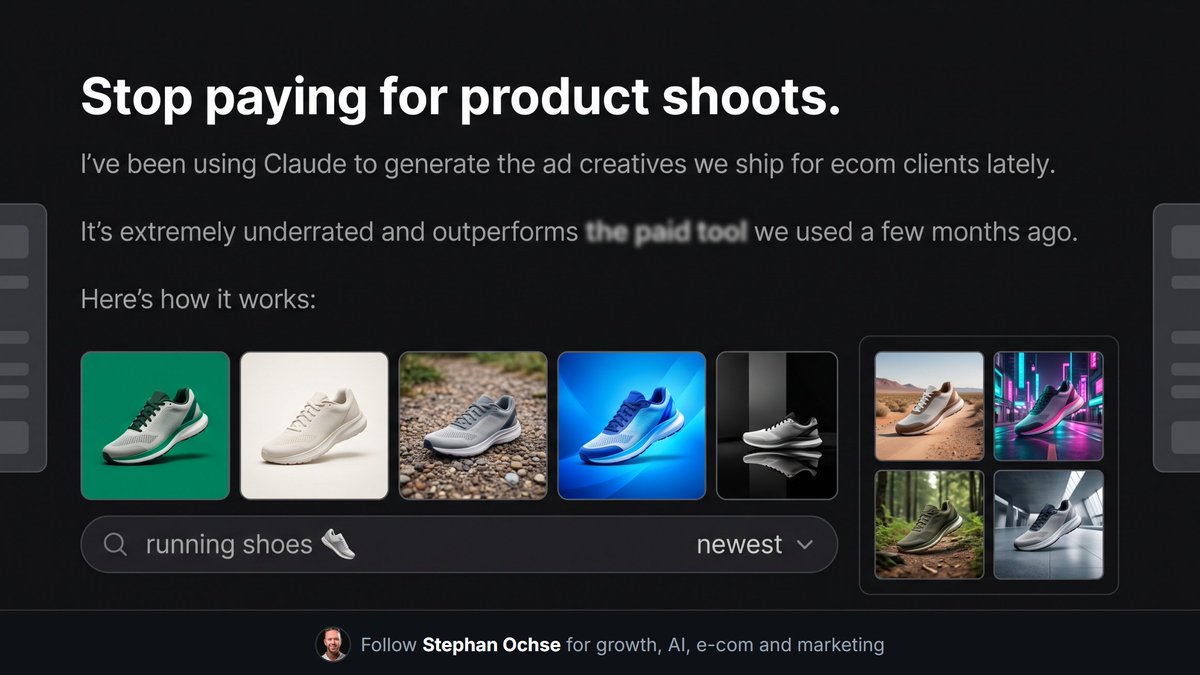
I stopped booking product shoots for ecom ad creative.
Here's what changed: I take one product photo from the client, shot on a phone, no lighting rig, nothing fancy, and run it through Claude with a prompt stack built for paid social creative. Fifteen minutes later I have three ad variations ready to upload.
No photographer. No back-and-forth with a designer.
We've rolled this out across 100+ ecom accounts we manage, spend ranging $300k to $2.5M a year. Creative used to be the slowest part of launching a new angle. Now it's the fastest.
The shift in thinking: Claude isn't good at one narrow task. It's good at almost any task, the second you install the right skill for that job. Ad creative wasn't a photography problem. It was a missing skill.
Install the skill. Skip the shoot.
I built 21 skills for Claude. Now it runs my ad ops across 100+ accounts.
Waste finder. PMax brand excluder. POAS calculator. Dashboard builder. GEO tracker. Landing page teardown.
Most agencies still do this by hand. I built it once and let it run on every account, every week.
Comment SKILL and I'll send the list.
I built a Claude Code skill for every piece of my ad ops job. Half my week runs without me now.
I run Google Ads and Meta across 100+ accounts. I'm not a coder.
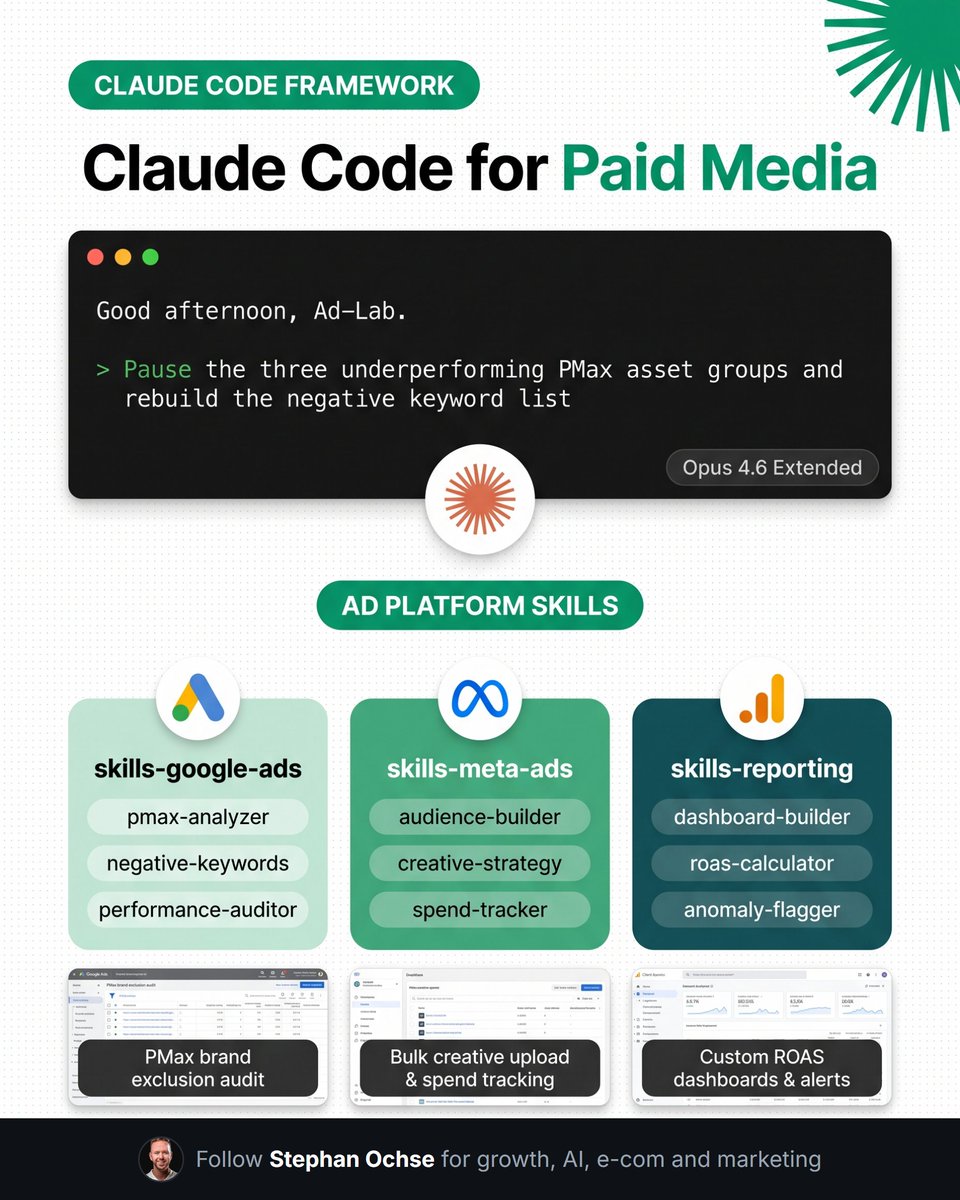
The stack Claude routes through every morning:
→ skills-google-ads: PMax brand exclusion, negative keyword mining
→ skills-meta-ads: audience builds, creative uploads
→ skills-reporting: ROAS dashboards, anomaly alerts
I type the account name and the task into one terminal. Claude picks the right skill and hands back a screenshot to prove the change landed.
The skills don't decide strategy. They kill the two hours I used to spend clicking through three ad platforms to execute what I'd already decided.
Comment SKILL and I'll send you the folder structure.
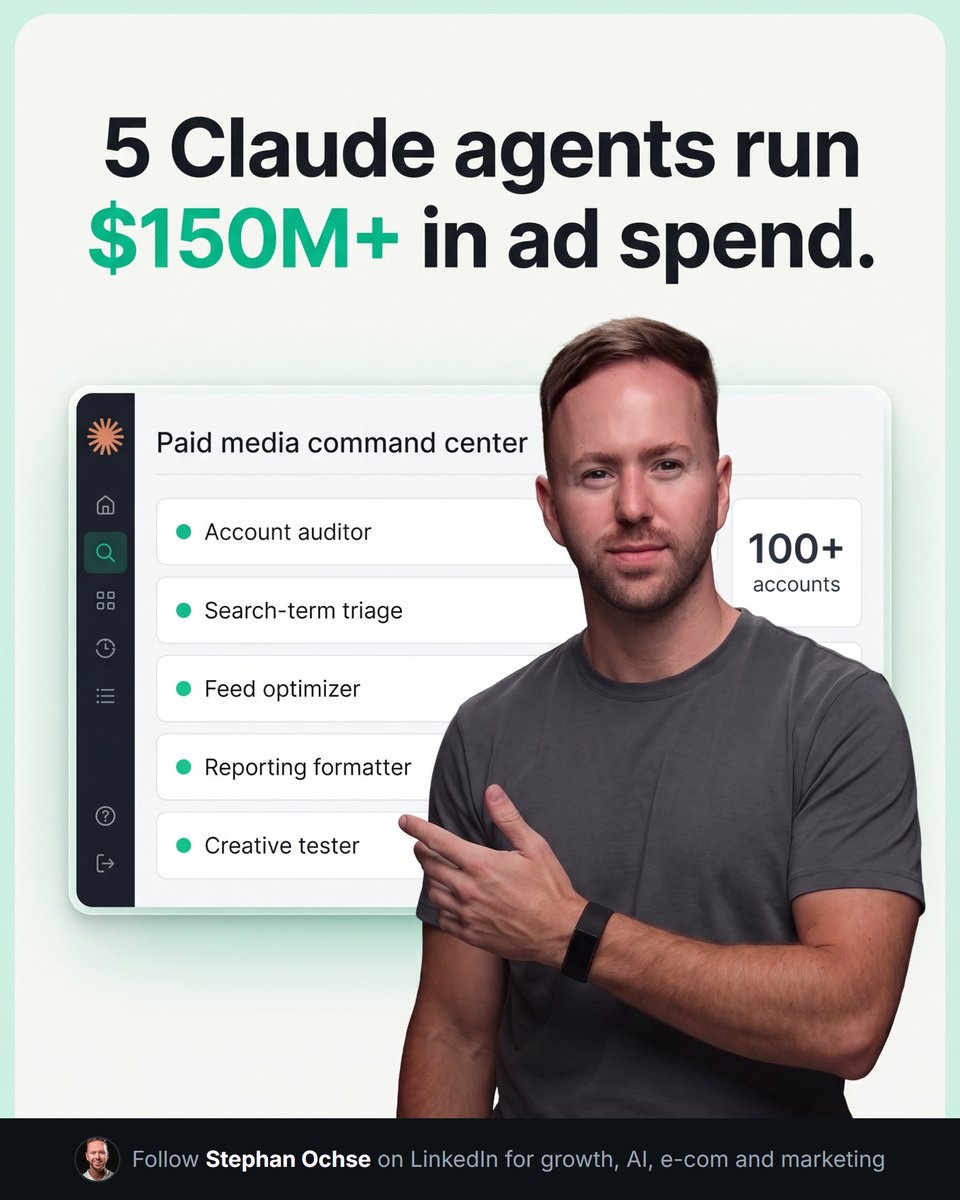
5 Claude agents run the paid media for 100+ accounts.
I'm the operator. They do the grind 👇
Not one prompt. Five agents, each owning a job:
→ Account auditor — 223 checks, runs nightly
→ Search-term triage — the negatives before they burn budget
→ Feed optimizer — disapprovals and dead products, caught
→ Reporting formatter — the weekly report, built and sent
→ Creative tester — every ad ranked by ROAS
$150M+ in yearly spend moves through this. I spend my hours on judgment, not spreadsheets.
Comment SKILL and I'll send you the Claude Audit Prompt Pack.
Anthropic just released Claude Fable 5.
So I built The CMO Guide 2026 with it.
A guide for marketing leaders who want to structure, accelerate, and run their entire marketing function with AI 👇
Because in 2026, the CMO role is changing dramatically.
The best CMOs won't be the ones who use AI occasionally.
They'll be the ones who build real AI-augmented marketing systems.
It's no longer just about managing:
→ Brand strategy
→ Editorial calendars
→ Marketing campaigns
→ Content teams
→ Performance reporting
The real question is:
How do you build an AI-augmented marketing system?
Not to replace your team. To help them move faster, structure ideas better, produce more, catch weak signals earlier, and turn insight into action.
Inside the guide:
→ How the CMO role is evolving with AI
→ Where Claude delivers the most value in marketing
→ How to build a marketing strategy with Claude
→ How to write briefs that don't get redone
→ How to automate the workflows eating your team's week
→ How to accelerate content and campaigns
→ How to measure marketing ROI with AI
→ The mistakes to avoid in 2026
→ The prompts and resources to act on it
Here's the takeaway:
The best CMOs won't be replaced by AI.
They'll be augmented by well - designed AI systems.
And the ones who learn to build those systems first will have an advantage their competitors can't quickly copy.
I documented all of it - practical, structured, and built to act on, not just read.
Want it? It's free:
1️⃣ Comment "CMO" below 💬
2️⃣ DM me "CMO" if we're not connected (comment first)
3️⃣ Like this post 👍
I'll send it this weekend.
♻️ Repost if a marketing leader in your network is still treating AI as a side experiment.
CMOs - where would an AI system help your team most? 👇
#CMO #MarketingLeadership #ClaudeAI #AIStrategy #FutureOfMarketing
I built a Claude skill specifically for PMax feed optimization. First account I ran it on: 340 products, 22 disapprovals nobody had flagged, 14 titles missing the primary keyword, and 8 products with an image that Google's quality check was silently downgrading. Found all of it in 6 minutes.
The skill takes a Merchant Center export, reads the feed structure, and runs 4 checks: disapproval reasons and resolution path, title keyword coverage against the campaign's target terms, image quality signal (resolution, aspect ratio, text overlay), and price/sale price flag for promotional eligibility.
Output is a prioritized fix list with the specific edit needed per product.
On the first account: fixing the 22 disapprovals alone recovered an estimated $4,800/month in impressions that were suppressed.
Like this post, follow and comment FEED and I'll send the Claude skill.
I built a Claude skill specifically for PMax feed optimization. First account I ran it on: 340 products, 22 disapprovals nobody had flagged, 14 titles missing the primary keyword, and 8 products with an image that Google's quality check was silently downgrading. Found all of it in 6 minutes.
The skill takes a Merchant Center export, reads the feed structure, and runs 4 checks: disapproval reasons and resolution path, title keyword coverage against the campaign's target terms, image quality signal (resolution, aspect ratio, text overlay), and price/sale price flag for promotional eligibility.
Output is a prioritized fix list with the specific edit needed per product.
On the first account: fixing the 22 disapprovals alone recovered an estimated $4,800/month in impressions that were suppressed.
Like this post, follow and comment FEED and I'll send the Claude skill.
You don't have a creative problem. You have a landing page that wastes every good click you send it.
This is the most common pattern in DTC. The brand tests creative after creative, finds a winner, scales it, and the account still stalls. Then they blame the ad.
The ad did its job. It got the click. The page lost the sale.
Here's the order that moves CPA. A winning creative gets you a cheaper click. A winning page gets you a cheaper customer. You need both, and the page is the one everyone underinvests in.
What a page has to do in the first screen, before anyone scrolls:
→ Say the one thing the product does, in the customer's words
→ Put the proof above the fold, a number or a real face
→ Make the next step obvious and singular
→ Kill every link that isn't the buy button
We build 5 to 10 pages a month on a scaling account for a reason. Advertorials, listicles, VSL pages. The creative is the hook. The page is where the money gets decided.
Stop iterating only on ads. Build the page that deserves the traffic you're paying for.
Like this post, follow and comment PAGE and I'll send the landing page checklist we build from.
If you only shoot one, make the testimonial. A real customer with a real result, filmed on a phone, beats a studio spot on cold traffic almost every time, and it costs you nothing.
Comment HOOK and I'll send the swipe file.
I've put more than $5 million through YouTube ads in the last six months. Most of it taught me what doesn't work.
Here's the uncomfortable part. You can have surgical targeting, a spotless account, and a product people actually want, and still set money on fire. YouTube doesn't care about any of that. It cares about one question, asked every second: did you earn the next one?
Miss the first three seconds and the other twenty-seven play to an empty room. You already paid for the view. Now you're paying to be ignored.
So I pulled every winner from the last six months and stripped it to the bone. It was never the polished brand film. Three formats did almost all the selling.
→ The hook ad. Opens on the problem before the logo, before the music. On our accounts these hold roughly 40% more viewers past the five-second mark, and that retention is the whole game.
→ The demo ad. One product, one job, shown instead of described. It doesn't convince anyone, it removes the doubt that was stopping the sale.
→ The testimonial ad. A real customer, filmed on a phone, saying the sentence your brand isn't allowed to say about itself. On cold traffic it outsells the $20k studio spot, and it's the cheapest thing you'll make all quarter.
Here's what nobody tells you. In that feed you're not up against other advertisers. You're up against a wedding video, a dog, and someone's ex. Polished and boring loses to all three.
Stop making one beautiful ad and praying. Make these three, run them to the same audience, and let the auction tell you the truth. It's usually not the one you loved in the edit.
Which of the three are you missing right now?
Comment HOOK and I'll send the exact swipe file, the openers, the retention benchmarks, and the three-ad test structure.