please do not greenlight eip8141, if we want pq accounts we can do it another way but eip8141 is just bad about mempool validation rules and will put us into erc7562 land which is terrible
add the validation rules to the eip and examine holistically
eip8141 is a mistake as-is
We’re hosting a major ACP discussion on Thursday, December 18, at 13:30 UTC / 10:30 ET, and you should be there.
@rrazvan1 will break down ACP-236 (continuous staking on the P-Chain), and @iJaack will lead a discussion on his proposal to change the delegation dynamics (ACP-247)
These updates could meaningfully shift validator workflows, economics, and decentralization. We want the whole community in the room!
🚨 P256 (secp256r1) curve precompile is now live on @avax C-Chain! 🚨
Verification of ECDSA signatures over secp256r1 now costs just 6,900 gas. 🔺
This unlocks native compatibility with Apple Secure Enclave, Android Keystore, HSMs, and WebAuthn devices, enabling device-native signing without seed phrases.
Wallets leveraging this precompile can deliver native, effortless onboarding, eliminating one more barrier to mainstream crypto adoption.
https://t.co/fTAmtTGWnZ
@twitt_tr@Keidaten The prior block production mechanism attempted (poorly) to target 2s block times.
Another option could have been to instead set it to the long running average block time (around 1.6s).
I'd love for you to advocate for any such opinions during the ACP calls next time!
ACP-236 introduces continuous staking to the Avalanche Primary Network. Validators can stake their tokens continuously, allowing their stake to compound and accrue rewards over time.
Questions? Post them in the discussion!
https://t.co/aLuuBxaCQa
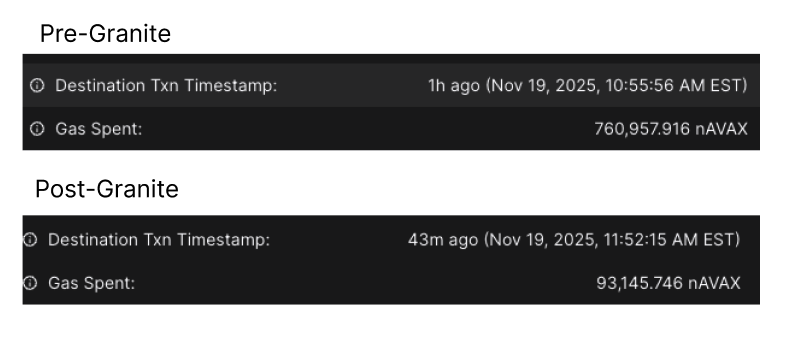
The Mainnet release for the Avalanche Granite upgrade has been published. The Mainnet activation is scheduled for November 19th, 2025 @ 11am ET / 3pm UTC.
All Mainnet node operators must upgrade to v1.14 before the scheduled activation time 👇 https://t.co/gHtC3d6YYD
This is actually a bigger deal than it seems. Proper on-chain privacy has been promised many times before, but none of the previous solutions have been remotely practical due to high gas costs, poor performance, the need for custom wallets, and more. As a result, they mostly stayed as research papers or ended up in clunky implementations.
eERC not only delivers the first truly usable confidentiality protocol on EVM, but also makes it incredibly straightforward to use—so much so that you can now send encrypted meme coins with it.
That’s huge. While others are still hoping institutions will adopt their custom solutions, eERC is already being used by degens on existing platforms.
@CryptoSlowKoala@luigidemeo@0xGasless So the benefit is: Rather than having users make a new smart contract wallet, the L1 provides the ability to convert an existing EOA into a smart contract wallet.
The end result isn’t really meaningfully modified, just the transition?
@EvaderSpace To clarify:
> It uses a new execution model where transactions are streamed to validators in real-time. No batching delays
Transactions are still batched into blocks for sequencing by consensus.
Stealth mode deactivated❗️
📢 Calling all devs for our next community call on 5/16 to discuss ACP-194: Streaming Asynchronous Execution ⚡️
https://t.co/vvHbNQCIPH
@twitt_tr Im not sure I understand your expectations.
It’s pretty hard to make assumptions like this on mainnet with all the different moving pieces of different validators having different mempools.
(Along with potentially different block building algorithms)
@twitt_tr I mean, don’t get me wrong, higher throughput is better.
But, from a system health perspective, extended bursts are not good.
If you disagree, you should definitely write up an ACP to increase the ratio of R/T from ACP-176
@twitt_tr The sliding window could result in “fee momentum.” This meant the price could continue to increase even after the spike in demand had ended.
The new mechanism correctly hits the target usage and correctly moves the fee up/down based on chain demand (unlike the prior mechanism)
@twitt_tr The prior mechanism targeted 1.5Mg/s. The new mechanism is dynamic (but is currently targeting 1.6Mg/s).
The refill rate is currently 3.2Mg/s.
The prior mechanism’s “bursty”ness resulted in significant (rapid) fee increases.