a few points that come to mind this evening, in no particular order:
- Kaspa pre-zk is a sequencing and data-carrying service; there’s no conceptual difference between txn payloads carrying EVM calldata, KRC20 inscriptions or Kasia chat msgs in that regard
- in particular, the above means there’s no settlement on L1; there are no validity proofs or fraud proofs verified. It’s a one-way route: L2s listen to L1 and the data it makes available; L1 has no idea what interpretation L2s give to this data
- hence an L1<>L2 KAS bridge (in this pre-zk era) cannot be fully trustless, no matter the cleverness of its designers
- this does not mean all L2 funds require trust (you can have tokens that live only on the L2; think of it as any other standalone EVM, eg Eth L1)
- in order for this normal L2 operation to be decentralized (other than KAS bridging which must hold some form of trust as mentioned), its codebase must be open-source and independent validators must be able to run it as they wish. I can respect a decision not to immediately open source something you worked on and holds significant IP, but the tradeoff is clear: until the L2 is fully open-source, there is a degree of centralization/trust in anything it executes, and users should be fully aware.
- (btw iirc some Eth rollups were partially closed-source at their respective mainnet launch, though the case is a bit different since they had L1 settlement support)
- I admire Kasplex’s efforts to bring smart contracts to Kaspa asap. If I’m allowed to be somewhat cynical I think tomorrow's launch is a win-win situation. If the launch succeeds it showcases Kaspa’s speed, responsiveness and immense throughput. If it somewhat stutters or has initial problems, they are not inherent to Kaspa and indicate nothing about the core technology and will be fixed in following iterations (or perfected by other entities). I’m not naive and I’m aware that not everyone understands the differentiation between layers, but it’s the simple truth and will eventually rise.
other r&d updates in short:
- dk: being worked on by some dkoders, initial implementation is already taking shape
- vprogs: not only a yellow paper, a rust prototype is wip
Kaspa is about to change the game for smart contracts — without rollups.
Here’s why the new vProgs architecture is one of the most important breakthroughs in L1 design since Bitcoin itself.
🧵👇
1. The problem with today’s smart contracts
Rollups & L2s offer speed and composability — but at a cost:
-Liquidity fragmentation
-Centralized sequencers
-Complex trust assumptions
-Incentives to not interoperate
Kaspa’s goal: keep all of that trustless, on L1.
2. Enter vProgs: Verifiable Programs
Think of each vProg as its own mini zk-VM, living directly on Kaspa’s L1.
It:
-Holds its own accounts & state
-Defines its own execution rules
-Regulates its own performance & costs
-Anchors state updates to L1 via validity proofs
3. Sovereignty + Composability
Each vProg is sovereign — no other program can break it or bloat its state.
But thanks to synchronous composability, vProgs can interact with each other instantly and trustlessly:
-Atomic cross-vProg transactions
-Shared liquidity
-No rollup silos
4. Why this matters
Without native synchronous composability, users and liquidity drift to rollups, because they offer unified execution.
Kaspa’s design brings that same composability directly to L1 — without the trade-offs.
5. How it works
-Transactions declare which accounts they will read/write
-Validity proofs commit state transitions to L1
-Cross-vProg calls carry all necessary witness data
-Proof-based trust ensures no need to “believe” another program’s execution
6. Performance & scalability
-Parallel execution where possible (no global bottlenecks)
-Each vProg manages its own state size & gas model
-No L1 hardware blow-up — keeps node requirements low
-zk-proofs keep scopes small & costs predictable
7. Developer freedom
vProgs are proof-system agnostic — you can bring your own zkVM, constants, and scaling rules.
The system is designed for inclusiveness while preserving security through verifiable standards (zk-SBOM).
8. Timeline
-Yellow Paper: end of this month
-Production-ready testnet: coming right after
-Devs can already join the L1<>L2 channel to prepare
9. Why this is huge for Kaspa
Kaspa isn’t just matching what other chains can do — it’s making L1 the optimal home for high-performance, zk-powered smart contracts.
That means:
-No liquidity fragmentation
-No reliance on centralized operators
-Composable, sovereign contracts at scale
10. Final thought
If Bitcoin was about trustless money, and Ethereum about programmable money,
Kaspa is about trustless, programmable money — at scale, on L1.
Study $KAS.
JUST IN: @chainlink has officially launched the Chainlink Reserve 👀
This economic upgrade creates a strategic LINK reserve funded by onchain & offchain revenue
Institutional adoption → protocol revenue → LINK purchases → Reserve
Here's what this means for $LINK 🧵👇
With $1.1m accumulated in 24 hours, the switch is on for $LINK, here is what this means:
1. Perpetual, protocol backed buy ups
Every dollar of off-chain enterprise revenue and on-chain service fees are automatically swapped into the $LINK token and locked into a multi year reserve.
2. First of its kind, reserve -> accrual model
The functionality of buy-back and burn funded by speculative activity shall be outmatched by ongoing revenue streams systematically getting swapped into the $LINK token.
3. Blue chip enterprise demand fueling growth
Hundreds of millions in revenue have already flowed into Chainlink from leading banking and capital-markets firms alongside cutting-edge DeFi protocols like GMX (which shares 1.2% of its trading fees) and Aave (35% of recaptured MEV fees). As these institutions continue to integrate Chainlink’s oracle, cross-chain, and data-stream services, that steady enterprise spend directly bolsters the on-chain reserve.
4. Compounding utility and tokenomics synergy
Chainlink’s modular services (Price Feeds, CCIP, Automation, Functions, etc.) drive network usage and every usage event can funnel back into LINK via the Reserve. This creates a virtuous cycle: more services -> more fee revenue -> more LINK accumulation -> stronger token economics, reinforcing long-term value.
5. Alignment of incentives across stakeholders
By design, the Reserve benefits every LINK holder, node operator, and staker. As adoption grows, the size of the locked-up pool swells, reducing circulating supply pressure and signaling to the market that real-world demand is underpinning price support. This kind of transparent, revenue-backed alignment simply doesn’t exist with any other oracle or “used token” in crypto.
We're excited to announce the launch of the Chainlink Reserve, a new upgrade centered on the creation of a strategic onchain reserve of LINK tokens.
https://t.co/Fgib8zR9uj
The Chainlink Reserve is designed to support the long-term growth and sustainability of the Chainlink Network by accumulating LINK tokens using offchain revenue from large enterprises that are adopting the Chainlink standard and from onchain service usage.
The Chainlink Reserve is being built up by using Payment Abstraction to convert offchain and onchain revenue into LINK, using a combination of Chainlink services and decentralized exchange infrastructure.
Demand for Chainlink has already created hundreds of millions of dollars in revenue, substantially from large enterprises that have paid offchain for access to the Chainlink Platform.
With increasing demand from a number of the world’s largest banking and capital markets institutions, this form of paying for the Chainlink standard is expected to grow into the future as the industry grows.
The Reserve has already accumulated over $1M worth of LINK from this early stage launch phase, which is expected to gradually grow in the coming months as more revenue is converted into LINK and placed into the Reserve.
We do not expect any withdrawals from the Reserve for multiple years and thus it is expected to grow over time. We believe that as the industry demand for Chainlink’s unique capabilities increases, that adoption of Chainlink services will enable the Reserve to grow further.
🧵👇
$Link isn’t a prediction anymore its going to be the rails for SWIFT,DTCC, and Fedwire and so much more but let's keep it simple for now
You want real $LINK price models?
Let’s talk fees,staking, collateral—
and why LINK is a one-way train to financial god mode
🧵👇
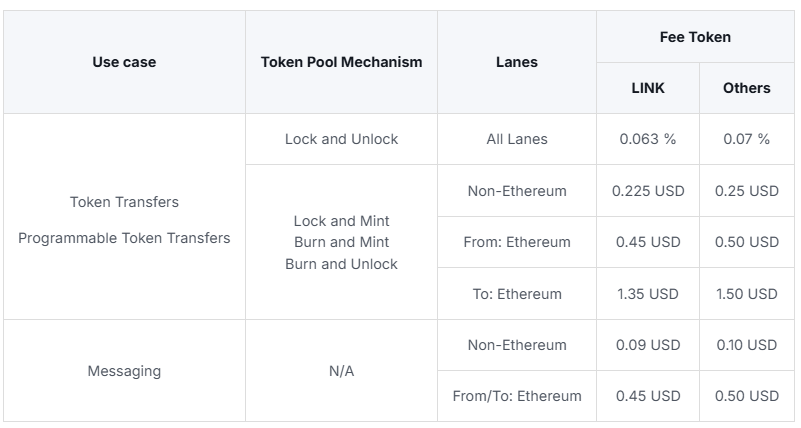
Fees used*