A bird house with a solar powered camera inside was installed at the Historic Cemetery in Easton, Pennsylvania.
Here's what happened next.
[📹 historiceastoncemetery]
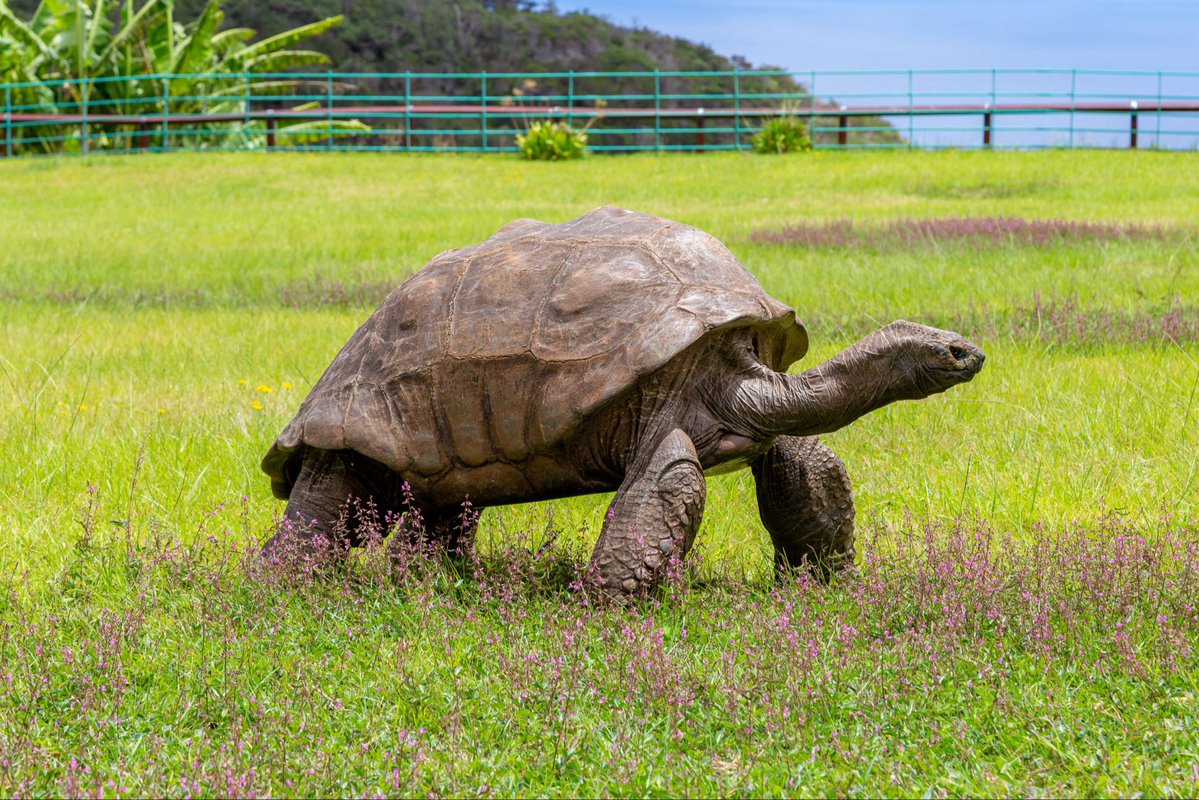
🚨 This tortoise was born before the first photograph of a human face was ever taken.
He watched the entire industrial revolution happen. He was already middle aged when electricity became a household concept.
Every person who has ever driven a car, flown in a plane, or used a telephone was born and died while Jonathan kept eating grass on the island of Saint Helena.
The biological reason he’s still alive is arguably more disturbing than the timeline. Tortoises like Jonathan don’t age the way mammals do. Their cells show almost zero increase in mortality rate as years pass. A 150 year old tortoise has roughly the same statistical chance of dying in a given year as a 50 year old one. Scientists call this “negligible senescence” and it essentially means his body forgot to receive the memo that aging leads to death.
His telomeres, the protective caps on chromosomes that fray and shorten in humans with each cell division, degrade at a rate so slow it barely registers. While your body is actively dismantling itself through the oxidative stress of simply breathing and metabolizing, Jonathan’s metabolic rate runs so low his cells accumulate almost no damage across decades.
He is not surviving despite time. His biology treats time as largely irrelevant.
Jonathan has outlived every single human who was alive when he was born. Every philosopher, tyrant, artist, and revolutionary from his birth year is dust. He shared the planet with Napoleon. He is still here.
The oldest verified human ever lived to 122. Jonathan is 194.
He has now lived longer than our entire concept of a long human life, twice over.
Truth Starterpack:
• 𝕏 — real-time global conversation
• Grok — instant analysis & context
• Grokipedia — AI-native knowledge base
• Primary sources
• Critical thinking
Signal over noise.
This is the best thing you'll read today
Known as the “Hermitage cats,” these felines have roamed the Hermitage Museum in Saint Petersburg for centuries, tasked with guarding the priceless artworks from rodents.
The tradition began in the 18th century, when cats were brought to the Winter Palace to protect the walls and paintings from rats and mice.
Today, the cats remain an essential presence at the museum. Once free to roam the galleries, they now make their home in the basement, emerging in the summer to lounge on the embankment and wander through the square.
They have a press secretary, three dedicated caretakers, and a head of the “cat department,” Irina Popovets, who famously declared that the cats are “as well-known as our collections.”
Classical Music Changes Your Brain—Here’s How
Doctors are discovering classical music can reduce seizures and help with dementia.
Simply hearing it can alter the brain.
And when classical musicians undergo brain scans, something remarkable shows up.👇
https://t.co/4bWu37aT9V