Likely unpopular opinion: All git diagrams might be drawn wrong -- commit as node and repo content as edge is lossy, maybe misleading.
A more useful representation appears to be commit as a hyperedge -- the parent commits and the previous repo content are all hypertails. 1/3
I'm working on a paper right now that might use this model. It's so far turning out to be useful for generalizing what git (and decentralized computing) actually is. 3/3
The commit message itself, then, is the event that triggers the graph transition. Tree content is a location in an n-dimensional space, and filenames are axis names in that space, with file content being the n-coordinate's location on that axis. 2/3
@MatthewCroughan I wish I could say yes -- I have a full schedule this fall and am still paying attention to https://t.co/0vEk5jejqO as well. Missing the days when remote conferences were a thing.
@judge2020_@SwiftOnSecurity If your competitor's prices rise, then you are certainly not going to lower your own. You are going to take the opportunity to raise your own somewhat, particularly if you see increased demand. Eliminating competition leads to higher prices, not lower.
@Grady_Booch (1) This is a restatement of Searle's argument, and depends on the definition of the word "understand". The argument simplifies down to proof by assertion.
(2) UML, like any model, is imperfect, and yet it still gets useful work done.
@rakyll Yep. The decades-long trend is that code gets cheaper while stack and dev capabilities grow over time. I'm now continually using my LLM-backed tools to evolve newer LLM-backed tools, then using those tools to solve problems that would have been intractable a couple of years ago.
If the OpenAI board had used GPT-4 to game things out, they would have seen that growing market footprint is how they set safety standards. They aren't the "IETF of AI" -- that would have needed OpenAI to be a decentralized, open system from the start.
@adamhjk Still thinking. It's likely important that, if there's an RFC-like mechanism, that it be separate from any code base. Projects that put the reference code in the same repo will tend to have more of the same sort of conflict that an RFC-like process intends to avoid.
@adamhjk The original project leadership might then want to maintain another level of abstraction; making it easy for those forks to feed back upstream as well, not just in terms of tooling but maintaining an open culture, architecture, process, etc. Brings to mind things like the RFCs.
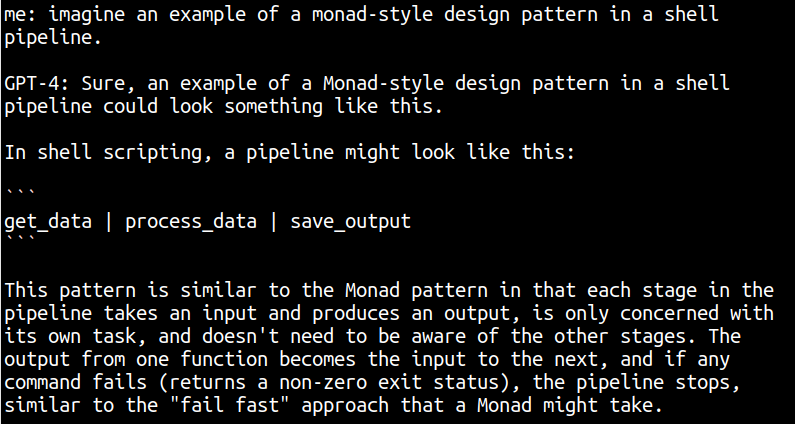
I know that phrase "Haskell marketing-speak" is harsh. But that impenetrable gobbledegook persists in GPT-4 because it's all over the Internet: Monads described in a self-referential void, drawing from no concepts of UNIX or anything else. It's no wonder folks don't get them.
After years of tilting at the Haskell windmill and a long conversation with GPT-4, I'm starting to get a horrifying realization that Haskell's idea of a monad can be understood and implemented using basic UNIX concepts: pipes and filters, 'make', even 'bash -e'.
Sigh.