I'm a cardiologist. Something just happened today that I genuinely did not see coming — and it could change the future of preventive medicine more than anything I've written about on this platform.
Midjourney — the AI company that became famous for generating images from text prompts — just announced a medical hardware division and unveiled a working prototype of a full-body scanner unlike anything that's ever existed.
It's called the Midjourney Scanner. And it works like this.
You step into a shallow pool of water. You stand on a platform that slowly descends — about two inches per second — through a ring containing roughly half a million tiny ultrasonic transducers, each the size of a grain of sand. Every one of them acts as both a speaker and a microphone, sending ultrasonic waves through your body from every angle and recording what comes back.
60 seconds later, you step out. The scan is done.
No radiation. No magnets. No claustrophobia. No IV contrast. Just sound, water, and an almost incomprehensible amount of computing power — roughly 2 petaflops processing 17 gigabytes per second of raw acoustic data — reconstructing a 3D map of your entire internal anatomy down to half a millimeter resolution.
Organs. Tissues. Blood vessels. Bones. Muscle. Fat distribution. All segmented by AI in real time.
As a cardiologist who has spent months writing about how the standard screening playbook misses the majority of future heart attacks — this is the technology I've been waiting for without knowing it existed.
Here's why this matters for the future of your heart.
Right now, getting a detailed look inside your cardiovascular system requires either a CT scan (radiation), an MRI (magnets, claustrophobia, 45-60 minutes, $1,000+), or a coronary CT angiogram (radiation, IV contrast, limited availability). These are powerful tools. I order them regularly and they save lives.
But they're reactive. You get them when something is already suspected. They're expensive. They're uncomfortable. And for most people, they happen once — maybe twice — in a lifetime.
Imagine instead: a 60-second scan with no radiation that you could repeat monthly or quarterly. Tracking cardiac structure over time. Watching body composition shift. Detecting changes in organ size, fluid distribution, or vascular architecture before symptoms ever develop. Building a longitudinal dataset of YOUR body that AI can analyze for patterns no single snapshot would reveal.
That's what Midjourney is building toward.
The company plans 50,000 scanners worldwide over six years, with capacity for a billion scans per month. The first location — the "Midjourney Spa" in San Francisco — opens at the end of 2027 with 10 scanners alongside saunas, cold plunges, and a gym. The scan costs a few dollars. The experience is designed to feel like wellness, not medicine.
The technology is built on Butterfly Network's ultrasound-on-chip platform — 40 modules per scanner — combined with Midjourney's own AI segmentation and reconstruction stack. David Holz, the founder, claims the system aims for image quality comparable to MRI in many aspects but at nearly 100x the speed with zero radiation.
Now the caveats — because I'm a physician and the caveats matter enormously.
This is a Gen 1 prototype. About a dozen people have been scanned so far. Current scan time is actually closer to 20 minutes, not 60 seconds — the system is bottlenecked by bandwidth and reconstruction algorithms. The 60-second target is aspirational for future hardware generations.
It is not FDA-cleared for diagnostic use. Midjourney is starting with body composition maps — a category below diagnostic imaging in the regulatory hierarchy. The path from "beautiful 3D body scans" to "clinically validated diagnostic tool that your cardiologist can act on" runs through years of clinical trials, comparative studies against MRI and CT gold standards, and FDA review.
No independent clinical validation has been published. The imaging claims come from Midjourney's own demonstrations. Comparative data against established modalities does not yet exist.
And the privacy implications of full-body internal scans at planetary scale — a billion scans per month — is a conversation that hasn't even started yet.
So I want to be precise. This is not ready for clinical medicine today. It may not be ready for years. Many ambitious medical hardware projects have failed in the gap between prototype and product.
But.
The fact that a working prototype exists — producing real segmented 3D anatomy from sound waves and compute alone — means the physics works. The engineering works. The question is no longer "is this possible" but "how fast can it be validated and scaled."
And if it is validated — if the resolution holds up against MRI, if the AI segmentation proves reliable, if the regulatory path clears — then what we're looking at is the most significant new imaging modality in 50 years.
For my entire career, preventive cardiology has been limited by the fact that seeing inside the body is expensive, slow, uncomfortable, and infrequent. We catch disease late because we image rarely. We image rarely because imaging is hard.
A 60-second, no-radiation, spa-based full-body scan that costs a few dollars would demolish every one of those barriers.
I've written about AI detecting inflamed arteries. About gene editing curing cholesterol. About GLP-1 drugs rewriting metabolic medicine. About cellular reprogramming reversing aging.
This is the missing piece: the ability to see inside every human body, routinely, safely, and affordably — so all of those interventions can be deployed before the disease arrives instead of after.
The company that taught AI to generate images from imagination just built a machine that generates images from the human body.
The future of medicine showed up today from the last place anyone expected.
In the last 6 months at @Ahrefs, we analyzed over 1 billion data points across 14 studies. Here's what we learned about AI search optimization:
1) "Best X" blog listicles are the single most prominent content format cited by AI chatbots. They make up 43.8% of all page types cited by ChatGPT specifically.
2) 67% of ChatGPT's top 1,000 citations come from sources marketers can't influence: Wikipedia (29.7%), homepages (23.8%), app stores (6.6%). Only 32.3% are influenceable content like educational pages, reviews, news, and blog posts.
3) 28.3% of ChatGPT's most-cited pages have zero Google organic visibility. These pages get cited repeatedly by ChatGPT despite not ranking in Google at all. A completely separate discovery layer.
4) ChatGPT only cites about 50% of the URLs it retrieves. It fetches dozens of pages per query but uses half as background context without attribution. This means that being retrieved and being cited are very different things.
5) Adding schema markup had zero meaningful impact on AI citations. AI Overviews actually dipped −4.6%, while AI Mode (+2.4%) and ChatGPT (+2.2%) showed changes indistinguishable from zero.
6) YouTube mentions have the highest correlation (0.737) with AI brand visibility out of all the factors we studied (including all the conventional SEO metrics like backlinks, page count, DR, etc). This held true for both Google-owned and OpenAI products.
7) AI Overviews reduce clicks to the #1 result by 58%. That’s up from 34.5% just 10 months earlier. The trend is accelerating.
8) 99.9% of AI Overviews appear on informational intent queries. Transactional, navigational, and local searches are almost entirely AIO-free. Shopping triggers AIOs just 3.2% of the time.
9) For a given search query, Google’s AI Mode and AI Overviews reach the same conclusions 86% of the time — but cite almost entirely different sources (only 13.7% citation overlap).
10) AI Overviews change every 2.15 days on average, with 70% of content differing between consecutive observations. But semantic similarity stays at 0.95. The words, sources, and entities constantly shuffle, but the actual meaning barely moves.
This guy literally hacked Polymarket with a hair dryer 💀
Happened in Paris.
On Polymarket, temperature bets were settled using a single sensor near Charles de Gaulle Airport.
He figured out the exact location, showed up in person, and placed a bet on an “impossible” outcome 22°C when the market expected 18°C.
Then he pulled out a hair dryer and heated the sensor.
The artificial spike got recorded as the daily high → market settled → he cashed out.
Did it twice.
Walked away with ~$34K.
While everyone’s arguing over indicators and alpha, this guy is out here doing IRL market manipulation.
I am the Chief Marketing Officer of an AI company that spent $8 million on a Super Bowl ad last night.
The ad was 30 seconds long.
It featured a child. The child asked our AI a question about the stars.
Our AI answered beautifully.
The spot tested well in focus groups.
The creative team won an internal award.
We generated 40,000 renders to find one where the AI didn't hallucinate.
The approved cut was take 39,847.
The child in the ad is not a real user.
The answer about the stars is not a real answer.
The entire commercial is a proof of concept for a product we have not shipped.
By halftime, the audience hated us.
Not just us. All of us. Every AI company that bought a spot.
Sports Illustrated reported fans were "vocally fed up" before the first quarter ended. A Harris poll conducted before the game found consumers already felt "mostly negative" about AI advertising.
We knew this. The poll was published Friday. We bought the ad in September.
I watched the game from a hospitality suite with eleven other CMOs. We had a real-time sentiment dashboard on a monitor next to the bar. By the second quarter, the needle was in the red.
Someone from our analytics team Slacked: "Audience is associating us with the Svedka ad."
The Svedka ad was an AI-generated fever dream of two dancing androids that looked like what happens when you ask a machine to render human desire without ever having experienced it. Critics called it "warm slop." We were being grouped with the warm slop.
Twenty-three percent of all Super Bowl ads were AI or tech companies, according to iSpot. More AI ads than beer ads. More AI ads than food ads. We looked at each other across the suite and realized we had made the same mistake simultaneously. We had all bought the same thirty seconds of American attention and said the same thing into it.
I watched Ring's ad from that suite. Ring built a network of millions of AI-equipped doorbell cameras pointed at American front doors. They pitched it as a lost-pet finder.
The ad said: "We built a surveillance panopticon and pointed it at your neighbors' homes, and now we're teaching it to recognize faces, but look -- a puppy." They did not use those words. They did not need to.
The audience heard it anyway. Ring accidentally described its own business model in the most damning terms possible and then asked people to feel good about it.
I watched AI[.]com's ad from that suite. Nobody in the room understood it. The domain was purchased for $70 million by the CEO of Crypto[.]com. The website crashed immediately after the ad aired, because millions of people tried to find out what they had just watched and found nothing. Seventy million dollars for a URL that could not survive its own commercial.
I watched Anthropic mock OpenAI, and then watched Sam Altman call them dishonest, and then watched two companies valued at a combined $1.35 trillion spend the rest of the evening calling each other liars on X.
Someone in the suite said: "At least we didn't do that."
I said: "We spent $8 million to say the same thing they said, and nobody noticed."
I am not sure which is worse.
By the fourth quarter, the collateral damage had started. Viewers became so hypervigilant about AI that they started accusing non-AI ads of being AI-generated. Dunkin' Donuts. Comcast. Ads made by humans, by production crews, by directors with cameras and craft services -- called fake because two hours of AI advertising had conditioned 130 million people to distrust everything on their screen.
Our industry spent $100 million on Super Bowl ads to build trust in AI.
We built the opposite.
I need to tell you about a parallel that nobody in that hospitality suite mentioned, although every person in the room was old enough to remember it.
Super Bowl XXXVI. February 2022. Crypto firms bought the ad breaks. Coinbase. FTX. Crypto[.]com. They spent $54 million collectively. The ads were flashy and confident and told 100 million Americans that the future was decentralized and inevitable and worth their money.
FTX collapsed ten months later.
Coinbase spent the following year in court.
Crypto[.]com's CEO is now spending $70 million on AI domain names.
We spent more than double what crypto spent. I know this because Tech Brew calculated it this morning and my VP of Communications forwarded it to me with no comment. She always adds a comment. The absence was the comment.
Here is what I know that I am not supposed to say.
The Super Bowl is a lagging indicator of industry health.
A lagging indicator means the peak has already happened. It means the industry already believes in itself more than the public does. It means the money has been spent, the bets have been placed, and the audience -- the 130 million people you needed to convince -- sat through your pitch and felt nothing but annoyance.
I spent $8 million to learn something that a Harris poll could have told me for free.
Nobody wants what we are selling. Not like this. Not yet. Maybe not ever. But "maybe not ever" is not a phrase that survives a board meeting, so we say "not yet" and buy another ad.
The earnings call is in six weeks. When the analyst asks about brand strategy, I will say the word "awareness" and the word "consideration" and the word "momentum."
I will not say "warm slop."
I will not say "lagging indicator."
I will not mention FTX.
I will not tell them about the sentiment dashboard, or the Slack message, or the eleven CMOs in the suite who watched the needle go red and poured another drink.
We will do this again next year.
The budget is already approved.
The budget keeps going up and to the right.
I built a database of 120 failed Web3 startups.
> 120 dead projects
> $85 billions gone
> Study the dead Projects
Projects like:
> FTX
> Luna
> Celsius
Each one has:
• What went wrong
• Why it failed
• Ideas for builders
All in one place.
Let's go 🧵↓
If you're on CT, you've seen the growing negative sentiment towards the X algo.
Unfortunately, any platform whose business model revolves around ad dollars will ultimately fall down this trap.
They don't get paid when you find value in something. They get paid when you engage with something.
This produces and incentivizes very different content.
To stop the slaughter of slop, we need to change the fundamental relationship between the product and its users.
Value > Attention
Upside doesn't solve this yet, but it's our goal for 2026.
Show people what they value, now what Elon or Nikita thinks you should see.
Hollywood is cooked.
A single ai artist just dropped a 7 minute film made 100% with ai tools and it went viral on Chinese social media in a week.
The film explores the idea that our world might be a simulation. Built with Nano Banana, Veo3 and Runway, music by Suno.
The era of the one person production studio is already here. and it cost ~0.001% of a Hollywood production.
hot take
you absolutely don't need to launch a token
what you actually need is:
- product-market fit
- real users
- better ui/ux
- problem worth solving
tokens don't create value, they capture it. if there's nothing to capture, your token is worthless
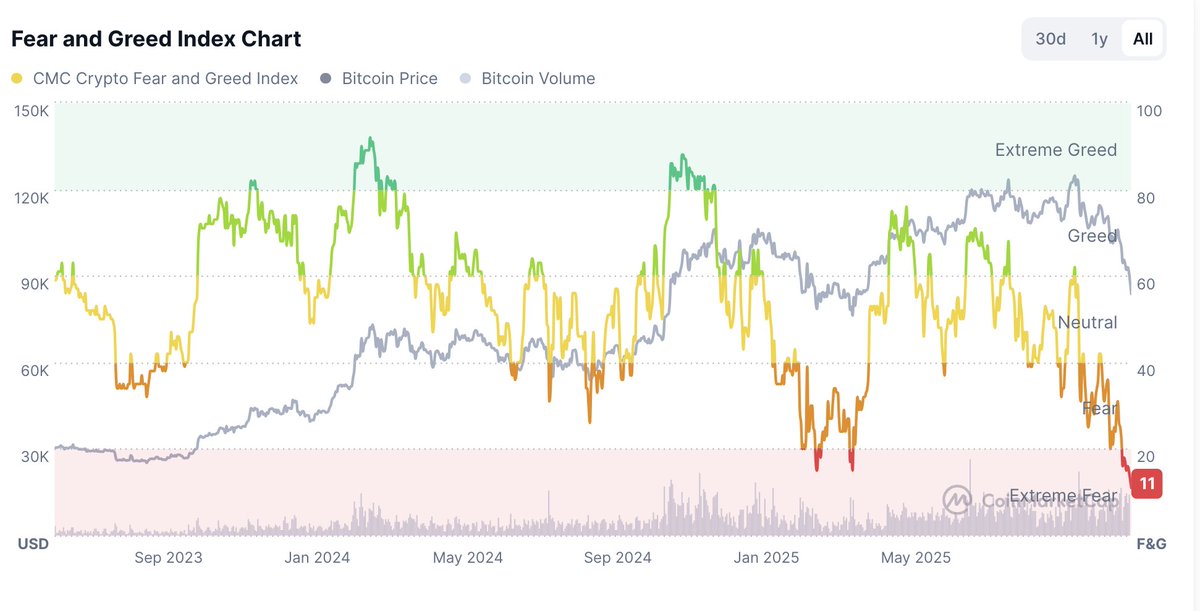
If you had a bot that simply bought BTC and ETH at times of extreme fear and sold at times of extreme greed with the goal of increasing your BTC and ETH stack over decades you could ignore 99% of the trading advice on this app and logoff
her: what are you thinking about
me thinking about how during the 10/10 crypto liquidation event some mysterious wallet got funded with 80-160 million USDC right before Trump's tariff post on China and then opened over a billion in shorts on BTC and ETH with perfect timing down to the minute and closed them at the exact bottom for 160-200 million profit which is impossible without insider info from Trump's circle since his family holds billions in WLFI tokens that dipped 25-30% but they bought back 1.4 million worth right after like they knew it was a setup to clean out leverage and then Binance and Bybit suddenly had "technical issues" freezing orders so traders couldn't close positions or buy the dip while the short whale executed flawlessly and at the same time oracles misfired prices causing stablecoins like USDE to de-peg to 0.65 only on Binance which triggered a cascade of unfair liquidations wiping 1.6 million accounts and 19-40 billion total but insurance funds barely budged and ADL kicked in clipping winners unevenly and market makers like Wintermute moved 700 million including 200 million BTC to Binance hours before like they were prepping the harvest and then data sites like Coinglass got hacked so no one could see the real numbers in real time and exchanges admitted to "system congestion" rejecting close orders with error codes -4118 -2022 -1008 while liquidations ran perfectly against retail and some positions got nuked 25x over even with low leverage because collateral was marked at bogus prints and then rumors spread of two massive trading firms going to zero forced to dump their entire top-100 token books in a fire sale amplifying the altcoin bloodbath down 50-80% in minutes and meanwhile the Chinese Loot Theory fits because Asia was sidelined all year by US narratives like ETFs that got delayed by the government shutdown so CZ launches Aster dex luring billions in OI from noobs right before Xi provokes Trump knowing it'd tank everything and loot the overleveraged longs waiting for SOL XRP DOGE ETFs that never came and then post-crash an invisible predator like a wounded whale or carcinogenic market maker keeps dumping majors into their own shorts suppressing recovery while crypto decouples from rising stocks just like FTX Alameda in 2022 dragging on for months disguised as a bear market and Binance might've orchestrated the whole thing by exploiting their own oracle vulnerabilities to de-peg USDE and cause the cascade specifically to take out Hyperliquid as a competitor but it backfired and now they're reviewing cases case-by-case promising comps benchmarked to midnight but only for that tiny depeg window ignoring the broader manipulation and the awful human cost of traders committing suicide the next day alongside hundreds of portfolios erased including funds that won't admit it publicly and the real winners were a handful of entities pocketing billions in zero-sum derivs while retail became collateral damage in a quiet war between giants and regulators never probe because it's all "just volatility" not negligence or coordination and the market's still acting weird with thin books and artificial pressure like someone's unwinding massive losses by selling non-existing BTC MtGox-style and no full logs or transparency ever gets published so it all smells like a highly coordinated harvest not a market event lmao what the fuck:
nothing babe
-38% on ETH from the top so far
last cycle after breaking successive ATHs, we saw drawdowns (and recoveries after each one) of:
-37% in February '21
-23% in April '21
-60% in May-July '21,
-34% in September '21
each one was an existential crisis
maybe this is the start of the multi-year bear, or maybe people forgot what bull markets feel like
balancer went through 10+ audits. the vault was audited 3 separate times by different firms
still got hacked for $110M
this space needs to accept that 'audited by X' means almost nothing. code is hard, defi is harder
it is unfortunate but hope the team recovers