The Goat Problem in Space Mission Design
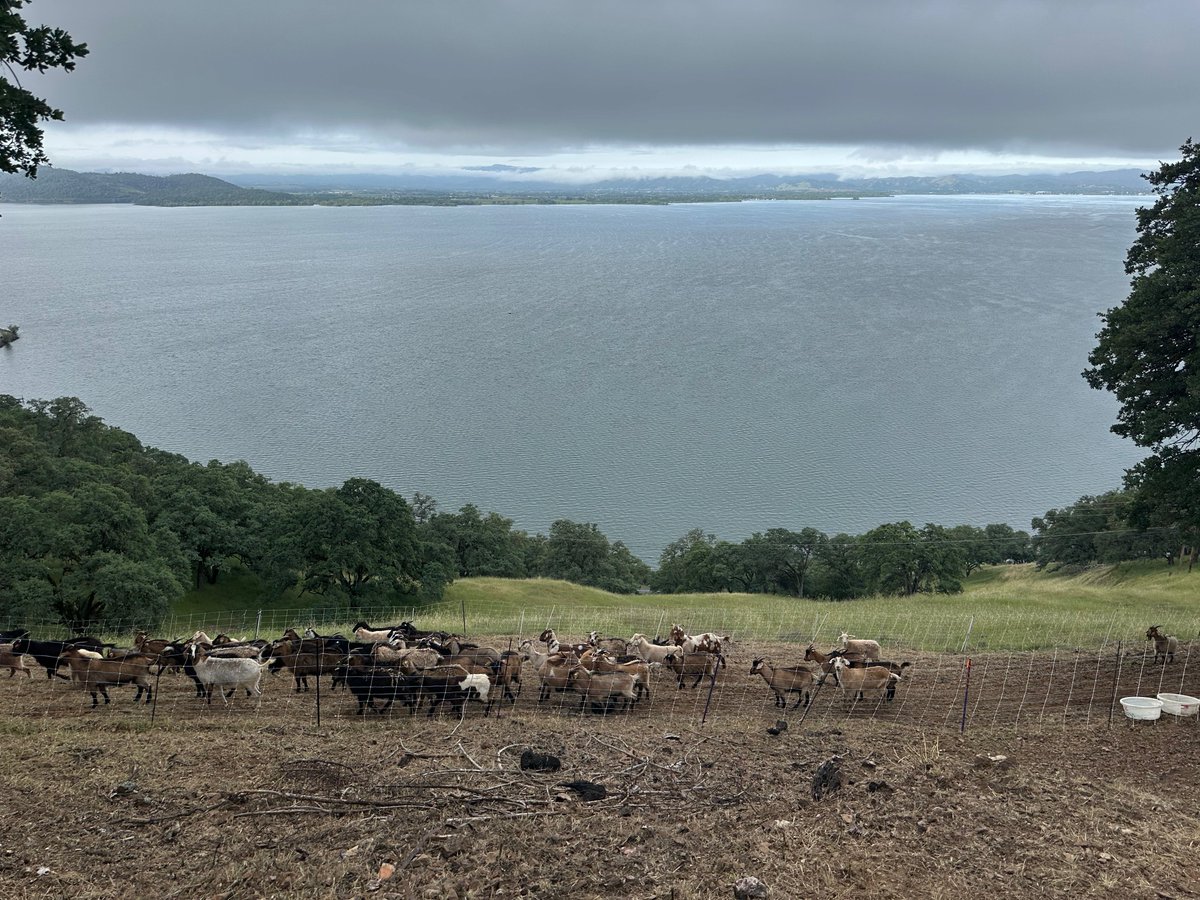
Sometimes the best solution isn't high-tech. Last month, I hired 71 goats to clear a firebreak on a steep slope. Robotic mowers couldn't handle the terrain. Human crews were too expensive and the slope risk was too great a fall hazard. The goats? Perfect solution in a week. This is exactly how we should think about space missions. We obsess over cutting-edge technology when simpler solutions exist: • Gravity and aeroassists instead of massive propulsion systems • Passive thermal cycling instead of complex active systems • Avionics and on-board compute power sized to what is needed • Local resource utilization instead of shipping everything from Earth • Science and exploration measurements extracted from the noise in data instead of being thrown away My favorite example: Mars Pathfinder's and the two Mars Exploration Rover missions airbag landing systems. Not elegant. Not sophisticated. Just beach balls bouncing across Mars. Low cost. Success rate: 100%. The lesson from aerospace to any complex challenge: Push the boundaries of your trade space. The optimal solution might be eating grass on a hillside, not the latest AI-powered system. What's your "goat solution" - the surprisingly simple fix that outperformed the complex alternative?
Moon landing = Mars orbit ?
Did you know that the ∆V required to land on the Moon from lunar orbit is the same as reaching Low Mars Orbit propulsively from hyperbolic approach?
∆V to Land on the Moon: 1.7 – 2.1 km/s
∆V for Low Mars Orbit: 1.4 – 2.1 km/s
Why should I care?
Systems designed for lunar landing can be modified for Mars in the near future. This could greatly reduce cost and increase how often we send missions and payloads to Mars!
https://t.co/GhiZcOQBV1
NASA’s #MissionToPsyche – on its way to explore a rare, metal-rich asteroid – is about to get a speed boost from Mars. 🚀🏁
On May 15, spacecraft will harness the Red Planet’s gravitational pull as a slingshot to increase its speed and adjust its trajectory. 1/2
From the ongoing space mission architecture and design series:
There are three* types of aeroassist in planetary exploration. You do need an atmosphere, even one that is 1% of Earth's like Mars, to pull this off.
1) Aerobraking. Used first with Magellan at Venus to lower the orbit without using much propellant. Also used in Mars Global Surveyor and Mars Odyssey orbiters. Uses many repeated hypersonic passes in the very upper atmosphere to reduce energy and lower an orbit without using much propellant. Useful to save propellant when you absolutely must.
2) Aerocapture. One hypersonic pass deeper than aerobraking through the atmosphere to greatly reduce energy and lower the orbit. Requires an additional maneuver after the atmosphere pass to prevent going back in the atmosphere catastrophically. Not yet tried for planetary exploration. It should be tried, in my opinion, to realize the benefits for future science and exploration.
3) Aerogravity assist. Hypersonic atmosphere passage with lift and large gravity turn "bend" for a gravity assist not possible other ways. Can greatly reduce flight times to the outer planets.
* - Landing on a surface with an atmosphere is also an aeroassist. This type of aeroassist is very similar to aerocapture except that the vehicle does not go into orbit and continues to reduce energy all the way to the surface.
https://t.co/UodGqbPkRn
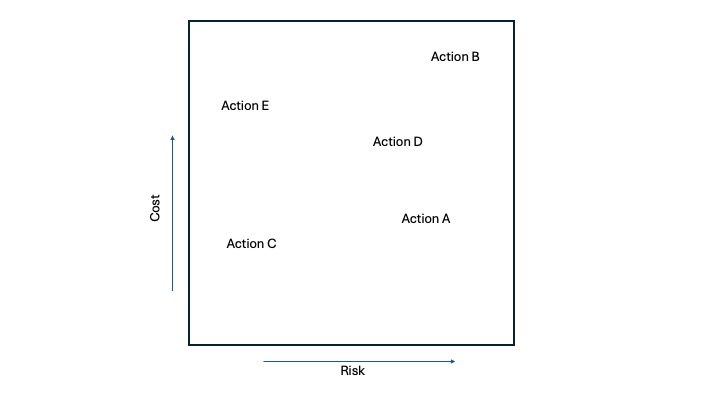
Sometimes high performing teams will reach a point where the choices of concept, action, component, ... are nearly equal. This can bring the team to a dead stop, wasting time and money. One way to quickly see if there is a choice that the group should move forward with is to lay out the choices quickly on a heat map. In this case, the five choices are nearly equal in Figures of Merit prior to this exercise. So, several members of the team lay out the actions on cost/risk quickly, the group discusses, then pick the choice that is the best and move on. Note: cost/risk used here though any two that are relevant will work.
The first public art/science project from @SpaceSongFound entails connecting a set of live trees with an orbiting spacecraft via radio waves. https://t.co/auu1oseFJ3
Congrats @virgingalactic I hope to hitch a ride someday in frugal economy class (I don't need legroom, laptop space, carryons, or food/beverages, swag, ...) just a window seat is fine