@WilliamNHavard I’d like to know the composition of the author and reviewing pool in terms of #nlp paradigms they have been exposed to. A proxy could be the distribution of ages of citations for nlp papers published in year Y. ACL was already getting narrower 18 years ago https://t.co/woQTLfWWOl
"Eileen may be invisible to the deliberately blind Funder, but everyone else can see her quite clearly."
Jeffrey Meyers reads 'Wifedom' by Anna Funder.
https://t.co/fJ9sJbNAtX
Last week I spoke at #CLARIN2024 on language technologies and the metacrisis, suggesting alternatives to the popular ‘hallucinating plagiarism machines’. These scalable methods and design patterns centre human agency, capacity, and diversity. Watch here:
https://t.co/xtqhva8c4n
On the final day of #CLARIN2024, @StevenBird gave a highly interesting and thought-provoking keynote speech on the "metacrisis": the crises of language, environment and meaning, and how our community should respond to this 💡
In his Keynote at #CLARIN2024, Steven Bird @StevenBird explores ramifications for our work in the space of language resources & technologies, and suggests some ways forward that avoid extractive processes & centre speech communities, to 'Making it Meaningful'.
@mjpost@LDCupenn These collaborators were Mark Liberman, Chris Cieri, Stephanie Strassel (Linguistic Data Consortium); Brian MacWhinney (TalkBank); Helen Dry, Anthony Aristar (LinguistList); and Gary Simons (Open Language Archives Community). The ACL Anthology came to life in this climate.
I proposed the ACL Anthology at the ACL exec meeting at ACL'01 in Toulouse in response for a call for proposals for a 40th anniversary initiative for ACL'02. I offered to build it with the support of @LDCupenn plus donations, on condition that it would be freely available.
@complingy@maria_antoniak@StevenBird The interesting part of this question as I see it, though, is how we avoided the paywall that encumbers so many other sites in EE and CS. Was it just fortune, or some inherent quality in our community?
@mjpost@LDCupenn But I argued that there were more benefits if the ACL Anthology was open, and that we would finance it not from ACL coffers but by exciting people about the vision. I had the sense of "build it and they will come", inspired by my collaborators at the time...
I got the idea at SIGMOD'99 where registration included all past papers from SIGMOD, VLDB, and other conferences in the "SIGMOD Anthology". I had been living in West Africa and experienced inequities of access... I wanted ours to be a society that made its content free to all.
One challenge was that the late 1970s editions of our journal _Computational Linguistics_ were only published on microfiche. The NSF sponsorship to the ACL was conditional on this arrangement, to bring forward the day when every scholar would have a personal microfiche reader 😆
For more of this story, please watch the 10 minute intro video, or dive into my ACL'24 paper "Must NLP be Extractive?"
https://t.co/qomtJAQd8n
https://t.co/WQV4qfRONn
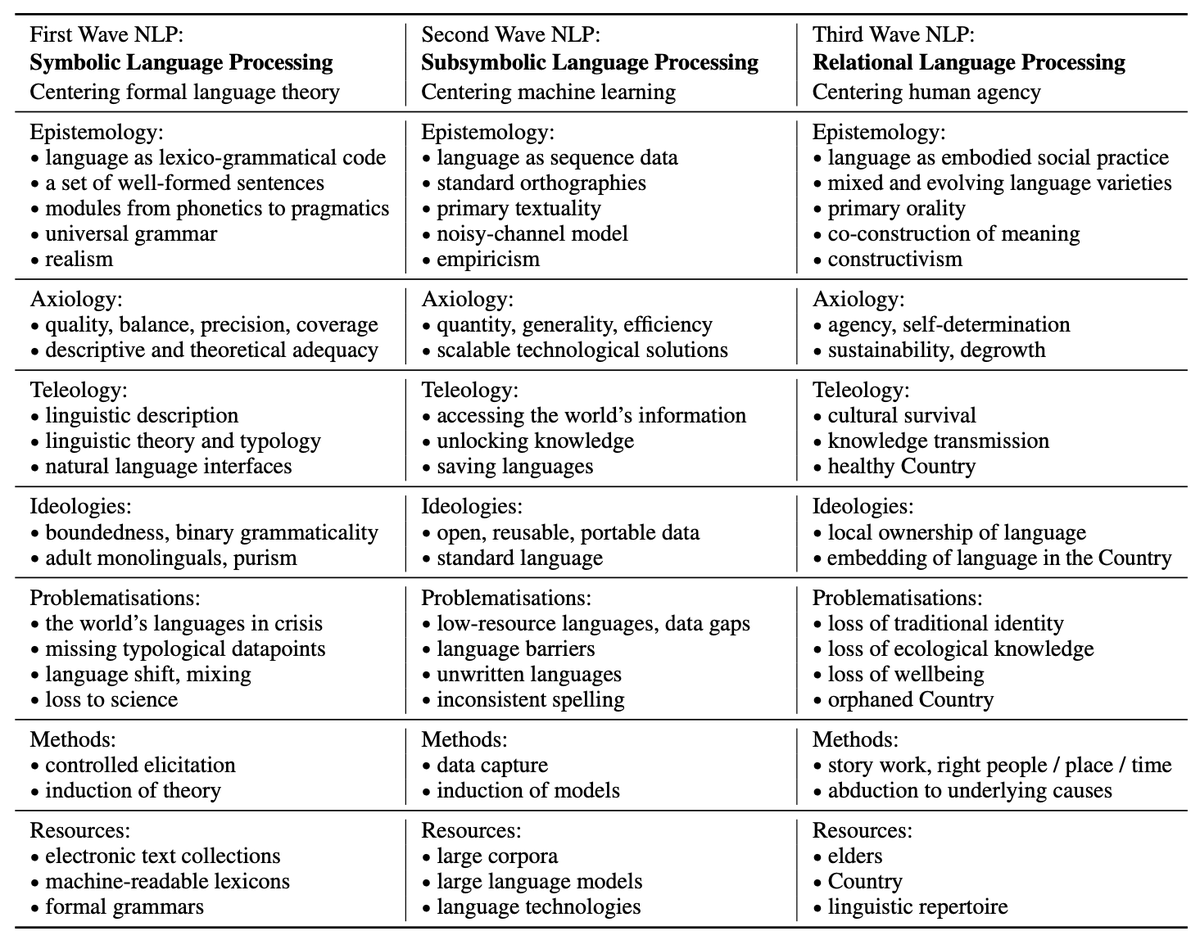
Thus, there are various ways of thinking about what language *is*. These are reflected in how we approach language technologies. The first wave and second waves of symbolic and subsymbolic NLP are familiar. I believe a third wave is emerging: Relational Language Processing.
When we do this, something interesting comes up: relationality. Language is intrinsically social. Language is inseparable from culture, society, or nature. Language both reflects and creates context. This exceeds notions of language as lexicogrammatical code, or sequence data.
It is instructive to look at Indigenous societies, who are guarding their agency in the face of relentless pressures from outside, enacting their sovereignty in shaping their lives, landscapes, and languages. We who increasingly cede our agency to AI may have something to learn.
To ask this question is to return to a fork in the road at the genesis of AI, between Artificial Intelligence (McCarthy) and Augmentative Intelligence (Engelbart). Is our agenda to replicate human intelligence inside a machine or expand human intelligence using machines as tools?
Artificial Intelligence extracts behavioural data and takes over human agency. Augmentative Intelligence carefully enhances human agency. What would it be like to take this other fork, and seek a path towards a non-extractive NLP committed to augmentative solutions?