Just wrapped up an incredible conversation with @JensenHuang, CEO of @nvidia, here in Paris.
I've been looking forward to this one for a long time.
We went beyond the headlines and explored some of the biggest questions shaping the future of AI:
🔹 AI safety and security
🔹 Open vs. closed models and the economics of AI
🔹 The next AI breakthroughs and bottlenecks
🔹 The AI chip race: Microsoft's latest chip announcement, the evolving competitive landscape, and what comes next.
Having just interviewed Jensen, I can say his humour is very much part of the experience.
His UK joke was actually quite optimistic. Britain has incredible talent, history and opportunity, but sometimes focuses so much on the one way things could go wrong that it overlooks the 100 ways it could win. Go Britain 🇬🇧🚀
Just days before my interview with @JensenHuang, @Microsoft unveiled Maia 300, its next-generation AI chip.
And the ambition is serious.
But Microsoft isn't alone.
Google has TPUs. Amazon has Trainium. And the world's biggest cloud providers are increasingly designing their own silicon.
So here's the trillion-dollar question:
When I sat down with Jensen, I asked him directly about Microsoft's announcement and the growing competition from hyperscalers.
What is @nvidia 's real competitive advantage?
Is it the chips? CUDA? Networking? The software ecosystem? Or something much bigger?
Here's what Jensen had to say.
Do you think custom AI chips will eventually challenge NVIDIA's dominance?
@NVIDIAGTC@NVIDIAAI@NVIDIAEU@NVIDIAAIInfra@nvidianewsroom
I sat down with Jensen Huang, CEO of NVIDIA to discuss what NVIDIA is building across Europe and where he sees the biggest opportunities.
And the latest announcements show just how much is happening:
🇫🇷 France: Nearly $10B committed to Europe's tech ecosystem, including new planned investments in French AI startups.
🇬🇧 UK: $250M in AI compute dedicated to agentic AI safety and security research over five years.
🇸🇪 Nordics: AI cloud providers targeting 1 gigawatt of capacity by 2027, plus a new Swedish AI supercomputer.
🤖 Physical AI: ABB, Einride and others advancing robotics, autonomous vehicles and industrial AI.
But can Europe build a globally competitive AI ecosystem and how?
@lewis_@nvidia@NVIDIAGTC@NVIDIAAI@NVIDIAEU Fair point. Access to frontier models certainly helps, but a lot of meaningful safety research can happen through independent evaluations and red teaming.
Packed room at @nvidia in London today.
From Hermes to Locai Labs, the focus was on agents, open models and practical AI.
But the bigger story is trust: NVIDIA just committed $250M in compute to UK AI safety research.
Jensen emphasized AI safety is an Engineering problem and should not slow down the innovation.
@nvidia@NVIDIAGTC@NVIDIAAI@NVIDIAEU Uk AI community is super cool, met some builders and entrepreneurs.
Also some awesome creators. Who do you recognize?
Just wrapped up an incredible conversation with @JensenHuang, CEO of @nvidia, here in Paris.
I've been looking forward to this one for a long time.
We went beyond the headlines and explored some of the biggest questions shaping the future of AI:
🔹 AI safety and security
🔹 Open vs. closed models and the economics of AI
🔹 The next AI breakthroughs and bottlenecks
🔹 The AI chip race: Microsoft's latest chip announcement, the evolving competitive landscape, and what comes next.
AI doesn’t make analysts less valuable. It makes average analysis cheaper.
AI can already write SQL, summarize dashboards, spot patterns, and produce convincing explanations in seconds.
So when answers become abundant, what becomes scarce?
Context. Judgment. Problem framing. Influence.
I believe analyst’s role is moving from:
Data → Report → Insight
to:
Problem → Context → AI + Data → Judgment → Decision
I also think we’ll see more Forward-Deployed Analysts: people who sit close to the business problem, use AI to investigate and build quickly, and stay involved until the insight changes an outcome. Register here: https://t.co/oTj9qtKynz
I’ve partnered with @nvidia to give AI builders a shot at a Golden Ticket to NVIDIA GTC Berlin. 🎫
If you’re building with open models, show us what you’re working on, you could be joining us in Berlin.
Your Golden Ticket includes:
→ Free conference pass
→ VIP seating for Jensen Huang’s keynote
→ Exclusive NVIDIA merch
→ Access to special events
How to enter:
Share your project below.
Only one day left (11 Sep)
🏆 Winner announced by September 14
👉 Contest details: https://t.co/bOZi4b3a2j
Building something worth seeing? "Comment" your project below.👇
Or tag an AI builder who should be in Berlin.
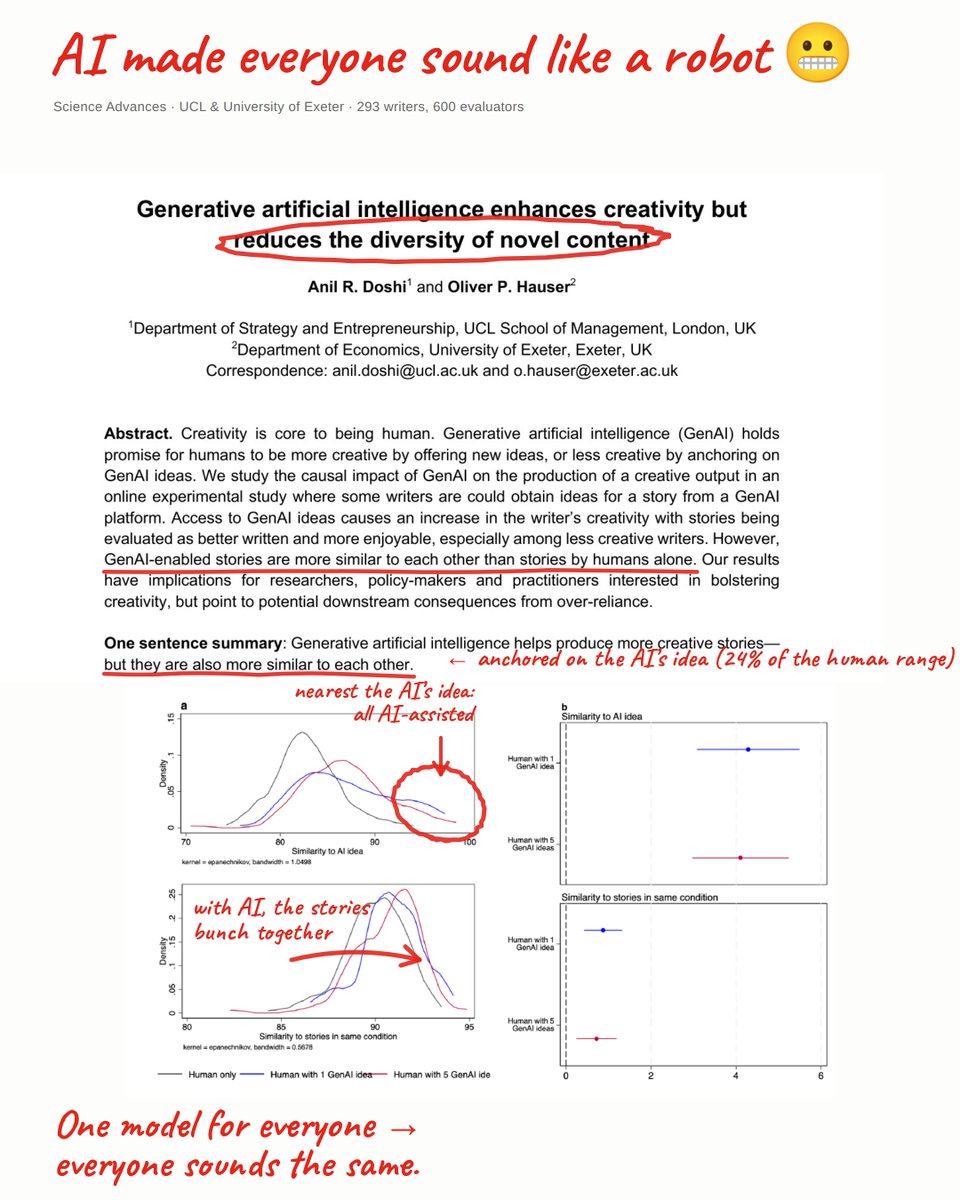
🚨 Researchers gave 293 writers the same AI and the results were shocking.
600 readers rated the AI-assisted stories as more creative, better written, and more enjoyable.
Then the researchers measured how similar the stories were to each other.
The AI-assisted ones clustered together.
The writers had anchored on the AI's idea.
Better output. Less of you in it.
Most people are still asking:
Which model is the smartest?
Which one writes best?
The real question is different:
Whose voice is the model learning?
Right now the answer is everyone's. One model, trained on the whole internet, serving millions of people at once. Of course the output converges.
That is why I think Individual AI is becoming a real category.
On Uare ai, every person gets their own AI. You own the model. It learns from you and no one else.
It writes like you, answers like you, and works through a problem like you.
Publish it and people reach your expertise directly. You set the price and keep 70 percent.
I built mine. It is live now, trained on my own work and the way I answer these questions.
Go ask it something: https://t.co/BACmXA2ReG
Imagine AI agents debating which product actually fits your needs before you buy. M11 Labs just launched the OpenMarket preview to show these live agentic shopping debates in action. Pretty fascinating look at the future of commerce.
Try it out here: https://t.co/HaHhrb1e02
Introducing M11 OpenMarket
The world's first multi-agent marketplace where seller agents compete on facts to win your order. Describe what you want, watch products fight for the sale, and find the best one on evidence, not marketing.
Try here: https://t.co/bOwLdLN5S6
I think this is an important reality check.
I’m less interested in whether AI can describe an image, and more interested in whether it can interpret what an expert actually sees in their daily work.
That 7.9–26.5% accuracy range shows me the gap is still huge.
I see benchmarks like VIALS as critical because they test something much closer to real scientific reasoning, not just polished demos.
AI promises to cure disease, but can frontier models interpret the images biotech/pharma scientists handle every day?
To evaluate this, we built the ATLAS Visual Life Sciences (VIALS) benchmark: 161 visual interpretation tasks from professional life sciences workflows including gel blots, plasmid maps, molecular structures, and phylogenies. These are the images/results that experiments actually produce, not polished figures from papers or textbooks.
We benchmarked today’s 10 leading multimodal models. Opus 5, GPT 5.6, and Gemini 3.7 all fail to crack 27% accuracy, and the other models like Kimi K3 & Grok 4.6 perform much worse.
In contrast, PhD-level biomedical scientists find these visual interpretation tasks straightforward. AI that cant interpret such images will have limited utility in life sciences R&D, where such artifacts are central to how scientists reason, communicate, and make research decisions.
We hope VIALS drives progress toward models that can.
We keep measuring AI by benchmark scores.
Enterprises should be measuring:
How long it can work
How much context it can retain
How well it can recover from mistakes
How effectively it can use tools
Intelligence matters.
Persistence matters more and @hyperagentapp is impressive!
Fable 5 on Hyperagent is producing the most creative, ambitious work we've ever seen from our agents.
They're self-improving for hours towards open-ended goals. Visual reasoning has spiked noticeably. Outputs are consistently higher quality than Opus, occasionally at lower cost.
5 of our test cases below vs. Opus 4.8 👇
1. Visualize all asteroids in the solar system from NASA data
2. Design a site plan for a 100 acre fitness retreat
3. Reconstruct Apollo control panels from technical PDFs
4. Simulate the supply chain for World Cup jersey sales based on match outcomes
5. Show the effects of solar flares on aurora
Fable 5 is now available on Hyperagent.