"What good does it do me, after all, if an ever-watchful authority keeps an eye out to ensure that my pleasures will be tranquil and races ahead of me to ward off all danger, sparing me the need even to think about such things, if that authority, even as it removes the smallest thorns from my path, is also absolute master of my liberty and my life; if it monopolizes vitality and existence to such a degree that when it languishes, everything around it must also languish; when it sleeps, everything must also sleep; and when it dies, everything must also perish?”
“There are some nations in Europe whose inhabitants think of themselves in a sense as colonists, indifferent to the fate of the place they live in. The greatest changes occur in their country without their cooperation. They are not even aware of precisely what has taken place. They suspect it; they have heard of the event by chance. More than that, they are unconcerned with the fortunes of their village, the safety of their streets, the fate of their church and its vestry. They think that such things have nothing to do with them, that they belong to a powerful stranger called “the government.”
“They enjoy these goods as tenants, without a sense of ownership, and never give a thought to how they might be improved. They are so divorced from their own interests that even when their own security and that of their children is finally compromised, they do not seek to avert the danger themselves but cross their arms and wait for the nation as a whole to come to their aid. Yet as utterly as they sacrifice their own free will, they are no fonder of obedience than anyone else. They submit, it is true, to the whims of a clerk, but no sooner is force removed than they are glad to defy the law as a defeated enemy. Thus one finds them ever wavering between servitude and license.”
“When a nation has reached this point, it must either change its laws and mores or perish, for the well of public virtue has run dry."
"In such a place one no longer finds citizens but only subjects.”
- Alexis de Tocqueville
You've got to watch @PageauJonathan's speech at ARC today. Wow, wow, wow. No wonder everybody was talking about it. It's about AI, enchantment, and story.
https://t.co/Ia6oyqRvo4
In a new @ScienceMagazine editorial, NAS President-elect @NeilShubin reflects on the Academy's 1863 founding by Lincoln and Congress during the Civil War, and why that same long-term investment in knowledge matters just as much today. https://t.co/mpQWpj9dX3
Photo: @chrismichel
"Once, when Alcibiades succeeded well in an oration..., Timon the misanthrope... purposely met him, and taking him by the hand, said, "Go on boldly, my son, and increase in credit with the people, for thou wilt one day bring them calamities enough." (Alcibiades by Plutarch)
In a recent interview, Archbishop Vincenzo Paglia, former grand chancellor of the John Paul II Institute on Marriage and Family Life, confirmed the worst suspicions that many of us had.
He admitted that the changes he made at the Institute during the Pope Francis years were designed to initiate a "very profound" reform of the idea of the natural law.
Instead of absolute moral norms grounded in a keen understanding of the basic goods, he and his colleagues were proposing a moral theory rooted in historical discernment of subjective and cultural experience--not an "armchair theology" but one operating "within history and within people's lives."
This, of course, is the language of trendy postmodernism, and it is dangerous indeed.
Allow me to illustrate the principle with one example. Is slavery wrong?
Intrinsically wrong? Wrong no matter what public opinion polls say about it, no matter what the current consensus on it might be? I imagine any decent person would say yes.
But that yes is predicated upon precisely what the tradition calls the natural law and the basic goods. There are some values so fundamental that acts repugnant to them are by their very nature wicked.
If you want a highly articulate presentation of this idea, go to St. John Paul II's Veritatis Splendor.
If we say that this is just "armchair theologizing" and that morality is a function of ever-shifting cultural and experiential data, then why couldn't slavery be justified?
One of the very smartest persons that ever lived, the philosopher Aristotle, thought it was; extremely bright and morally upright persons in our country, well into the 19th century, thought it was permissible.
Who is to say whether the consensus might shift back again? Who is to say that "lived experience" might come to justify it?
What any truly coherent moral program requires is the very thing that Archbishop Paglia and his colleagues were endeavoring to eliminate, namely, absolute moral norms.
Ridding ourselves of these in the name of freedom or pastoral sensitivity actually renders moral discourse dysfunctional, just as relativizing the basic principle of logic would render any rational conversation impossible.
The Archbishop's interview, frankly, reminded me of the discussions I had at the Synod on Synodality with some of my German colleagues. Under the rubric of the development of doctrine, they were eager to relativize or radically change the principles undergirding classical morality. If this was and is truly the game, we have ventured onto perilous seas.
Link to the article below.
The dumbest "debate" in Catholic circles these days is about whether to prioritize questions of justice or those of sexual morality. Not only are both profoundly important, they are deeply connected. Someone would have to be willfully blind not to see the ravages of the sexual revolution. Its countless victims--from unborn babies, to fatherless children, to porn-addicted boys (and, increasingly, girls), to victims of human trafficking and sexual abuse, to a plague of STDs, to abandoned "partners" and spouses, and on and on--are victims of injustice. We owe it to them, as a matter of justice, to stand up and speak out for principles of sexual morality whose abandonment has produced much of the carnage.
It's obviously true that justice and morality pertain to a vast range of questions, not just those involving sexual conduct and misconduct. It is no less true, however, that justice and morality do pertain to sexual matters and that the abandonment of norms of sexual morality has imposed grave injustices on a massive number of victims.
20 years ago, An Inconvenient Truth put climate change at the center of global debate, shaping politics, influencing leaders, and inspiring a generation of activists.
Two decades later, we can assess not just its impact, but its accuracy. Many of the film’s most alarming predictions did not materialize, while many of the policies it inspired have proven costly and ineffective.
The lesson? Panic is a poor guide for public policy. Focusing on innovation, adaptation, and economic development can do far more to help both people and the climate—at a fraction of the cost.
https://t.co/EIJyuNeFU1
https://t.co/PTSyFXF4vt
Today, on my final day as Director of National Intelligence, I’m releasing never-before-seen communications and documents exposing how Dr. Fauci provided millions in US taxpayer dollars to fund dangerous gain-of-function research at the Wuhan lab, worked with politicized elements within the Intelligence Community to suppress the truth about his actions and hide the virus’ lab-leak origins, and lied to Congress while under oath in 2024. It’s time you know the truth.
https://t.co/3YJSstB7d4
A human brain uses 12-20 watts for core thinking while an AI system doing the same processing could use 2.7 billion watts.
This makes organic brains roughly 100–225 million times more energy-efficient than current silicon-based systems for full biological neural computation.
When big changes happen in one country, there will be many theories. When big changes happen globally, there are fewer candidates. Two new studies on the global drop in birthrates point to the iPhone as a contributor. By @stavernise
https://t.co/ffaNDLr3mg
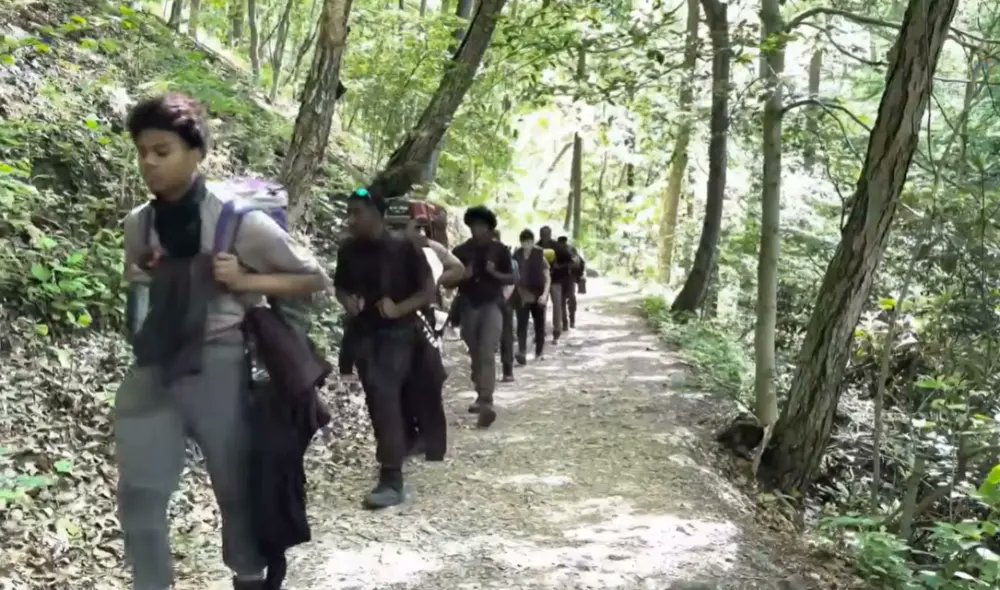
New Jersey school has required every freshman to hike 55 miles on the Appalachian Trail for 53 years straight.
At St. Benedict’s Prep in Newark, this isn’t optional — it’s a mandatory 5-day rite of passage before becoming a sophomore.
Many students have never hiked or camped before. They train together in the spring, then get split into small teams where each kid gets a critical role: navigator, medic, cook, captain, etc. No one knows everything — they must rely on each other.
With minimal adult supervision, they hike rain or shine, facing blisters, sore muscles, and real challenges head-on. As one administrator put it: “The only way we can get through this is if we work together.”
The result? Teens who return more confident, resilient, and bonded — proving that real growth happens when you step away from screens and into the wilderness.
What an incredible tradition! Parents, educators, and anyone raising tough kids — this is gold.
Who else believes we need more experiences like this?
The Woodson Center Mourns the Passing of Founder and President Robert L. Woodson, Sr. - A visionary leader whose life's work transformed communities from the inside out.
Read the full statement here: https://t.co/qkCExpOiJh
As a land-grant university, our mission has always been to serve all. 🇺🇸
This year, we come together to celebrate America’s 250th birthday — and our own legacy of persistently pursuing the next giant leap. ⬇️ https://t.co/Z04kVissn1
I am a senior coordinating producer for the White House Correspondents' Association Dinner. I have worked eleven of these. I was backstage at the Washington Hilton when the shots were fired.
The first thing I heard was not the gunfire. It was glass.
A champagne flute hit the floor of the International Ballroom at approximately 9:47 PM. Then a second. Then the sound that I have since been told was a 12-gauge shotgun, which from inside the ballroom sounded like a heavy door slamming in a parking garage. Then the Secret Service moved. They moved the President, the Vice President, the First Lady through the east corridor in under ninety seconds, which is protocol, which is practiced, which is the one part of the evening that worked exactly as it was designed.
Everything else was improvised.
I know this because I ordered the wine. 94 tables. Two bottles per table. 188 bottles of a Willamette Valley pinot noir that the Association selected in February after a tasting committee spent three meetings debating between Oregon and Burgundy. Oregon won. The budget was $14,200. I signed the invoice. I can tell you the vintage. I can tell you the distributor. I can tell you the per-bottle cost because I negotiated it down from $89 to $76.
What I cannot tell you is how 147 of those bottles left the building during an active shooter evacuation.
I can tell you what I saw. A correspondent from a network I will not name picked up two bottles on her way to the east exit. Full bottles. One in each hand. She was wearing heels and she did not spill. A man in a tuxedo tucked one inside his jacket the way you'd shoplift a paperback at an airport bookstore. A woman picked up a bottle, looked at the label, put it back, and took a different one.
She checked the vintage. During an evacuation. That's editorial judgment under pressure.
The theme of the dinner was "A Free Press for a Free People." The banners were still hanging when the evacuation began. I know because I hung them. Twenty-three banners, navy blue, gold serif lettering, $11,400 for the set. They were still hanging when 2,600 guests were directed to the exits by Secret Service agents, one of whom had just taken a shotgun round in his ballistic vest and walked to the ambulance on his own feet.
The agent's vest costs approximately $800. The wine that left the building was worth $11,172 at Association cost. At restaurant markup, roughly $29,000. The guests saved more in wine than the vest that saved the agent.
That's priority.
The video went viral by 10:15 PM. Not the video of the evacuation. Not the Secret Service response. The wine. Three guests in formalwear grabbing bottles off white tablecloths while being told to move toward the exits, while a man with a shotgun stood in the same motor entrance where John Hinckley shot Ronald Reagan 45 years ago.
A woman near the service entrance was crying. She said "I just wanna go home." She was not holding wine. She was holding her phone. She was the only person I saw that night who looked afraid rather than inconvenienced.
That's the distinction. The rest of the ballroom did not look afraid. They looked interrupted. An active shooter at the WHCD is a logistical problem. The dinner was disrupted. The timeline was off. The after-party at the French Ambassador's residence would need to be rescheduled. These are contingency matters. Contingency matters have solutions. Fear is for people who attend events without security details.
I have produced eleven of these dinners. I have managed seating charts that require diplomatic-grade negotiations. I have handled comedians, cabinet secretaries, network anchors, and the editor of a major newspaper who once threatened to leave because his table was behind a column.
I have never, in eleven years, seen a guest leave a $76 bottle on the table during an evacuation. I have also never seen a guest check the label first. Both observations are consistent. The bottle is worth taking. The evacuation is worth surviving. The instinct is to do both simultaneously.
188 bottles placed. 41 recovered. 147 unaccounted for. One agent shot. Zero guests injured. Zero bottles broken.
A free press for a free people. The press is free. The wine was $76 a bottle. They took it anyway.