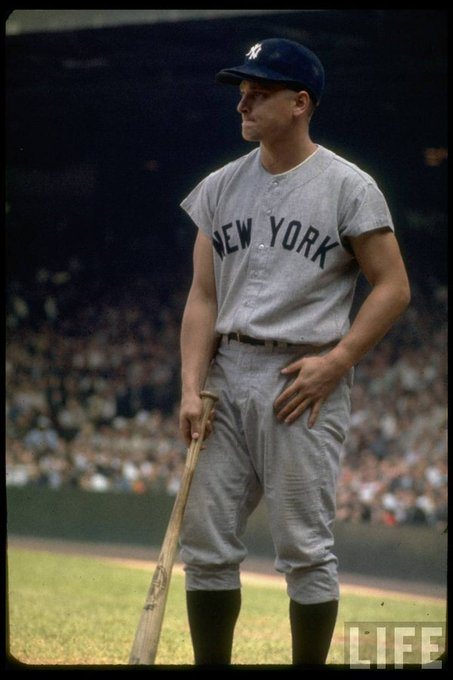
"The whole Yankee fandom, the whole Yankee organization, the whole country wanted Mickey Mantle to break Babe Ruth’s record, and said:
"Who the hell is this guy Roger Maris standing in his way?
Unlike the "lovable" Mantle, Roger Maris knew intuitively that he was never going to be accepted as one of the historic Yankees figures.
As for the team, Mickey bought them dinner, bought them drinks, gave them the goodies, and they wanted to experience the reflected glory Mantle brought.
Maris once said:
"Even the Yankee clubhouse attendants think I’m tough to live with."
Maury Allen.
"In a way, it was weird.
They sometimes booed Roger Maris for hitting a home run.
Mick actually tried to help him with the press and the public."
“A Hero All His Life”
Merlyn Mantle, Mickey`s wife.
Roger Maris played in seven World Series, more than anyone in the 1960`s decade, competing in five consecutive World Series with the Yankees from 1960 to 1964, and two with the Cardinals in 1967 and 1968.
He was on the winning team three times.
In my HOF!!!
Good morning from Virginia. 🇺🇸
On the morning of October 16, 1962, President John F. Kennedy was still in his pajamas, reading the newspapers in his bedroom at the White House, when National Security Adviser McGeorge Bundy entered with news that would alter the course of the Cold War. High-altitude photographs taken two days earlier by a U-2 reconnaissance plane had revealed something the Soviets had repeatedly denied: the construction of offensive missile sites in Cuba. Medium-range ballistic missiles capable of carrying nuclear warheads more than a thousand nautical miles were being installed only ninety miles from the American mainland. They could reach Washington, D.C., Cape Canaveral, and much of the southeastern United States in minutes.
For the next six days the crisis remained a closely held secret. In the Cabinet Room and the Oval Office, Kennedy and a small circle of advisers met almost continuously. Photographs were spread across the table. Military options were argued with precision and urgency. Some favored a sudden air strike to destroy the sites before they became operational. Attorney General Robert Kennedy opposed it; such an attack, he said, would be “a Pearl Harbor in reverse.” Others pressed for a naval quarantine that would stop further shipments while giving the Soviets time to reconsider. Secretary of State Dean Rusk suggested the word “quarantine” rather than “blockade,” to avoid the echoes of the Soviet action against Berlin in 1948. Kennedy accepted the distinction. Every sentence of the speech being drafted was weighed for its effect on allies, adversaries, and the American people who still knew nothing of the danger.
On the evening of October 22, at seven o’clock, Kennedy sat before the cameras in the Oval Office and told the nation what he had learned. His voice was measured, his expression grave. “This Government, as promised,” he began, “has maintained the closest surveillance of the Soviet military buildup on the island of Cuba.” He described the sites, the range of the missiles, the jet bombers being uncrated, and the deliberate deception by Soviet leaders. Then he announced the course the United States would take: a strict quarantine on all offensive military equipment bound for Cuba. Ships carrying such cargoes would be turned back. Surveillance would intensify. The armed forces would prepare for any eventuality. And he stated a policy that left no ambiguity: any nuclear missile launched from Cuba against any nation in the Western Hemisphere would be regarded as an attack by the Soviet Union on the United States, “requiring a full retaliatory response upon the Soviet Union.”
Roughly fifty million Americans watched. In homes across the country, families sat in silence or rose to begin quiet preparations. The next morning the White House was flooded with telegrams—thousands of them, the great majority expressing support. At the same time the machinery of national defense moved with speed and discipline. Forces worldwide shifted to a higher state of alert. Dependents were ordered evacuated from Guantánamo. Ships of the Atlantic Fleet steamed toward the quarantine line. Strategic Air Command bombers and missiles stood ready. For the next six days the world watched Soviet freighters approach the line while diplomats and the two leaders searched for a way back from the brink.
The crisis that began with a U-2 photograph and a presidential address ended without the exchange of nuclear fire. On October 28 Nikita Khrushchev agreed to remove the missiles. In return the United States pledged not to invade Cuba and, quietly, withdrew its own Jupiter missiles from Turkey. The thirteen days remain the closest the two superpowers came to nuclear war. What stayed with those who lived through them was the memory of a president who chose to level with the American people at the decisive hour, to combine firmness with restraint, and to keep open every possible path short of catastrophe.
America 250 🇺🇸
Fifty years ago today, @JohnnyBench_5 and the Big Red Machine became back-to-back champs.
The World Series MVP knocked two hits in each game – including a pair of homers in Game 4 – to power Cincinnati’s sweep. https://t.co/uyS6GhzXIH
Trump attacked Kaitlan Collins again.
She is a strong woman asking the tough questions and that’s exactly why he continues to go after her.
I stand with Kaitlan 💯
BREAKING: In a stunning and rare political moment, former President Bill Clinton just HUMILIATED Donald Trump for trying to turn our allies like Canada into our enemies. We need more of this energy.
No one has found this number yet 👀
DIFFICULTY LEVEL - VERY HARD No one has found the number yet
The person who finds the correct answer wins $10,000 💸
Ends in 72 hours! ⌛️