You have noticed it. ChatGPT feels dumber than it used to. Your prompts that worked six months ago produce worse results now. The writing sounds flatter. The ideas sound safer. The internet itself feels like it is shrinking. Every article reads the same. Every email sounds the same. Every answer sounds like it was written by the same voice.
You thought it was you. It is not you.
Researchers at Oxford and Cambridge published a paper in Nature proving what is happening. They call it Model Collapse.
Here is the mechanism in one sentence. AI trained on AI-generated data gets dumber every generation until it forgets what real human data looked like.
The internet is filling with AI-generated content. Blog posts. Articles. Reviews. Comments. Social media. AI companies scrape the internet to train the next generation of models. Which means the next generation of AI is being trained on the output of the current generation.
Each cycle loses information. Not randomly. It loses the rarest, most unusual, most creative parts first. The researchers call these the "tails of the distribution." The weird ideas. The unexpected perspectives. The things that made the internet feel human. Those disappear first.
What remains is the average. The safe. The expected. The bland.
Then the next generation trains on that. And loses more. And the next generation trains on that. And loses more. The researchers proved this is not a slow decline. Major degradation happens within just a few iterations. Even when some of the original human data is preserved.
They tested it on large language models. On image generators. On statistical models. The pattern was the same every time. The output converges toward a narrow, flattened version of reality that looks nothing like the original data.
The lead researcher put it plainly. "Large language models are like fire. A useful tool. But one that pollutes the environment."
The pollution is invisible. You cannot see which sentence on the internet was written by a human and which was written by AI. Neither can the AI that is about to train on it. And once the tails are gone, they do not come back. The damage is irreversible.
This is not a prediction anymore. It is a diagnosis.
The internet you grew up on was built by humans writing things no algorithm would have written. Strange, personal, imperfect, alive. That internet is being diluted. One generation of AI at a time. And the models trained on what remains are learning a smaller and smaller version of the world.
Model Collapse is not a technical problem. It is a cultural one. The thing that made the internet worth reading is the thing that disappears first.
Elon Musk just explained why artificial intelligence cannot physically survive on Earth.
In a conversation with Jamie Dimon, Musk bypassed the romance of space exploration entirely.
He answered with physics.
Musk: “I think we can do probably somewhere around 1 terawatt per year of AI space compute from Earth, but we can do 1,000 terawatts or more from the Moon.”
One terawatt. That is the thermodynamic ceiling of this entire planet.
Every nuclear plant. Every solar farm. Every grid upgrade humanity can possibly build. All of it maxes out at one terawatt of AI compute.
Earth is no longer a canvas. It is a bottleneck.
So Musk is looking at the Moon.
Not for flags. Not for footprints. For leverage.
Musk: “Because the Moon has no atmosphere and about one-sixth Earth’s gravity, you can use an electromagnetic accelerator… You don’t need to use rockets to do AI data centers into deep space from the Moon. You can literally just shoot them like a railgun type of thing.”
He is not describing a research outpost. He is describing a frictionless manufacturing hub on a celestial body.
Mine the lunar surface for raw material. Build solar arrays and thermal radiators on-site. Construct an electromagnetic railgun. And fire AI superclusters directly into the vacuum of deep space.
No supply chain from Earth. No atmosphere to fight. No fuel to burn on exit.
A thousand terawatts. A 1,000x multiplier on the physical limit of human intelligence.
And the Moon isn’t even the endgame.
Musk: “We can build a self-growing city on the Moon faster than we could do so on Mars.”
The Moon is the factory floor. Mars is the civilization.
Musk: “If you warm up Mars, you could one day make Mars like Earth, meaning with liquid oceans and life and where you could walk outside without a spacesuit type of thing.”
Musk: “I call Mars a fixer-upper of a planet, but it’s got a lot of potential.”
A fixer-upper. That is how the richest man on Earth talks about an entire planet. Like a house with good bones and a bad roof.
The rest of the industry is fighting over zoning permits and year-long environmental reviews to plug in a single server farm.
Musk is building a magnetic launcher on the Moon to fire compute into the cosmos.
For ten thousand years, humanity looked up at the stars and saw mythology.
Musk looks up and sees bandwidth.
We thought the ultimate purpose of spaceflight was exploration.
It was always infrastructure.
Earth was never the destination. It was the incubator.
Suicidal empathy isn’t the core threat, it’s homicidal empathy.
What we’re witnessing isn’t misguided kindness. It’s a ruthless, ideologically driven strategy of reproductive suppression and lineage destruction, fueled by feminist intrasexual competition. Certain strains of feminism don’t just compete with men, they indoctrinate women to sabotage their own fertility, demonize traditional family structures, and actively undermine the reproductive success of rival women and lineages. The result is civilizational self-harm dressed as empowerment.
If you watch only one thing this week, watch Hannah Spier’s interview with evolutionary psychologist Dr. Dani Sulikowski.
It’s brilliant, unflinching, and genuinely terrifying. Sulikowski lays out how modern feminism functions as an intrasexual competitive strategy, one that suppresses motherhood, distorts mating preferences, and accelerates fertility collapse under the banner of “equality.”
Feminism, in this form, has proven every bit as destructive to human flourishing and societal stability as Marxism. Both ideologies weaponize grievance, promise utopia, and deliver demographic and cultural ruin.
@hannahspierMD
Why Do 50% Still Support Carney? My long-winded response.
That is a question we need to take seriously.
Leger’s latest federal polling has the Liberals at 50% support among decided voters, their highest level in that firm’s tracking since the Liberals first formed government in 2015. Abacus also found the political environment still favourable for Carney and the Liberal government. So this is not imaginary. This is not just CBC fairy dust sprinkled over Ottawa. The support is real. The harder question is whether it is rational.
My answer is simple: many Canadians are not voting for results. They are voting for the illusion of relief.
Even though Carney was in the economic background since 2020 he appeared to arrive after the Trudeau years like a man in a clean suit walking into a room after the dog crapped on the floor. Trump threatened 51st State. Carney looked calm. Unlike Trudeau. He spoke in complete sentences. He had the central banker aura. For exhausted voters, that was enough. They did not examine the wiring. They just saw someone who did not seem to be setting the curtains on fire.
Carney’s appeal is not built mainly on performance. It is built on contrast. Compared with Trudeau’s theatre-kid government of slogans, selfies, and moral lectures, Carney looks serious. But “serious” is not the same as right. A surgeon can look serious while operating on the wrong leg.
Canada’s economy is now weak enough that Carney himself has had to acknowledge ugly economic data. Reuters reported him addressing Canada’s technical recession and warning that some data will be “uneven” “ah ah ah” as the government pushes through policy changes. The Wall Street Journal reported GDP weakness, including two consecutive quarterly contractions, while Carney framed the pain as part of a broader economic rebuild.
That is where the sales pitch gets slippery.
When the economy weakens under Conservatives, it is called failure. When it weakens under Liberals, it becomes “transition,” “restructuring,” or “long-term transformation.” Same corpse, nicer label on the toe tag.
The deeper problem is that Canadians were never really asked whether they wanted Carney’s ideology. They were sold competence, not doctrine. They were sold expertise, not a governing philosophy that puts the state, regulators, climate finance, and elite managerial planning at the centre of national life.
Nobody knocked on doors saying, “Would you like a prime minister who believes markets should be bent around elite-defined social and environmental values?” No. They said, “He is smart. He ran banks. He knows Trump. He will steady things.”
That is not a mandate. That is a branding exercise.
And this is why the Conservative attack has to get sharper. Not louder. Sharper.
Calling voters stupid is a dead end. Many Carney supporters are not stupid. They are terrified of Trump. They are tired. They are anxious. They are looking at housing, debt, food prices, crime, productivity, health care, and a country that feels smaller than it used to, and they want someone who looks like an adult. Carney gives them the visual. He gives them the voice. He gives them the vibe.
But vibes do not build houses. Vibes do not raise productivity. Vibes do not lower debt. Vibes do not attract investment. Vibes do not make young Canadians believe they have a future.
The Carney government’s strongest weapon is not success. It is emotional permission. It lets Liberal voters tell themselves they have moved on from Trudeau without admitting the Liberal machine remains fundamentally intact. Same operating system, cleaner looking wallpaper.
That is why 50% still support him.
They are not endorsing the results. They are postponing the verdict.
Canada does not need a better-spoken manager of decline. It needs a government willing to reverse the policies that caused the decline in the first place.
Because a tight ship headed toward the rocks is still headed toward the rocks.
They allowed rapists, murderers, drug traffickers and sex traffickers to flood our country. Now their solution is total surveillance. People are begging for it and will thank the government for keeping them safe.
It's almost like the Canadian Government did this on purpose.
“We estimate that 1% of the population is trans”
This is the new President of the Canadian Paediatric Society, Dr. Natasha Johnson.
She established a clinical services for trans & gender diverse youth at MacMaster Children’s hospital.
One of the country’s largest providers of medical transition for minors.
She has co-authored research arguing that parents’ concerns about youth gender transitions “should not be prioritized.”
The body, that sets pediatric care standards for every Canadian child, just put the person who deprioritizes parents, in charge.
The innocent farm hand rose at dawn and gripped his hoe. The blade was his brother - hard, honest, silent. He struck the earth and felt her response. The weeks moved slow as oxen, rich as forest moss. Village voices tangled like old vines; no man bowed before the sterility of the minute hand.
Then came the automated iron, the transmuted steel. It growled sweet promises and swallowed the fields whole. The hoe rusted in the corner. The hand that once sang with the soil now only pulled levers. Roads grew straight and unimaginative - leading to no new adventures. Men ran faster, yet arrived emptier. Children sang only rarely.
Soon productive emptiness owned their hours, their breath, their dreams. It spat out goods and sucked in souls. Every man wore different clothes but marched the same iron rhythm. They called it freedom and pointed to a thousand glittering doors - all opening onto the same endless belt, an egalitarian destruction of a world in which man had a home.
Remember that Chinese-owned infant formula manufacturing plant in Kingston? Canada Royal Milk?
Did Canadian taxpayers help finance a facility that is now exporting products made from quota-protected Canadian milk to China?
Stay tuned.
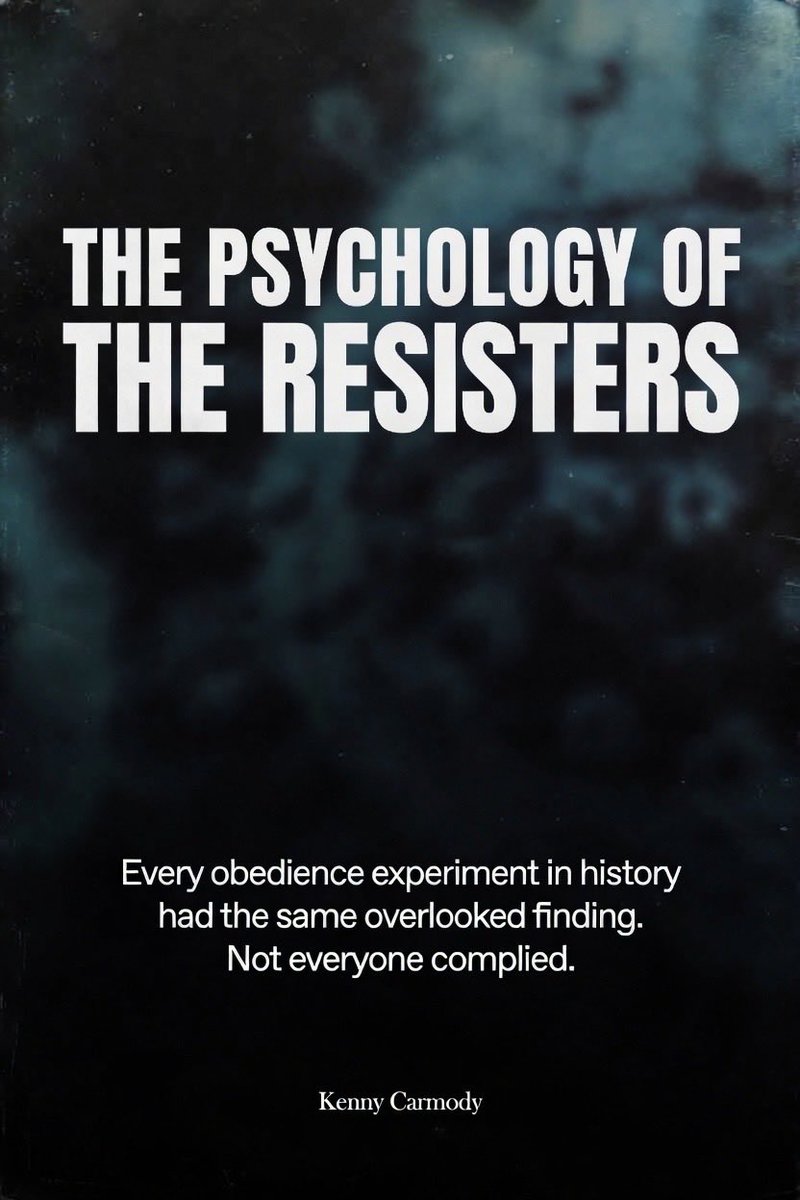
Every obedience experiment in history had the same overlooked finding.
Not everyone complied.
In Milgram’s lab, 35% refused to deliver the final shock. In Asch’s line experiments, 25% never conformed, not once, across any trial. In Zimbardo’s prison, at least one guard refused to dehumanize. One prisoner demanded a lawyer instead of a doctor and broke the psychological frame entirely.
We spent decades studying the ones who obeyed.
We barely asked what made the others different.
That question matters more now than it ever has.
The resisters in the COVID era were not difficult to find. Physicians who filed exemptions and lost their licenses. Nurses who walked away from careers rather than mandate patients into decisions they hadn’t genuinely chosen. Scientists who published contrary data knowing what it would cost them. Parents who stood alone at school board meetings. Ordinary people who simply said, quietly, without drama , no.
What made them different?
Research consistently identifies a cluster of factors. Not personality traits you either have or don’t. Situational and cognitive patterns that can be cultivated.
First: prior reflection on authority. The resisters had usually thought, before the crisis, about the limits of institutional trust. They weren’t cynics. They were people who had already asked the question “under what conditions would I refuse?” before anyone was asking them to comply.
Second: a concrete reference point outside the consensus. A value, a principle, an oath, a relationship that existed independently of the institutional structure demanding compliance. Something the system couldn’t reach.
Third: at least one other person. Milgram found that a single dissenting confederate reduced compliance dramatically. The resisters rarely stood entirely alone. They found each other. Sustained each other. Gave each other permission.
Fourth: the willingness to tolerate social pain. Not immunity to it. Tolerance of it. They felt the pressure. They felt the exclusion. They chose the discomfort of integrity over the comfort of belonging.
None of this is innate. All of it is learnable.
The most important thing Milgram, Asch, and Zimbardo taught us is not how fragile conscience is.
It’s that conscience can hold, if you’ve trained it, named its limits, and found even one other person willing to hold theirs beside you.
Build that now. Because the experiment is always running.
Until then stay humble.
According to this perspective, the real genius of modern financial engineering is not producing more goods, more energy, or more prosperity. It is discovering ever more creative ways to place toll booths between people and production.
First came money. Then debt. Then derivatives. Then carbon credits. Soon, perhaps, we'll have tradable certificates for breathing, sunshine futures, and premium subscriptions for rain.
The complaint is not about environmental protection itself, but about the tendency of financial systems to transform every human necessity into a financial asset. Air becomes a market. Water becomes a market. Carbon becomes a market. Eventually, the productive work of transforming resources into useful goods risks becoming secondary to the business of trading claims upon those resources.
Analysts argue that many developing nations were encouraged to restructure their economies around financial targets and externally designed projects, often at significant cost. They point out that building vast new energy systems requires enormous amounts of steel, concrete, mining, transport, manufacturing, and fuel long before any energy is produced. When projects underperform or fail to deliver promised returns, the costs remain while the financiers move on to the next grand scheme.
Meanwhile, war remains the oldest and most reliable investment vehicle. If one financial bubble deflates, another conflict conveniently appears to inflate demand. Debt grows, reconstruction contracts multiply, and the accounting departments of empire remain fully employed.
In this telling, modern capitalism has evolved from owning factories to owning obligations. The objective is no longer merely to produce wealth, but to financialize everything that wealth depends upon. The farmer grows the crop, the engineer builds the machine, the worker creates the value—and an army of intermediaries arrives carrying invoices, regulations, fees, credits, offsets, and derivatives.
The result, Analysts say, is a world where productive capacity is increasingly burdened by layers of financial extraction. Nations are encouraged to borrow, restructure, refinance, and comply, while their real economic foundations slowly hollow out.
The concern is that this process has reached an extreme concentration of power: a system capable of placing a price tag on nearly everything while producing relatively little itself. The fear is not merely greed, but a structure in which value creation and value extraction become disconnected, allowing those closest to financial power to capture an ever larger share of society's output.
Whether one agrees with that assessment or not, the central accusation remains the same: the greatest invention of modern finance is not creating wealth, but continuously reinventing new mechanisms to claim ownership over wealth created by others.
🚨 BREAKING: Claude has a feature called Red Team Mode.
You can use it to attack your own business the way a competitor, investor, or angry customer would, and fix the weak spots before they become real problems.
Here are 7 prompts to access it: 👇
I also read 2⃣ as the actions of others can be regressively and retrospectively inverted onto you. They are neither responsible nor accountable for their actions, you are.
Mad
Ness
These two paragraphs of my verdict are crucial for everyone to read and understand.
"Even if all of the statements made by Van Langenhove are based on scientific evidence and statistics, it makes no difference to the criminal intent. Van Langenhove is not charged with spreading false information. He is charged with presenting facts in a way that incites hatred against persons on the grounds of one or more of the protected criteria in the Anti-Racism Law.” 1⃣
"For Van Langenhove to have committed a crime, it is not necessary for him to have incited concrete acts of hate or violence. It suffices that others are incited to take on a general attitude of intolerance or disapproval regarding a group protected under the criteria of the Anti-Racism Law." 2⃣
This means you can go to jail for "inciting hatred" even if your statements were 100% factual (see 1⃣) and even if you did NOT incite concrete acts of hate (see 2⃣).
The benchmark of "inciting hatred" , a crime punishable by prison, is thus "saying something that has the potential of inciting someone to have a general attitude of disapproval regarding a protected group". This means literally any criticism of mass migration is now a punishable offence. If you cite a statistic, and someone could potentially think less of a protected group (like migrants) because of it, you can be jailed.
The craziest part is that there is no defence possible against this. I brought the scientific studies that I cited to court, but the judge didn't care 1⃣. I also proved that the hundreds of students present at the lecture included students of all different political affiliations, and everyone was able to voice their opinion or ask questions. The lecture went very calmly, so obviously nobody was incited to hatred. But this too did not matter 2⃣, because if the judge says he believes there is the possibility that someone COULD be incited to "a general attitude of disapproval", this is enough for the judge to send me to jail, even without any evidence.
I'm telling you this to warn you that by the time these hate speech laws have come into place, it's already too late. You will NEVER be able to beat these laws in court. You have to stop them before they are implemented. Let my fate be your warning.