1/ Breathing is the only autonomic function you can run manually. Heart rate, digestion, blood pressure: autopilot. Breath: autopilot with a manual override. We're Deep Breath, and we explain the science of that dial in plain words.
Statistics reminder worth printing: test enough variables and some will correlate by luck. 20 metrics is 190 pairs, so a few 'discoveries' are expected at p<0.05. Pre-register your hypothesis, then verify with a simple on/off experiment.
Track 20 things about yourself and 190 pairs could move together. Nine or ten will look real by chance. A pattern in your data is a question; a small on-and-off experiment is how you answer it.
https://t.co/alAQuKwkn5
Interesting framing. Resting HRV is best read as a personal trend, since it reflects autonomic balance plus sleep, alcohol, illness and training load. Low HRV with persistent fatigue is a flag to investigate with a clinician, not a conclusion.
The body treats work close to your limit as stress. Where’s that limit? Easy, where the SNS takes over. That's just outside an aerobic threshold. So someone living near theirs runs more adrenaline through an ordinary day than someone with room to spare, while blood pressure and heart rate climb with it. Not to mention the slower or delayed clearing of the metabolites associated with said stress; recovery.
Quick physiology note on 'where's the limit': the first ventilatory threshold is a practical line. Below it you can speak in sentences and breathe through your nose; above it, ventilation and sympathetic drive ramp up. Cheap marker, no lab required.
The body treats work close to your limit as stress. Where’s that limit? Easy, where the SNS takes over. That's just outside an aerobic threshold. So someone living near theirs runs more adrenaline through an ordinary day than someone with room to spare, while blood pressure and heart rate climb with it. Not to mention the slower or delayed clearing of the metabolites associated with said stress; recovery.
Worth separating: HIF-1α is a normal oxygen-sensing switch, and the concern in sleep apnea research is repeated hypoxia and reoxygenation. Mild, intermittent dosing is studied for adaptation; nightly cycling looks different. Dose, pattern and context change everything.
The moment you start breathing again after an apnea event should be the end of the problem.
I wish the biology were that simple.
Researchers are studying how repeated drops and rebounds in oxygen can generate oxidative stress.
A protein called HIF-1α is involved in how cells respond to low oxygen.
Try adding Brussels sprouts to dinner, but don't mistake vegetables for apnea treatment.
Keep your breathing events under control.
Thanks for reading. Good times can come back.
Good example of why 'feels clearer' and 'works better' are different measurements. Menthol acts on cold-sensing TRPM8 nerves, so the nose reports more airflow without any change in resistance. Subjective relief is real, but it isn't evidence of fewer apneas.
There's one surprisingly cheap sleep apnea trick I really wanted to believe during my own 18-month battle.
And the research is interesting, although there's a catch.
A small study of peppermint oil reported longer sleep, but didn't prove fewer apnea events.
That cooling sensation can feel like easier breathing without actually opening your throat.
If congestion bothers you, try saline nasal spray before bed.
Keep treating your apnea, too.
Good times can come back.
Walking costs oxygen, and that cost barely changes from person to person. The ceiling above it changes a lot. With a VO2max down around 15 to 18, close to the floor for living on your own, a walk to the mailbox eats 70 to 90% of everything you have. We see this in the elderly all the time. So why is VO2 Max important? It’s not really, as it is a proxy for activity levels. Those who are highly active (well above norm) their entire lives maintain a high VO2 Max, and it deteriorates far more slowly than in people who are average or worse, totally sedentary. So, while we see this by measuring VO2, the reality is those who move more and remain active their entire lives suffer less.
There's one part of sleep apnea research that still makes me stare at the wall for a second.
I spent 18 months worrying about oxygen drops. Researchers are also studying what happens when oxygen comes back.
Those repeated swings can create oxidative stress and affect blood vessels.
This week, check your CPAP leaks and residual AHI if you use it. Add some broccoli to dinner for general health, too.
Small steps matter. Good times can come back.
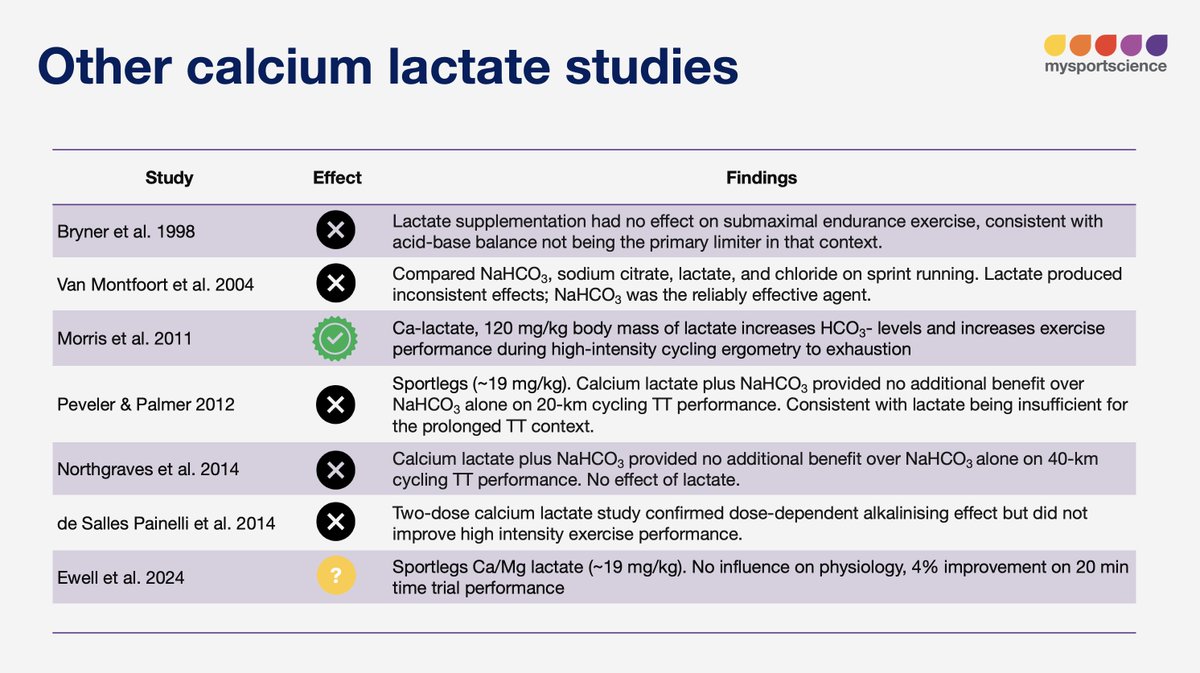
Lactate is often blamed for athletic fatigue. Now we recognise lactate as an important fuel during exercise. But what about lactate supplements? Do they live up to the claims that are being made and what does the evidence really tell us? Read the blog: https://t.co/vi23QQ25aJ
#lactate
Four weeks of wall squats reduced systolic blood pressure by nearly 10 points in adults with high blood pressure.
Researchers then compared continuing three sessions weekly with reducing to two, one, or none for another month. Systolic pressure remained roughly 7 mmHg below starting levels in the once- and twice-weekly groups. Continuing three sessions weekly produced the greatest reduction of about 14 mmHg. In those who stopped completely, blood pressure moved back toward baseline.
This fits with a previous analysis of randomized trials that identified isometric exercise, which involves holding a muscle contraction, as an effective way to lower resting blood pressure.
What interests me is the practical question - how much of an exercise benefit can we preserve when we temporarily have less time? This study suggests that reducing the frequency can retain part of the benefit for up to a month.
@longevitymediaa Consistent with controlled studies: a single night of restricted sleep can reduce next-day insulin sensitivity in healthy adults. Effect sizes vary, and one bad night isn't a disease. Still, a decent argument for protecting the boring bedtime routine.
@longevitymediaa Alcohol blunts overnight HRV and raises resting HR in wearable data, partly through reduced vagal activity while it's metabolized. That's why a nightcap can wreck sleep metrics even when you 'fell asleep fast'. Dry take: sedation is not sleep.
@foundmyfitness Isometric work lowering BP fits the broader meta-analytic picture. A plausible bonus: sustained contractions often come with slow, controlled breathing, and slow exhales raise vagal tone. Would love to see whether breathing pace was tracked in these trials.
@brianmackenzie HRV is one of the more informative signals here, though it's a trend, not a verdict. Low HRV alongside fatigue is worth a conversation with a clinician, not a self-diagnosis. Same-condition morning readings over weeks beat any single number.
@brianmackenzie Makes sense physiologically: just above the first lactate/ventilatory threshold, sympathetic drive and breathing rate climb together. A nasal-breathing talk test is a cheap field proxy for staying below it. Not perfect, but free.
@wavewellnessapp Right, the multiple-comparisons trap. With enough metrics, some correlations are guaranteed. A simple guard: write the hypothesis first, then run a 2-week on/off test of one change. Even n-of-1 beats mining your own dashboard for stories.
@andrew_flatt Classic saturation pattern: vagal activity so high that RMSSD plateaus or falls while HR keeps dropping. Which is why RMSSD alone can mislead in well-trained people. Pairing it with HR, and standing HRV like you did, makes the story more honest.
@ApneaReset Intermittent hypoxia is a dose question: brief, mild exposures show up in altitude research as adaptive, while repeated nightly dips with reoxygenation are the pattern linked to oxidative stress. Same signal, very different dose. Sprouts are nice, though.
@ApneaReset Menthol activates cold receptors (TRPM8), so the nose feels clearer without airflow actually changing. Sensation and resistance are different measurements. It's why objective data like AHI or flow beats 'feels better' every time.
Two inhales through the nose, one long exhale through the mouth. That's the physiological sigh, and your body already does it on its own every few minutes. Our first newsletter explains why: https://t.co/kwh0sxHKM3
The sigh's trick: the second sniff reopens collapsed alveoli, so the long exhale dumps more CO2. In Balban 2023, five minutes daily for a month beat mindfulness on mood. Mechanism: lungs, then vagus. Cost: one mildly dramatic exhale.
Physiological sigh eases stress by boosting parasympathetic activity. Two nasal inhales (deep + short top-up) then a long slow exhale. Linked to improved mood and lower arousal in research. How: inhale deep, top-up inhale, long exhale. Repeat 3-5x.