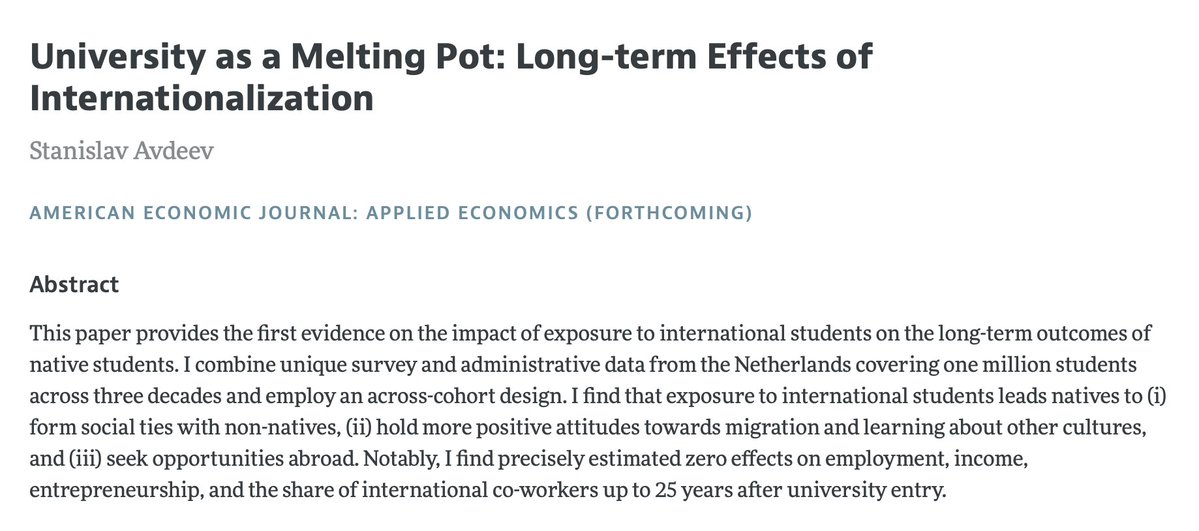
Forthcoming in AEJ: Applied Economics “University as a Melting Pot: Long-term Effects of Internationalization”
Debates on international students often focus on capacity, funding, or competition.
My paper shows the main effects on natives are not academic or economic, but social
Forthcoming in AEJ: Applied Economics “University as a Melting Pot: Long-term Effects of Internationalization”
Debates on international students often focus on capacity, funding, or competition.
My paper shows the main effects on natives are not academic or economic, but social
New WP "University as a Melting Pot: Long-term Effects of Internationalization"
Debates on international students often focus on capacity, funding, or competition.
My paper shows the main effects on natives are not academic or economic, but social.
https://t.co/Dgx4q9HrYn
1/8
Forthcoming in AEJ: Applied Economics: "University as a Melting Pot: Long-term Effects of Internationalization" by Stanislav Avdeev. https://t.co/ki3UH8tTyU
Join the online @PhdEvs seminar where I present the findings of my paper on the impact of international students on native students in the Netherlands on 5th February.
The full working paper is open access and available here:
https://t.co/M4ImsR5X6e
🗓️Join us Thursday, 5 Feb, as Stanislav Avdeev (@stnavdeev) from the University of Amsterdam presents his research:
“University as a Melting Pot: Long-term Effects of Internationalization.”
Register: https://t.co/zgPrCjH8h9
#EconTwitter#EconJMP#EducationEconomics#Migration
I gave an interview about my paper on the impact of internationalisation in the Netherlands. We discussed findings showing that studying with international students makes natives more culturally open and internationally oriented, without compromising their local economic success.
‘Studenten die met internationals hebben gestudeerd lijken ook echt meer open te staan voor de rest van de wereld, en verhuizen bijvoorbeeld significant vaker naar het buitenland.’ https://t.co/mcxziCiYaK
For a short, non-technical summary of the main results, see my earlier post:
https://t.co/eX2jLzhluZ
The full working paper is open access and available here:
https://t.co/M4ImsR5X6e
New WP "University as a Melting Pot: Long-term Effects of Internationalization"
Debates on international students often focus on capacity, funding, or competition.
My paper shows the main effects on natives are not academic or economic, but social.
https://t.co/Dgx4q9HrYn
1/8
The article discusses findings from my recent research showing that exposure to international students during university has lasting effects on social cohesion and attitudes with no negative effects on the labor market outcomes.
@litetalker@AmirGrinstein 1. Yes, tuition fees are the same for all EU countries.
2. Some programs are taught in Dutch and others in English, at bachelor’s and master’s levels.
3. In 2019 (the last year I analysed), tuition fees were about €2,000 per year for Dutch/EU students and €12,000 for non-EU.
@litetalker@AmirGrinstein It’s a mix: some programs lack enough domestic students, non-EU students pay higher fees, NL relies on international talent for its knowledge economy. EU mobility makes it easy to study here, tuition is low vs. other English-taught countries, and the quality of education is high
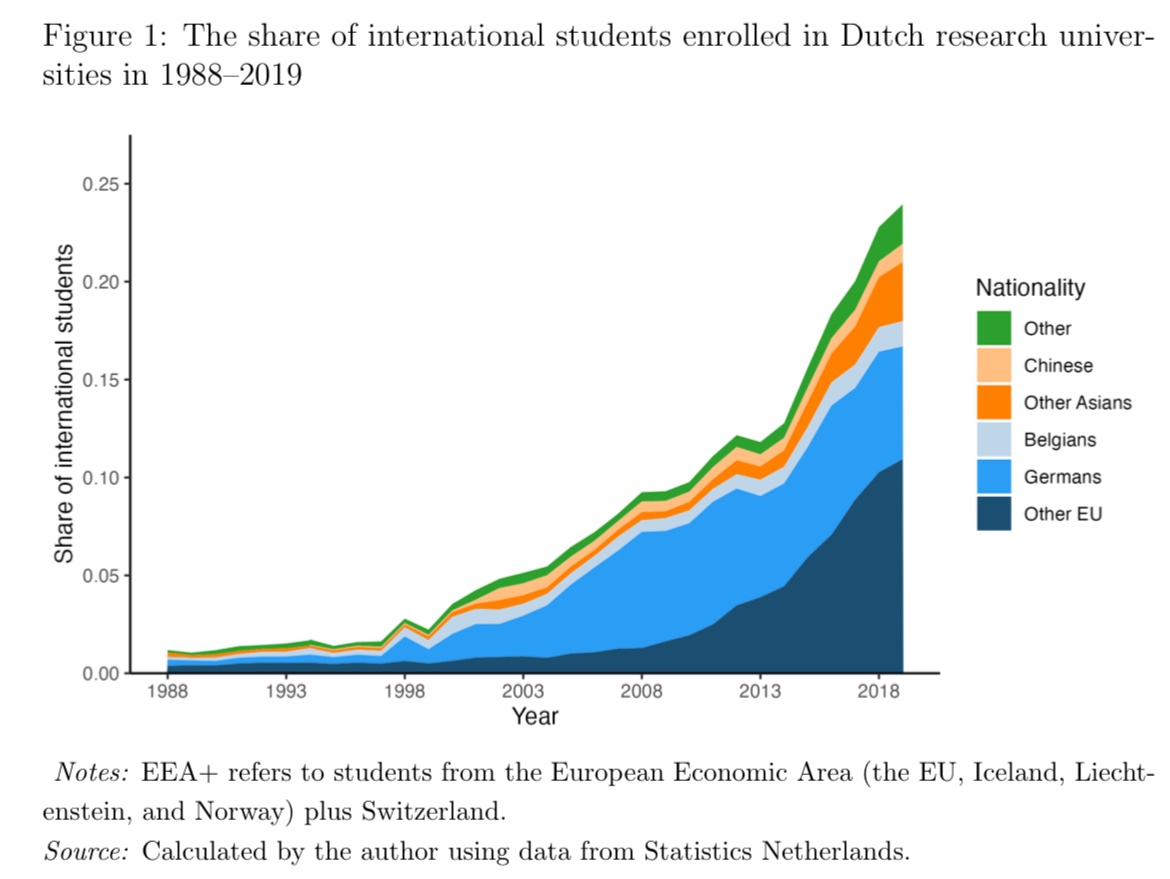
@litetalker@AmirGrinstein For context, the overall share of international students in tertiary education is 13.7% in the Netherlands, 12.7% in Germany, and 10.1% in Belgium. Source: https://t.co/MIhNBYkDtm
@litetalker@AmirGrinstein The figure I’ve shared is from my paper and shows the share of international students among first-year students in bachelor’s programs. The share is higher in master’s and PhD programs.
Policy takeaway
Much of the policy debate focuses on restricting international student inflows. However, such limits may carry societal costs: reduced cultural openness, weaker social integration, and no offsetting gains in the labor-market outcomes of local students.
8/8
New WP "University as a Melting Pot: Long-term Effects of Internationalization"
Debates on international students often focus on capacity, funding, or competition.
My paper shows the main effects on natives are not academic or economic, but social.
https://t.co/Dgx4q9HrYn
1/8
Effects depend on context
Social-integration gains are largest in:
- Non-STEM fields
- Larger programs
- Programs with more gender balance
- Exposure to international students from culturally proximate European countries.
7/8