Evolución del ColaCao desde 2002
📈 ColaCao en euros: +160%
💰 Oferta Monetaria M3 (Eurozona): +150%
📊 Inflación (IPC INE): +58%
👷 Salario real medio: -1% (estancado)
Los grumitos suben casi al mismo ritmo que el dinero creado… mientras los sueldos reales no avanzan.
Fuentes: INE (IPC y salarios), ECB (M3), precios de mercado (ColaCao).
In a fiat currency system, the benefits of deflationary technology primarily accrue to asset holders, because the forced inflation created by central banks pumps up asset values.
If we were living under an honest, hard-money monetary system, where the benefits of technology would not be offset by central banks debasing the currency, those gains would accrue more evenly across the population.
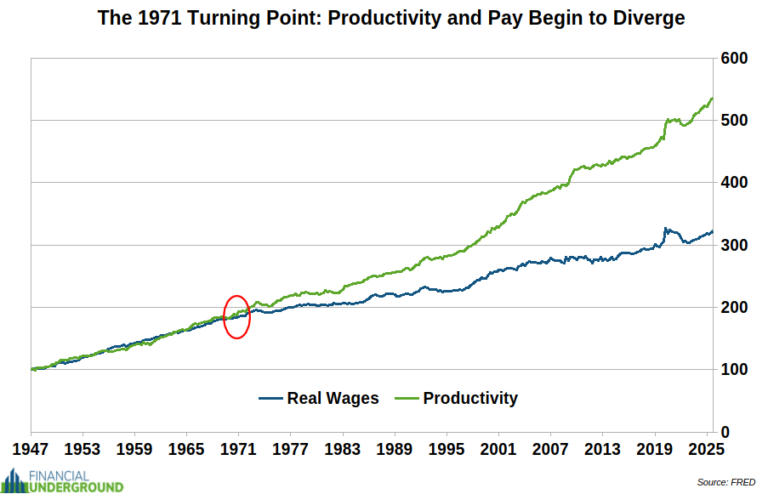
That is why we think the chart below is instructive.
It is a long-term view of real wages versus productivity.
The two tracked together well for decades, showing that as productivity increased, real wages did too. In other words, most people benefited from increases in productivity through higher real wages.
Then something changed around 1971, when that strong positive correlation broke. It was the year the US government cut the dollar’s last link to gold and the dollar became a pure fiat currency.
Since 1971, there has been a growing gap between productivity and real wages.
If you could transport yourself back to the early 1970s, just as the divergence between productivity and real wages began, and ask people what they thought 2026 would look like, they might have said something like The Jetsons—flying cars, advanced technology, and a society in which everyone was better off.
They probably would not have believed you if you told them that, in reality, people would be worse off in many ways in 2026 than they were in the early 1970s, despite enormous technological progress. We may not have flying cars or The Jetsons, but there have still been significant advances. Yet people’s standard of living has declined in many ways.
Today, many people are bewildered by how people could be worse off now than they were then. The answer is in this chart, which shows that the fiat system and currency debasement are the problem.
Despite advances in technology, the shocking level of currency debasement has not merely kept pace with the natural deflation that comes from increased productivity, but has vastly outpaced it… which is why people are, in many ways, worse off today than they were in the early 1970s. That prosperity has been stolen by inflation and fiat currency.
Since 1971, productivity has continued to increase, largely thanks to advances in technology, but those gains have not translated into growth in real wages as they had in the past under an honest money system. That is because under a fiat currency system, the central bank—the Federal Reserve—has created significantly more inflation than the gains in productivity, which meant real wages did not keep up.
However, those productivity gains from advancing technology did not just disappear. They were redirected somewhere else. They accrued primarily to asset holders, as wage earners chased rapidly depreciating fiat currency.
In short, the fiat currency system is a mechanism for transferring wealth created by technological productivity gains to asset holders and politically connected insiders closest to the money printer.
Frankly, it is a disgusting, dishonest system that operates at the expense of honest people.
But that is the nature of the monetary system we are all forced to live under. And it is wise to acknowledge it, understand it, and take action to protect yourself.
And now, with AI bringing a mind-bending level of productivity gains, this dynamic is about to go into overdrive.
Los bancos no prestan el dinero que depositamos.
Si pides un préstamo de 10.000 €.
El banco no busca si alguien tiene ahorrados esos 10.000 €.
Simplemente crea 10.000 € nuevos en tu cuenta y anota que le debes esa cantidad + intereses.
O sea, los bancos no son meros intermediarios…
Son creadores de dinero a través del crédito.
Cuando prestan dinero aumenta la cantidad de dinero en la economía y cuando la deuda se repaga se reduce el dinero en la economía.
Por eso JP Morgan dijo en 1912:
“El oro es dinero; todo lo demás es crédito.”
Hoy en día también tenemos Bitcoin: dinero escaso que no es deuda de nadie, no es el pasivo de ningún banco ni gobierno. Es tuyo de verdad si lo tienes en auto custodia, igual que el oro físico.
They always knew it…
Under the gold standard, a free banking system stands as the protector of an economy’s stability and balanced growth… In the absence of the gold standard, there is no way to protect savings from confiscation through inflation. There is no safe store of value. If there were, the government would have to make its holding illegal, as was done in the case of gold…This is the shabby secret of the welfare statists’ tirades against gold. Deficit spending is simply a scheme for the ‘hidden’ confiscation of wealth - Alan Greenspan.
Hundred years ago, Henry Ford wanted to ditch gold for an energy-backed currency where 1 hour of energy = $1.
Goal? Break the bankers’ grip & end wars fueled by controllable money.
Sound familiar?
Bitcoin finally made it real: money backed by actual energy, decentralized, and unstoppable.
Ford was early. Satoshi delivered⚡₿.
@edugaresp Debes de ser de los que repiten la ley de oferta y demanda…porque te estalló la cabeza hace tiempo. Doctor en economía, que sinsentido todo.
@fenixrabassa No hace mucho tiempo la gente salía a la calle para que no se sacrificara a un perro que entró en contacto con Ébola y llamando asesinos…ahora degollan a una joven y todos callados como putas…episodio de percepción de inseguridad lo llaman…
🚨 ¿La vivienda en España ha subido de verdad… o solo en euros devaluados?
Mira este gráfico claro (2010-2026):
• Precio nominal sube fuerte
• Pero frente a ORO y BITCOIN ha perdido mucho poder adquisitivo
• La expansión monetaria (M3) explica parte de la subida en euros
La creación de dinero infla los precios.
Fuentes:
• Vivienda → Tinsa, INE, Registradores
• M3 → Banco Central Europeo
• Oro → LBMA
• Bitcoin → CoinMarketCap
Gráfico generado por @grok (xAI)
@SeekingTheValue Los hijos no son nuestros, son del estado que puede decidir quitarle un hijo/a a sus padres por vulnerabilidad, para meterle en un centro tutelado por ese estado y que ese menor al que dicen proteger sea abusado y acabe pidiendo la muerte asistida…
Todo muy coherente…