▶️ Looking for cheap high growth stocks with expanding margins
▶️ Mostly small & microcaps
▶️ Target: 30% portfolio return p.a.
⚠️ Not investment advice
@paviaanicapital Congrats, man! Fingers crossed for you that the market shows an appropriate reaction to this news tomorrow. The AH drop is absolutely ridiculous.
Reason for the sell-off was that operating profit for FY 2027 was lowered from 4.5b JPY in the mid-term management plan to just 4.0b JPY in the actual forecast.
Reasons cited in a Q&A were lower than expected productivity gains from AI, higher guaranteed rents, a lower than expected occupancy rate, and higher IT security costs. IMO the stock is definitely very interesting at current levels. Probably the highest-quality smallcap in Japan.
IMO, URGN is by far (!) the most undervalued biotech in the entire market, and also the one with the best R/R. Don't understand the recent price action at all.
If it’s because of the imminent readout from CGON, this would be absolutely ridiculous, because IMO URGN has the big advantage that it replaces a TURBT (painful surgery), while CGON's drug is given in addition to a TURBT. For the patient, from my layman's perspective, Zusduri from URGN is therefore clearly the preferred choice. URGN's CEO has talked about this topic quite often in past conferences.
I haven’t been following the recent newsflow or the earnings call, as I sold my position mid-last month to de-risk my portfolio. I agree with you that I also wouldn’t read too much into the company’s silence regarding the PAI, because that’s almost certainly for legal reasons so close to the PDUFA date.
I don’t know yet if I would re-enter post-approval. Depends on whether I have cash on hand at that point and where the stock is trading.
Current analyst consensus is modeling $1.65 in EPS by 2030. Given the execution risk that remains even after a potential approval, I’d personally want a 40% IRR. My base case would be 15x PE in 2030, which means the share price couldn’t go above $6.45 for a 40% IRR. Using a slightly more optimistic multiple of 20x PE, a 40% IRR would work up to a price of $8.60. So for me personally, anything above $8.60 probably would be too expensive.
I discussed the statements on QUELL from the call with AI again, and the way I understood it, the study design just wasn’t good or the study wasn't meaningful because of it. With pain-free rates in the mid-50% range, you need far more study participants for statistical significance.
And even though the primary endpoint (pain during surgery) was missed, secondary parameters (pain over 24h, corneal protection, etc.) look good. And since no further study is planned, they won't get a label expansion, but the data seems sufficient enough for Harrow that they believe they can increase adoption in retina with it.
@paviaanicapital Yes! Oh and btw I was also very pleased with the increase in the gross margin level. Depending on how much they choose to spend for S&M, I see long-term potential for a very attractive EBIT margin in the 30-40% range.
$NRXS
I rarely talk about Neuraxis because a few smart investors on X are already covering the stock quite well. That said, I still think the broader market is sleeping on this name.
Last week, the company was invited to an investment conference, and CEO Brian Carrico shared several interesting insights that I'd like to break down below.
1️⃣ Insurance Coverage
➢ As I already noted in my brief Q2/26 review (https://t.co/q0u64LDbjJ), the lack of broad insurance coverage is by far the most critical bottleneck when it comes to scaling the business.
➢ Reason: While the company already has 100m covered lives, they are scattered across the country. In most pediatric hospitals, coverage for local patients was sitting at just 20% to 25%. With penetration rates that low, many hospitals hesitate to set up standardized treatment protocols or allocate dedicated capacity, as doing so involves fixed overhead against uncertain revenue potential.
➢ The consequence, in the words of CEO Carrico: “We are not recognizing even a fraction of the insurance policy coverage we have…”
➢ Whereas Carrico remained rather vague on the call regarding the exact timing of new coverage wins, the company announced a major win of 18m covered lives just one day later, bringing the current total to 120m covered lives. As a reminder: on the Q2/26 call, Carrico guided for 200m covered lives by year-end 2027.
2️⃣ Concrete Actions to Accelerate Growth
➢ While Neuraxis currently has 7 full-time sales reps on staff, they plan to increase that headcount to 15 by end of 2026 and to 30 by year-end 2027. On top of that, they currently have 10-12 independent sales reps signed. In my view, this is a strong signal that management is gearing up for a significant top-line inflection.
➢ In addition, they hired a new VP of Market Access, Reimbursement, and Provider Solutions. Key responsibilities include:
◦ Onboarding new commercial payers,
◦ Getting the IB-Stim CPT code (effective since early 2026) added to the Medicaid fee schedules in roughly 20 states that haven't adopted it yet (meaning IB-Stim cannot be reimbursed there today),
◦ Updating legacy payer policies that still require patients to fail other treatment options before IB-Stim is considered medically necessary.
3️⃣ Revenue & Margin Potential
➢ During the presentation, Carrico guided for $7m–$8m in FY26 revenue, though that assumes zero additional insurance coverage, which is already obsolete following the recent 18m lives win. He expects cash flow break-even at roughly $13m-$14m in revenue.
➢ Sourcing patients is explicitly not an issue; according to the CEO, patients at hospitals with active treatment programs currently face 2-3 month waiting lists for an appointment.
➢ Addressing the latent demand that could be unlocked with just 2–3 additional major commercial payers, he stated:
“And if you talk to our sales team or anyone on the commercial side and you said, what do you think you could do today if you had 2 or 3 more policies, what's the demand? … with our eyes closed, they would tell you 10x.”
➢ This implies a revenue run-rate potential of $70m–$80m with the existing sales team alone.
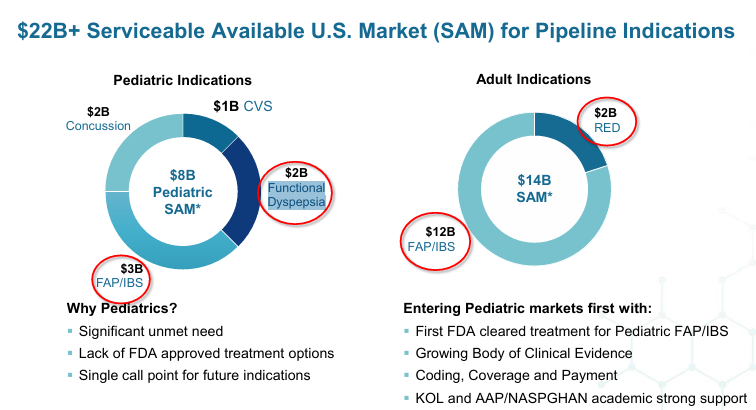
As noted in my initial post: the current $5b pediatric SAM, covering both cleared indications functional dyspepsia (FD) and irritable bowel syndrome (IBS), represents $250m in revenue potential at just 5% market penetration.
➢ On top of that comes the veteran market, which I hadn't covered previously. Across 7m veterans with an estimated 3% FD prevalence, this represents a ~$840m SAM, or another ~$42m in revenue potential at a 5% market share. The VA healthcare operates without commercial insurance middlemen, removing that scaling bottleneck entirely for Neuraxis.
➢ In total, looking strictly at the currently cleared and commercially pursued indications, I consider about $290m in long-term revenue as realistic. At a 5x sales multiple, that would translate to a market cap of $1.45b. Currently, the fully diluted market cap (calculated with 20.4m shares) sits at around $150m.
➢ Clinical trials for the adult market in FD and IBS outside of the VA market (representing another ~$11b SAM that I haven't factored in above) are already underway. While IB-Stim is already FDA-cleared for adult indications, these studies are specifically required to secure commercial insurance coverage.
➢ With a gross margin target in the high 80% range explicitly highlighted in the presentation, I personally expect Neuraxis to achieve EBIT margins of >30% in a more mature state.
4️⃣Conclusion
➢ Trading against 2026e revenues of about $8m, Neuraxis doesn't look cheap at a $150m diluted market cap. However, considering the grwoth potential outlined above, and remembering that Neuraxis holds the only FDA-cleared therapy for pediatric FD and IBS, I believe valuing the company on 2026 multiples is fundamentally the wrong approach.
➢ With additional insurance wins, I expect a meaningful acceleration in revenue growth over the coming years. The CEO wrapped up his presentation with: “I believe we're going to see a very nice run in the next 15, 18 months.”
➢ I therefore remain invested, my average cost is $4.74.
As always: This post does not constitute financial advice.
$NRXS
Neuraxis is my #2 top performer YTD, up 70%. I added to my position yesterday. Personally, I believe this is one of the best R/R profiles I have ever seen in the microcap space.
Here’s a quick pitch including sources for own research🧵
➢ US Medtech, $83m mcap. Their device IB-Stim, is the first-ever FDA-cleared treatment for both Irritable Bowel Syndrome (IBS) and Functional Dyspepsia (FD) in adolescents. Now moving to mass commercial execution.
➢ Unit Economics: Each IB-Stim wearable is priced at $1,195 ($4,780 per 4-week treatment, one device per week). Gross margins are ~90%.
➢ Market Size: The currently reachable pediatric SAM for the two cleared indications is $5b per year. With additional indications (studies ongoing) and adult indications (FDA clearance already obtained, but additional studies required for insurance coverage, which are also currently ongoing), the SAM grows to $22b USD per year. Again, for comparison: the current market cap is just $83m.
➢ Permanent Category I CPT code for IBS & FD became effective Jan 1, 2026. Insurance coverage exceeding 100m covered lives following the massive Anthem win (45m members) in December 2025. Negotiations with other insurance providers are ongoing.
➢ Management didn't give much away during last week's Q4 call regarding the inflection following the Category I CPT code. However, they mentioned: Early Q1 2026 Prior Authorization submissions are running 10x higher than last year, signaling a rapid revenue ramp.
➢ Also interesting: New Federal Supply Schedule (FSS) contract active, opening a direct channel to 7M veterans. First orders already received, outpacing internal expectations. In the veteran market, no additional insurance coverage is required, as the FSS listing means the treating physician alone decides on the application.
➢ Revenue grew 33% in 2025 to $3.6M – before the Category I CPT code went live. The company targets operating break-even at $11M annual revenue. The current cash balance is ~$6M USD. According to the Q1 call: "...no near-term need for additional financing at this time."
➢ To put the potential of the stock into perspective: based solely on the current pediatric SAM of $5b USD, a 5% market penetration would represent $250m in revenue potential. At 5x sales (which should be realistic given the high margin potential), that implies a potential market cap of $1.25b vs. $0.083b today.
⚠️ Not financial advice. I am invested personally, so a potential conflict of interest exists.
Sources for own research:
https://t.co/aYR0CPrEIi
https://t.co/Df7buEqzJx
https://t.co/I8hSgi3Cmr
https://t.co/s6lOlgVfa2
https://t.co/REOsyL5nMw
I listened to the call yesterday and agree with you. Story is on track, very little changed for me. I think the guidance regarding cash flow break-even at $13m - $14m annual revenue from Q2 can no longer be held with the increased opex, it’s probably rather $16m - $17m now.
Otherwise, the mentioned issues with one of the newly won insurers were a bit unfortunate (that only one instead of four devices gets approved here), so I'm also rather expecting a not too exciting Q4. Positive for me was the increased prior authorization rate of 38% as of Oct 30 compared to 32% as of Sept 30 previously.
Still convinced of a strong 2027, especially with the new internal sales reps and the external sales reps for VA. Regarding dilution, they stated „we remain optimistic regarding the liquidity profile of our ATM facility,“ which is what you just posted. Let's see. Even with slightly more dilution than expected, the upside on a 4-5 year view remains extremely high, so I’m not worried in that regard.
$458870.KQ
Absolute bloodbath today. The stock is down 30% following catastrophic quarterly numbers (revenue down 38% YoY & 66% QoQ, negative operating profit).
After management assured back in Q2 that implementation delays with large customers from that quarter would be recovered in Q3, they are now blaming hardware shortages of servers and server components for the bad numbers. These servers are installed on-site at customer locations to process incoming patient data captured via the gateways.
I sold my position today because I have lost all confidence in management. In both an analyst interview (https://t.co/3E4s0dO0EO) and recent investor presentations, they guided for a growth rebound in Q3/26, only to drop these disastrous numbers without warning at a time when the broader market is already under severe pressure.
I already had a slightly bad gut feeling with the equity raise discussed in the post linked below. Why would a company execute a capital raise at a seemingly depressed share price right after quarter-end if they truly believed Q3 numbers would rebound and trigger a rally? Now I know. In hindsight, I really should have trusted my gut instead of getting blinded by the market's initial positive reaction to the raise.
I also want to sincerely apologize to anyone who might have followed me into this name. I am deeply sorry.
Right now, I don’t even feel sad, just completely empty. My portfolio has now given back all of its YTD gains, which is a absolutely devastating outcome considering how much time I put into stocks and investing alongside my full-time job.
Honestly, I’m not sure what conclusions to draw from the brutal price action over the past few weeks. Virtually everything in my portfolio has taken a hit lately - whether deserved, like Seers, or completely unjustified, like UroGen and the majority of my other holdings. Does it even make sense to avoid AI stocks if the portfolio gets dragged down by the tech sell-off anyway? Should I rotate back toward more US names and cut exposure to more exotic markets? Would going back to broader diversification (~25 names) make more sense, given how much better that strategy worked for me in 2024 and 2025? Should I deprioritize hypergrowth? Should I put more weight back on classic quality filters, like steady, reliable QoQ revenue growth and predictability?
These are the questions I need to answer for myself over the coming weeks. For now, I’m taking a step back and going on a multi-week break from here to gather my thoughts. Not sure yet if or how this account will continue afterwards.
$458870.KQ
Seers managed to escape the sea of red across my Asia portfolio this morning, up +3% on an interesting announcement.
The company issued 110b KRW in convertible bonds ($82m USD against a market cap of around $700m USD) with a 5-year maturity (due Oct. 21, 2031).
At first glance, this might not sound like a reason to celebrate given the dilution (9.38% based on the agreed conversion price), but the terms are remarkably favorable for the company, and the use of proceeds is highly interesting:
➢ Coupon rate is 0.0%. Investor upside is entirely dependent on the conversion into equity.
➢ Conversion price: 30,586 KRW per share (+23.8% premium vs. today’s close).
➢ Starting Oct. 21, 2027, Seers holds a call option for 2 years to buy back up to 50% of the bonds at a very modest premium of 0.1% p.a.
➢ Buyers of the bonds are 38 very reputable South Korean institutions and funds, including KB, Shinhan, Kiwoom, Mirae, and Samsung.
➢ Use of proceeds:
◦ 10b KRW for automation and expanding production facilities,
◦ 30b KRW for upgrading existing products & services, R&D for new products, and working capital,
◦ 70b KRW for investments into the MENA and US subsidiaries of Seers.
➢ In a news article that I found, the Seers CEO gets more specific:
"This funding round is a strategic investment to expand our medically proven medical AI technology and business model into the global market. In the U.S., we will secure local diagnostic service infrastructure and AI solution networks, and in the UAE, we will expand business execution based on existing supply contracts to grow into a global medical AI platform company."
➢ In the US, Seers intends to acquire an equity stake in an IDTF (Independent Diagnostic Testing Facility) to accelerate the rollout of its outpatient monitoring platform mobiCARE. IDTFs are diagnostic facilities independent of physician offices or hospitals that conduct, for example, long-term ECG monitoring and bill directly to Medicare. As a reminder: at $250, reimbursement for mobiCARE is roughly 5x higher in the US than in South Korea.
➢ This allows Seers to bypass building out its own US sales network from scratch and avoids lengthy proof-of-concept studies, enabling an immediate market entry into the US.
➢ In MENA, they plan to establish a dedicated operating base for diagnostic services and to roll out specialized arrhythmia centers.
🔍 My take:
➢ A successful international expansion is a core pillar of my investment thesis, so I welcome any positive color on this front. Since Seers' CEO is the largest shareholder, owning around 26% of the comapny, he must have strong conviction that the bond proceeds will turn out to be value-accretive long term, far outweighing the dilutive impact. The 0% coupon alongside participation from such a broad base of high-profile institutional investors also is an encouraging signal in my view.
➢ Following the Q2 print, many Korean analysts cut their growth estimates, which I find hard to understand, as the revenue miss back then was largely a timing issue rather than soft demand (as discussed in my post linked below).
➢ Yet even on these very conservative numbers, the stock IMO is not expensive, trading at 15x EV/EBIT 2026e & 11x EV/EBIT 2027e. Based on my own projections, it's even cheaper than that.
➢ Should Q3 numbers come in strong alongside continued positive newsflow regarding international expansion, I can easily see analysts revising their estimates materially higher again.
BTW: Seers now provides English-language investor decks as well, which you can check out here:
◦ Part 1: https://t.co/1kwWkCRMUi
◦ Part 2:
https://t.co/5kKo0FMSIE
As always: This post is not financial advice.
@juansar14616081 Thank you for the compliment. I will probably continue posting, but first I need to get some peace of mind and draw my lessons from the past weeks and months. But thanks in any case.
@FriendlyCapMgmt Danke dir vielmals! Ja, da hast du wahrscheinlich Recht, aber aktuell ist es einfach maximal frustrierend, wenn die Arbeit von einem Jahr innerhalb von einer Woche quasi vernichtet wird. Hoffentlich ist mein persönlicher Tiefpunkt nun erreicht worden.
Ist wirklich so. An so Tagen wie gestern und heute denke ich mir, warum nicht einfach ein ETF und gut ist. In diesem Jahr standen der Aufwand, den ich Betrieben habe, und der Ertrag einfach in keinem Verhältnis zueinander. Die gewisse Portion Glück, die ehrlicherweise dazugehört und die ich vor allem in den letzten beiden Jahren hatte, fehlt mir dieses Jahr einfach komplett.
Ich denke, ein wichtiger Punkt wird sein, zukünftig Unternehmen mit one-off-Umsätzen mehr zu meiden, außer, ich habe eine wirklich gute Sichtbarkeit in die Zukunft. Ansonsten werde ich wirklich in mich gehen in den nächsten Tagen und darüber nachdenken, wie ich wieder meinen Ansprüchen gerecht werden kann.
@vlusinvest Thank you! Hope that in the future I can dig up more successful ideas here again. Results like with Seers are definitely not my standard that I set for myself.
Yeah, that’s so true. You can't emphasize enough how important an honest management team is. Although in this case, I really should have listened more to my gut after the raise and less to the PR blah-blah, so a big part of the blame lies with me.
Thanks! I hope so as well, but I’ve definitely written off this year.
@alexeliasson Thanks Alex! Wish I had followed at least one or two of your pitches, then my year would've been much better. Almost all of your ideas that I remember were home runs.