Paris, 2012.
Der Wind in Frankreich dreht sich. Präsident Francois Hollande gewinnt die Wahl mit dem Versprechen: 75 % Spitzensteuersatz für Millionäre. Reiche werden zum Staatsfeind erklärt.
Bernard Arnault, der reichste Mann Europas, fackelt nicht lange. Er beantragt die belgische Staatsbürgerschaft. Die Schlagzeilen überschlagen sich, die Empörung ist riesig. Doch Arnault weiß: Kapital ist ein scheues Reh. Es bleibt nicht dort, wo es geschoren wird.
Arnault zog den Antrag später zwar zurück (nachdem er seine Stiftungen in Belgien abgesichert hatte), aber die Botschaft saß. Die Steuer brachte kaum Einnahmen, vertrieb aber Investoren und Kapital. 2015 wurde sie heimlich begraben. Der Staat wollte das Gold, verlor aber die Gans, die es legt.
Der Staat hat legitime Aufgaben. Aber er hat auch Interessen. Und diese Interessen sind nicht immer deckungsgleich mit deinen.
Inflation ist keine Naturgewalt. Sie ist eine politische Entscheidung. Wer Ersparnisse in Bargeld hält, subventioniert diese Entscheidung freiwillig.
Vermögenssteuern, Erbschaftssteuern, kalte Progression. Das sind keine Ausnahmen. Das sind Werkzeuge. Sie werden eingesetzt, wenn der Staat Geld braucht. Und er braucht immer Geld.
Good Morning from Germany, where electricity prices are now regularly falling below zero around midday. On May 1, they even dropped to the floor at -49.999 cents per kilowatt hour. The reason is simple: we are generating more solar power than we can use or store. As a result, Germany has to cover the gap between these negative market prices and the guaranteed feed-in tariffs paid to producers—an expensive outcome. These prices are a clear indication of the utterly disastrous energy transition.
LIQUIDATION CONTAGION
Wealth taxes are even worse than you think. Any asset held by Californian billionaires or Dutch citizens is now at risk of experiencing forced liquidation pressure.
So: it’s not just that you don’t want to hold assets as a Dutchman. You also don’t want a Dutchman to hold your assets. Because the logic of forced liquidation is contagion.
Let’s think it through.
(1) First, suppose there is an asset with a total market cap of $10,000, with 10 shares total, of which 1 share each is held by 10 different holders, all in the Netherlands. To simplify the math, assume the Dutch holders bought those shares at par, or close to $0.
(2) Now suppose today is the unrealized cap gains tax day, and the share price is $1,000 per share. Each Dutch guy is hit with a 36% tax, and owes $360. The first guy sells his one share, gets $1,000, and pays $360 in tax while retaining $640.
(3) But the first guy’s sale reduces the market price to $960 per share. So when the second guy sells, he only retains $600 after paying $360 in tax.
(4) Now assume that by the 7th guy, all the selling has pushed the share price to collapse to $200 per share. This is a very reasonable scenario if 60% of the cap table has suddenly been dumped. Indeed it might go much lower.
(5) At $200 per share, the 7th guy actually has to go into debt to pay the tax as he owes $360. He sells his one share, pays all $200 of the proceeds in tax. And still owes $160 more in tax.
(6) The 8th, 9th, and 10th guys are even more screwed. By the time they sell, the price will likely have crashed to $100 per share or less. As with the 7th guy, even 100% liquidation will not cover their tax burden.
(7) So we immediately see many negative things about the Dutch unrealized cap gains tax bill.
(a) First, it will cause large simultaneous forced liquidations. Everyone must sell 36% of their stake near the same time.
(b) Second, it may be literally impossible to pay if a critical mass of the cap table is all subject to it at the same time. In the example above it was 100% Dutch holders, but has it been just 60% the result would have been much the same: a collapse in the share price.
(c) Third, that means it would be disastrous to have too many Dutch citizens (or Californian billionaires!) on the cap table. Their forced sales will crash your share price.
(d) So, you might have to start mass blocking those resident in wealth-taxing jurisdictions from investing in your companies.
(e) This in turn makes the poor Western European guy even poorer, as he gets locked out of high growth assets.
To be clear: I really do feel bad for the formerly Flying Dutchmen, now Crying Dutchmen. They invented much of modern capitalism. They founded New Amsterdam, now New York. They’ve punched way above their weight. I wish them only the best.
Nevertheless…they should prepare for the worst. This may be a tough century for Western Europe. The first ones out might get to freedom, while the slowest may be stuck behind a new Iron Curtain, spending a century paying off the debts their states incurred over the last century.
Because the long run fruits of Western Keynesianism are the same as Soviet Communism, in the sense of wealth seizure and pauperization.
I mean, if you knew the future, you wouldn’t want to co-own a farm with a Russian in 1916. For similar reasons, you might not want to co-own a share of stock with Dutch national in 2026. Or with anyone in a seizure-curious jurisdiction…which unfortunately includes much of Western Europe, Canada, and Blue America.
You instead want assets that are not held by those subject to forced liquidations. Now, I grant that this is an unusual way to rank assets…Dutch holders considered harmful?!? Yet it might sadly be necessary to minimize your exposure to liquidation contagion.
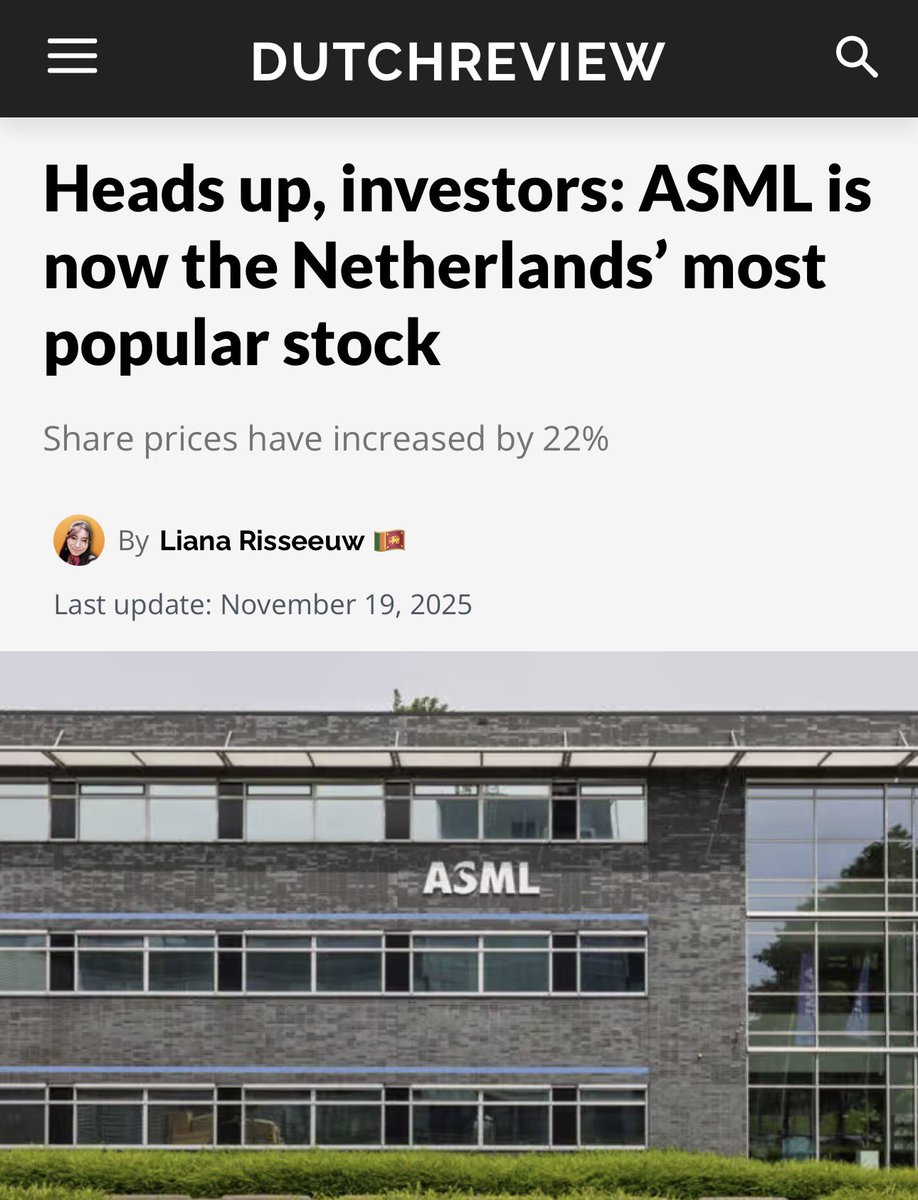
PS: guess which crucial stock is most held by the Dutch? ASML. So: this unrealized cap gains tax may not literally be a communist plot, but it would have the same effect.
To restate the argument in more obvious terms.
The eventual end state of labor under automation has been understood by smart men (ie not shallow libshits) for ≈160 years since Darwin Among the Machines. The timeline to full automation was unclear. Technocrats and some Marxists expected it in the 20th century.
The last 14 years in AI (since connectionism won the hardware lottery as evidenced by AlexNet) match models that predict post-labor economy by 2035-2045. Vinge, Legg, Kurzweil, Moravec and others were unclear on details but it's obvious that if you showed them the present snapshot in say 1999, they'd have said «wow, yep, this is the endgame, almost all HARD puzzle pieces are placed».
The current technological stack is almost certainly not the final one. That doesn't matter. It will clearly suffice to build everything needed for a rapid transition to the next one – data, software, hardware, and it looks extremely dubious that the final human-made stack will be paradigmatically much more complex than what we've done in these 14 years.
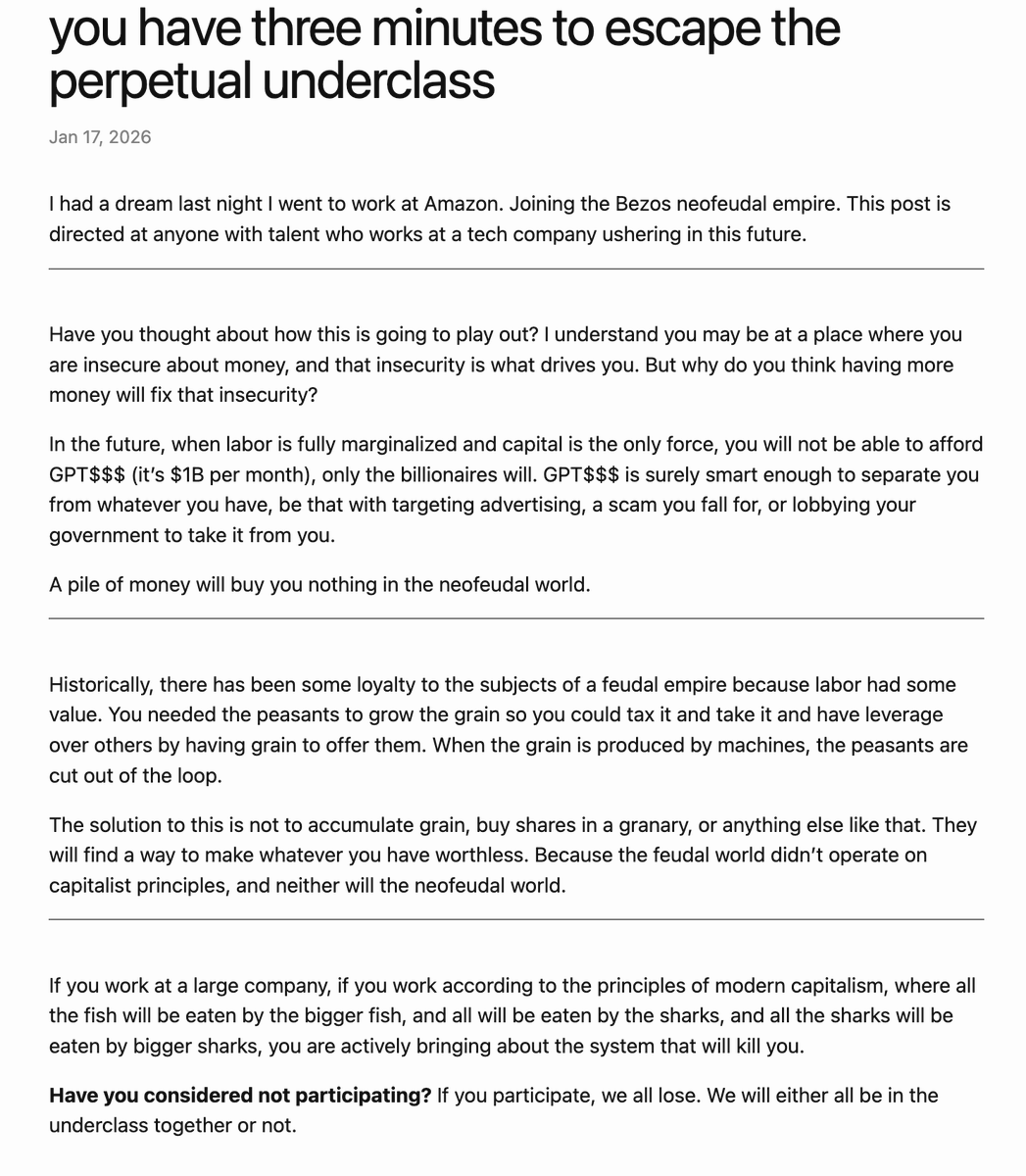
Post-labor economy = post-consumer market = permanent underclass for virtually everyone and state-oligarchic power centralization by default.
As an aside: «AI takeover» as an alternative scenario is cope for nihilists and red herring for autistic quokkas. Optimizing for compliance will be easier and ultimately more incentivized than optimizing for novel cognitive work. There will be a decidedly simian ruling class, though it may choose to *become* something else. But that's not our business anon. We won't have much business at all.
The serious business will be about the technocapital deepening and gradually expanding beyond Earth.
Frantic attempts to «escape the permanent underclass» in this community are not so much about getting rich as about converting wealth into some equity, a permanent stake in the ballooning posthuman economy, large enough that you'd at least be treading water on dividends, in the best case – large enough that it can sustain a thin, disciplined bloodline in perpetuity.
Current datacenter buildup effects and PC hardware prices are suggestive of where it's going. Consumers are getting priced out of everything valuable for industrial production, starting from the top (microchips) and the bottom (raw inputs like copper and electricity). The two shockwaves will be traveling closer to the middle. This is not so much a "supercycle" as a secular trend.
American resource frenzy and disregard for diplomacy can be interpreted as a state-level reaction to this understanding.
There certainly are other factors, hedges for longer timelines, institutional inertia and disagreement between actors that prevents truly desperate focus on the new paradigm. But the smart people near the levers of power in the US do think in these terms.
Speaking purely of the political instinct, I think the quality of US elite is very high, and they're ahead of the curve, thus there are even different American cliques who have coherent positions on the issue. Other global elites, including the Chinese one, are slower on the uptake. But this state of affairs isn't as permanent as the underclass will be.
For people who are not BOTH extremely smart and agentic – myself included – I don't have a solution that doesn't sound hopelessly romantic and naive.
$1.5T is a war-time budget.
We are at war and Wall Street just doesn’t know it yet.
You don’t increase spend by that much if you aren’t serious about breaking away from China.
China understands this and will act accordingly…further accelerating a decoupling.
But Trump is a performer at heart.
Theatre is important.
It’s why you conduct ops in Venezuela with massive overmatch. It’s why you bomb Furdow with B2s based in Missouri.
Maintaining a narrative and veneer of Trump wanting to maintain trade with China is valuable…until that veneer is too costly.
And like I said from the start Washington benefits from prolonging the pre-positioning stage… we get to do things like lock-down swing producers of energy and buyout back-up territories like Greenland.
China meanwhile sees the board clearer than Wall St… but nevertheless is confused because Washington’s risk-tolerance was impossible to gauge at the start…it’s why it froze when tariffs were first rolled out, didn’t react appropriately as it’s “allies” were attacked and now seemingly is confused as to how to react to H200s… or the Dutch on Nexperia…
But as time goes on it becomes clearer that I was right when I said back in April that Street is massively underestimating Trumps risk tolerance and he really said “fuck it we ball”.
Soon you will be hearing a lot more from Bessent and Lutnik again…
Soon USMCA will start getting shat on…
And behind closed doors Carney and Claudia will start getting aggressively squeezed…
And soon Vietnam will become a hot topic again and Washington will suddenly “revisit” the tariff rate because they “suddenly” realized China is still through-putting massive export volumes…
And soon Bessent is going to announce a “review” of how the U.S. doles out dollar liquidity and swap lines…
And meanwhile voters will be aggressively bribed into midterms.
And you will all sit back and try to make sense of the chaos and repeat to yourself “man, Trump just woke up on the wrong side of the bed today” “there’s no 4D chess, everyone in Washington is retarded”….
But you know who won’t be telling himself that? Xi
Because he might have a false sense of superiority in his system but he at least has the benefit of having read history.
Something most of you clearly have never done.
Dalio is wrong…..this isn’t the fall of Rome.
This is the transition from republic to empire.
🫡
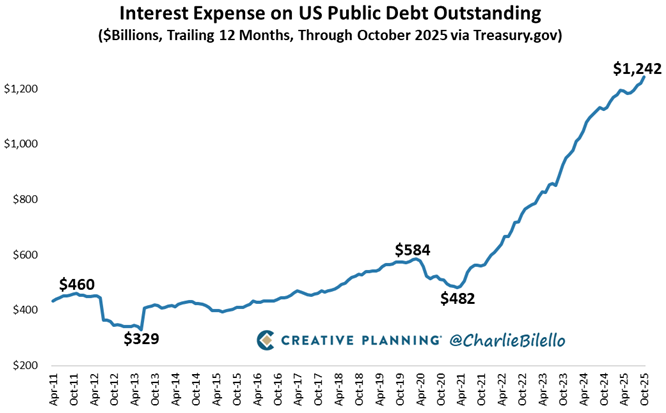
The Interest Expense on US National Debt rose to a record $1.24 trillion in the last 12 months, more than doubling over the past 4 years. The US Government now spends more money on interest than it does on National Defense.
Video: https://t.co/2vr4renD4x
Deutsche Bank is exploring ways to hedge its exposure to data centers. It's looking at options including shorting a basket of AI-related stocks and buying default protection via synthetic risk transfers. https://t.co/7Hn6MK7yDk
Companies that pay their workers partly in stocks are probably the closest that has ever existed to the communist dream of workers owning the means of production. Isn’t it ironic?
$NVDA
Was at a startup networking event in Europe last night
The innovation and energy was off the charts
Just a few of the revolutionary ideas that were pitched:
"Uber but for the Estonia market"
"Airbnb but for locally-owned rentals in Italy"
"Google but GDPR-compliant"
The list goes on and on
You wouldn't see ideas this good at an American networking event
And yes, I did gain express consent and GDPR-compliant waivers to post these ideas publicly
Long Europe!