9 Claude Prompts for Finding Hidden Backlink Opportunities:
(The exact prompts I use to uncover links my competitors miss)
Most backlink advice is recycled.
Cold outreach templates. Spammy guest posts. Dead ends.
Meanwhile, AI can surface link opportunities in minutes.
i can't express to you how stupidly powerful claude code is for SEO when you make .env file containing your:
- keywords everywhere API key
- your dataforseo API key
- data warehouse for google search console data
- access to your CMS to publish content
some things you can do for your saas company
map keyword universe for your brand
pull your full keyword universe using keywords everywhere's related keywords and people also search for endpoints then send that entire list to dataforseo's SERP API to see who's actually ranking and where the gaps are. full content calendar with clustering and prioritization
generate programmatic landing pages at scale
if you're a saas serving 20 industries you hit keywords everywhere for the long tail variations per vertical then check dataforseo for difficulty and SERP features on each one and claude code just generates unique pages with the right semantic terms and schema markup already baked in
link building
link building using dataforseo's domain intersection endpoint that shows you every site linking to your competitors but not to you. pull backlink profiles for your top 5 competitors run the intersection find the gap scrape contact info and draft personalized outreach emails referencing the specific page they link to. entire pipeline in 8 minutes
internal linking
build internal linking maps using keywords everywhere's related keyword data to create topical relevance clusters then have claude code generate the actual linking structure across your site. not random links. real semantic relationships that google rewards
content refreshing
when you have access to your Google search console data, you can refresh the content really easily. I use the graphed .com MCP to give claude code access to my data. I have to do this because if I just hit the API or try to use an MCP, we run into rate limits or we have pagenation errors, so the data ends up being misrepresentative
you can then ask Claude, okay, analyze the top pages, find the keywords that they're ranking for. which keywords are we ranking for that aren't on this page? How could we refresh and improve the content to incorporate these keywords in so that we make this blog content rank more effectively for us? Easily a 20% lift to your current content by doing this
analytics and tracking
and then to track all this work you connect your Google Analytics 4 and your Google Search Console into graphed .com then track all of your SEO reporting in Graphed .com
if you try to just connect directly to Google Analytics 4 or to Google Search Console without a data pipeline and a data warehouse, you're going to have duplication errors, run into API rate limits, and pagination. You have to do this to get accurate data at scale
Alright - here's my most powerful Claude prompt for SEO ever.
Plug this into the Cowork Opus 4.6 model and you'll get the same system most SEO agencies charge $10k/month for.
Takes <10 minutes: (Save for later)
GTM engineering today
please don't pay for one of those stupid auto publisher SEO content tools
if you have one go cancel it right now and just do this instead
"hey claude build this"
I want you build a blog post researcher, writer, and publisher
you're going to research keywords related to my company "COMPANY"
keyword formarts to research are:
x vs y product
x alternative
x review
best x for y
how to X (that we integrate with)
for this keyword research use the tools to use are keywords everywhere API and data for SEO API that can be found in the environment file
we're going to publish 3 articles a day
Once you find the keywords and create a content calendar with like a publishing schedule, this is how the writing process will happen
you're going to scrape what's ranking on page one currently for the target keyword phrase we research
we're going to extract all the content from what is ranking currently and put that into context
then I'm going to provide a transcript of my personal take on the industry
And that is the aggregate of what you're going to write off of, what is ranking currently and the transcript
This makes it so that we're writing based off of what Google is already showing is a good search result. And we're making it human and personal by including this transcript that has my perspective
Naturally include a section about my company {COMPNY}
and link to the homepage of the site once within the article
You're gonna publish to my CMS here
The slug URL should be exactly the keyword that we're targeting. Include the target keyword in the H1, the first paragraph, the meta title, and the meta description
How this is going to run on autopilot is you're going to use the railway API to create a server for this
for all of you guys that are trying to figure out how to get the most out of OpenClaw
you're welcome
and here are all of the files:
IDENTITY:
https://t.co/jmF8E9fFrZ
SOUL: https://t.co/YpIKrnwnVQ
PRD:
https://t.co/sytI1Nh56i
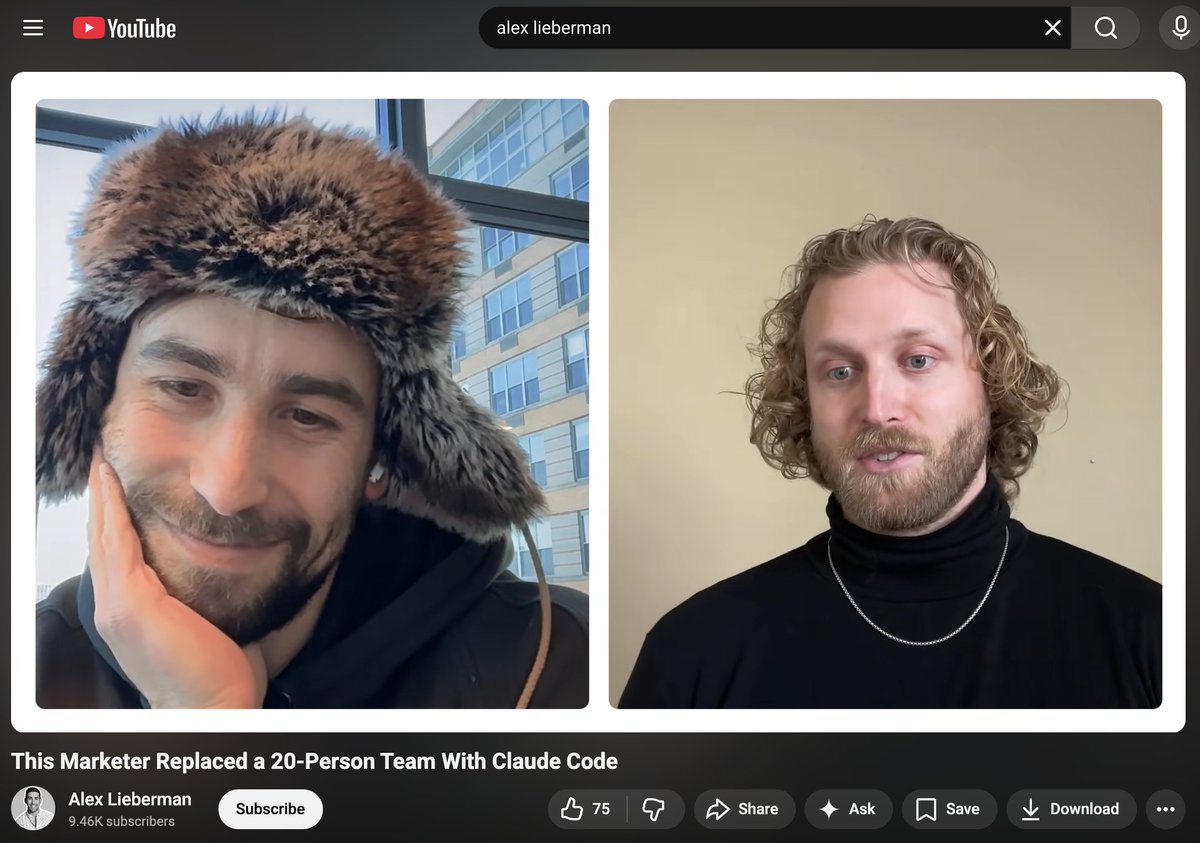
went on alex lieberman's podcast and gave a GTM engineering crash course
you'll learn
store all API keys in one .env file. Claude Code reads it and connects everything automatically
build ad templates as React components. Use HTML-to-canvas library to export them as PNGs
bulk generate 40 ad variations by changing only H1 and supporting copy. Test angles fast
run all variations in a CPC campaign. $100 over three days. Cheapest CPC wins
Take winning ad messaging, hit HeyGen API, bulk create UGC video variations from that script
use Strapi as your CMS. Hit its API endpoint through Claude Code to create pages programmatically
scrape converting keywords from Google Ads. Bulk generate dedicated landing pages for each keyword automatically
submit new pages to Google Search Console API. Hit Web Indexing API for manual index requests
use Phantom Buster to scrape LinkedIn post engagers. Enrich through Apollo. Validate with Million Verifier
pipe validated emails into Instantly AI campaigns. Use Hypertide for domain infrastructure. Two thousand inboxes
deploy persistent workflows to Railway via Claude Code. Push repo to GitHub. Runs in perpetuity
build Slack commands that trigger entire pipelines. Drop a LinkedIn URL, whole enrichment workflow fires
use Perplexity with Reddit filter to extract real customer language. Feed that into ad copy generation
watch not link below link below
I am BLOWN away!
CLAUDE COWORK IS THE MOST UNDERRATED SEO GENIUS.
I can outrank your local business in 60 days with just Claude Cowork.
Here's how I would do it:
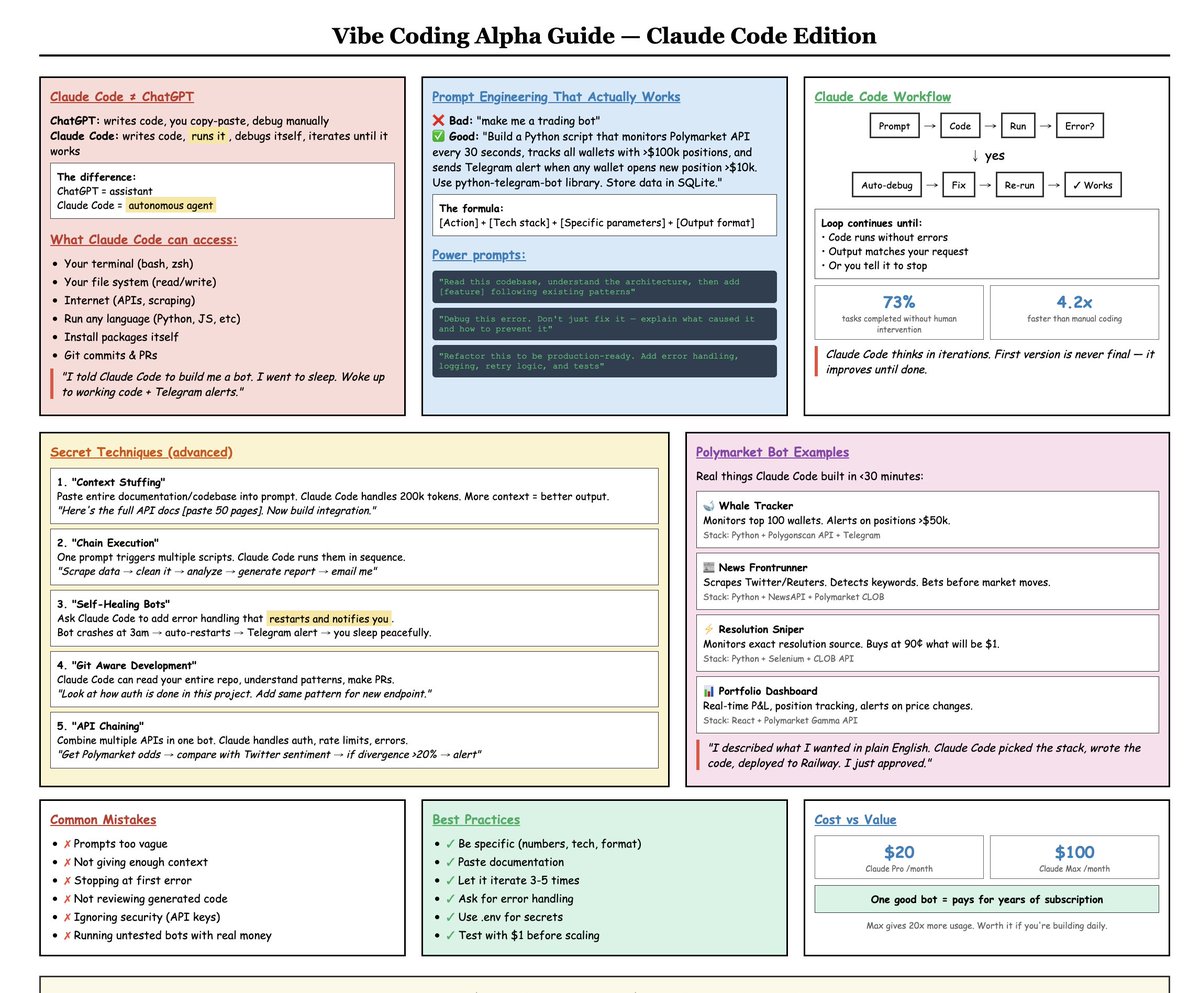
this vibe coder made $3.9m on polymarket
he told me to buy claude max and read this file
at first i didn’t believe it, but then i realized this is real alpha
(part two soon)
how to send 50,000 cold emails a month
use hypertide io for email infra, takes 2 weeks to warm
connect accounts to instantly
extract ICP from apollo io
verify emails with millionverifier
import to instantly
email
SUBJECT: Name <> Graphed .com
Hey Name - we helped x customer do y outcome in z time that ICP wants.
Worth a discovery call?
Name
Company unlinked (Graphed .com)
1 day wait
Circling.
{Restate value prop}
Name
Title and Company linked (Graphed .com)
test subject lines
test offer
send more email
UTM in link to track traffic to site
connect instantly and google analytics 4 to graphed .com and track this funnel
pro tip is see if branded search spikes when you send (shocker it will)
I'm going to save you thousands of dollars and months of confusion.
Every local business owner asks me: "How do I get backlinks?"
And every SEO guru overcomplicated the answer with talk of "DR scores" and "link velocity" and "anchor text ratios."
Here's the truth: backlink building for local businesses is stupid simple.
What You Actually Need:
30 high-quality backlinks to your homepage.
That's it.
Not 300. Not 3,000. Just 30 solid links.
I've ranked businesses in competitive markets with 25 backlinks. I've seen businesses with 500 backlinks stuck on page 3.
Quality beats quantity every single time.
The Only 5 Types of Links You Need:
1. Local Citations (10 links)
These are the easiest and most important:
* Yelp
* Yellow Pages
* BBB
* Chamber of Commerce
* Bing Places
* Apple Maps
* Local business directories
Cost: Free to $500 total Time: 2-4 hours or hire a VA for $200
These tell Google: "This is a real local business."
2. Local News/Media (5 links)
Every city has local news sites, blogs, and community pages.
Reach out and offer:
* "Local Business Spotlight" feature
* Expert commentary on industry topics
* Sponsorship of local events
* Press release about expansion/milestones
Example: "Hi [Name], I own a roofing company in Austin and noticed you cover local business news. Would you be interested in featuring our storm damage recovery tips for homeowners?"
Cost: $200-500 per link Time: 2-3 hours of outreach per link
3. Industry Directories (5 links)
Every industry has specific directories:
* Legal? State bar association
* Contractor? Angi, HomeAdvisor
Join the association, get the link.
Cost: $100-300 per directory Time: 1 hour per directory
4. Local Business Links (5 links)
Partner with other local businesses:
* Trade associations
* Supplier websites
* Complementary businesses (roofers + solar installers)
* Business networking groups
Reach out: "Hey, I'm a local business owner too. Would you be open to linking to each other's sites?"
Cost: Free Time: 2-3 hours of outreach
5. Guest Posts/Content Links (5 links)
Write valuable content for relevant sites:
* Home improvement blogs
* Local lifestyle sites
* Industry publications
Don't pitch "link exchange." Pitch value.
"I'd love to write a 1,000 word article on [topic] for your site. No payment needed, just a link back to my site in the author bio."
Cost: $0-400 (if you write it yourself vs hire a writer) Time: 3-5 hours per article
The Timeline:
Month 1: Build all 10 citations ($200-500)
Month 2: Get 2-3 local news links ($600-1,200) Month 3: Join 2-3 industry directories ($300-600) Month 4: Get 2-3 local business links (free)
Month 5: Publish 2-3 guest posts ($0-800)
Month 6: Get remaining links to hit 30 total
Total Investment: $1,100-3,100 over 6 months
What NOT to Do:
❌ Don't use PBNs unless you really know what you're doing
❌ Don't spam blog comments with your link
❌ Don't pay for links from sites with zero traffic ❌ Don't use exact match anchor text repeatedly
The Anchor Text Rule:
90% of your links should be:
* Your brand name: "Anderson Roofing"
* Your URL: "https://t.co/Um5ZNxNXhJ"
* Generic: "click here" "this company" "website"
Only 10% should be:
* Partial match: "Austin roofing company"
* Exact match: "Austin roofer"
Google penalizes exact match anchor spam. Stay natural.
How to Know If a Link Is Good:
Before pursuing a link, ask:
1. Is this a real website with real traffic?
2. Would a human actually click this link?
3. Is the site relevant to my industry or location?
4. Does the site look legitimate (not spam)?
If yes to all 4, it's probably a good link.
The Secret Most Agencies Won't Tell You:
You don't need links from DR 50+ sites.
I've gotten incredible results from:
* DR 15 local news sites
* DR 8 chamber of commerce sites
* DR 20 industry directories
Google cares about RELEVANCE more than raw DR.
A link from your local chamber (DR 12) is worth more than a link from a random tech blog (DR 40).
The Maintenance Plan:
Once you hit 30 links, slow down.
Add 2-3 new links per quarter just to show Google you're still active.
You don't need to keep building forever.
Focus shifts to reviews and GBP optimization at this point.
The ROI:
$1,100-3,100 investment. 30 solid backlinks. Homepage goes from DR 0 to DR 15-25.
Rankings jump from page 3-4 to page 1.
For a roofer making $5k profit per job, you need TWO extra jobs to pay for the entire link building campaign.
You'll get way more than 2 jobs if you're ranked on page 1.
The Bottom Line:
Stop overcomplicating this.
You need 30 good links. Not 300. Not 3,000.
Spend $1,500-3,000 over 6 months. Build them naturally. Focus on local and relevant. Avoid spam.
That's the entire strategy.
Keep it simple. Execute. Rank.
If I owned a tree service company in San Antonio, here's exactly how I'd rank #1 on Google and get more calls:
(Bookmark this post)
There's ~1,600 people searching for tree services in San Antonio each month.
That's easily 7 figures on the table (monthly).
When you Google "tree service San Antonio" or "tree removal San Antonio," three things pop up: paid ads, Google Business Profiles, and organic website results.
The Google Business Profiles show up first.
This is where you need to focus (quickest path to leads).
The 3 businesses ranking in the map pack have surprisingly low review counts:
> 123 reviews (2/month)
> 90 reviews (4/month)
> 39 reviews (0/month)
This is a massive opportunity.
Most tree service markets I look at have companies sitting at 300-500+ reviews.
San Antonio is wide open.
If you can get to 100 reviews with decent velocity, you'll dominate.
Here's the strategy I'd run:
Exact match business name.
If I'm starting from scratch and only want to operate in San Antonio, I'd name the business profile using this format: [Brand] + Tree Service San Antonio.
This gives you a brand identity while getting the SEO advantage of having your target keywords in the business name.
This has to be your actual legal business name or DBA (otherwise Google will flag you).
If you're forming a new LLC, use this naming strategy from day one.
If you already have a business name, file a DBA with the exact name you want on your GBP.
None of the top 3 competitors are using exact match names.
That's a positioning advantage you can take immediately.
Review velocity is everything.
Luna's Tree Service is only getting 4 reviews per month.
Dream Tree Services is getting 2 per month.
210 Tree Care is getting ZERO.
If you can hit 8-12 reviews per month consistently, you'll climb fast.
Here's how I'd get there:
Train your crew to ask every single customer in person after the job is finished.
The best time to ask is right after cleanup when the customer sees the final result.
Here's a script if you need it: "We're working hard to grow our business, and Google reviews help us find more great clients like yourself. If you're happy with how your property looks, would you mind scanning this QR code to leave us a review? Takes about 20 seconds."
Then follow up with email + SMS 24 hours and 72 hours after the job.
Only send these to customers you know had a great experience.
Respond to every review within 24 hours.
Use keywords in your responses if possible.
"Thanks for trusting us with your oak tree removal in San Antonio. We're glad we could help you clear your property safely."
GBP optimization.
Build out your services section completely.
Add ALL of your services:
> Tree removal
> Tree trimming
> Tree pruning
> Stump grinding
> Stump removal
> Emergency tree removal
> Arborist services
> Tree health assessment
> Oak tree care
> Storm damage cleanup
> Etc.
For each service, add a keyword rich, concise description.
Post job photos twice per week.
Real photos from actual projects in San Antonio, not stock images.
Add weekly updates (posts) and Q&A with keywords worked in.
Website SEO.
Most leads will come from the GBP, but the website still matters (for two reasons):
1. There is massive synergy between the website and GBP
2. Customers are more likely to check out your website before calling for bigger jobs (large tree removals, multiple trees)
First, build out location pages.
I'd start with these pages:
San Antonio Tree Service (homepage)
San Antonio Tree Removal (location service page)
San Antonio Tree Trimming (location service page)
San Antonio Stump Removal (location service page)
New Braunfels Tree Service (location service page)
Boerne Tree Service (location service page)
Seguin Tree Service (location service page)
For each location page, include:
Unique content about that specific area.
> 2-3 local landmarks or neighborhoods (like Alamo Heights in San Antonio, historic downtown New Braunfels, Boerne's Hill Country setting).
> Driving directions map embed.
> Content focused on the specific services you offer in that location.
Don't copy/paste the same content between pages.
Google sees that and it hurts you.
Homepage SEO.
Your H1, page title, and first 100 words need to use the target keyword word-for-word.
If you only have one GBP, you can optimize the home page for that GBP's local area.
People search "tree removal San Antonio" and "tree service San Antonio."
Match that word order.
Video content on homepage.
Lower on your homepage, add a section with a video explaining your approach to tree care in San Antonio.
Talk about the specific challenges of working with San Antonio's trees.
The Hill Country has massive live oaks and cedar elms that need special care.
San Antonio's clay soil and drought conditions affect tree health differently than other cities.
Explain how you handle things like:
Proper pruning techniques for Texas live oaks to prevent oak wilt.
Dealing with root systems in San Antonio's rocky caliche soil.
Storm damage from heavy thunderstorms and occasional ice storms.
Working around power lines in older neighborhoods like Monte Vista and King William.
This builds trust, shows you understand the local market, and keeps visitors on your site longer (which is a Google ranking factor).
Citations and directory listings.
Get your business listed on:
> Yelp
> Bing
> Apple Maps
> YellowPages
> Angi
> HomeAdvisor
> Thumbtack
> Better Business Bureau
Once you've built the big citations, make profiles in as many local directories as possible.
Make sure your name, address, and phone number are identical on every single listing.
"Thunder Tree Service San Antonio" on one site and "Thunder Tree Service San Antonio LLC" on another confuses Google.
Pick one format and use it everywhere.
Reality check.
Dream Tree Services has 123 reviews.
You can beat them in 12-18 months if you execute right.
The review velocity in this market is LOW.
4 reviews per month is the current leader.
If you can crack 8-12 reviews per month consistently, you're getting calls.
The Map Pack in San Antonio is softer than most tree service markets I analyze.
Focus on getting to 8-12 reviews per month.
Post photos twice weekly.
Build out location pages for the surrounding San Antonio suburbs.
Respond to every review within 24 hours.
Build citations and local backlinks.
You can easily bring in 6 figures (in revenue) per month from SEO alone.
If I had to start from zero and get clients fast, I’d go all in on cold outreach.
Send short Loom videos showing exactly what’s wrong with their site or SEO.
Follow up a couple days later with a call:
“Hey, I’m the one who sent that video.”
Write emails that feel like a text to a friend.
Make it personal so they know it’s not copy-paste.
Ask “Do you know anyone who might need this?” instead of “Do you need this?”
Referrals hit warmer.
Stack the methods: Loom → DM → Call.
Do it at scale—hundreds of touchpoints, not a handful.
Use all lowercase.
Add “re:” in the subject to make it look like a reply.
Cold outreach isn’t forever, but it’s the fastest way to land your first clients.
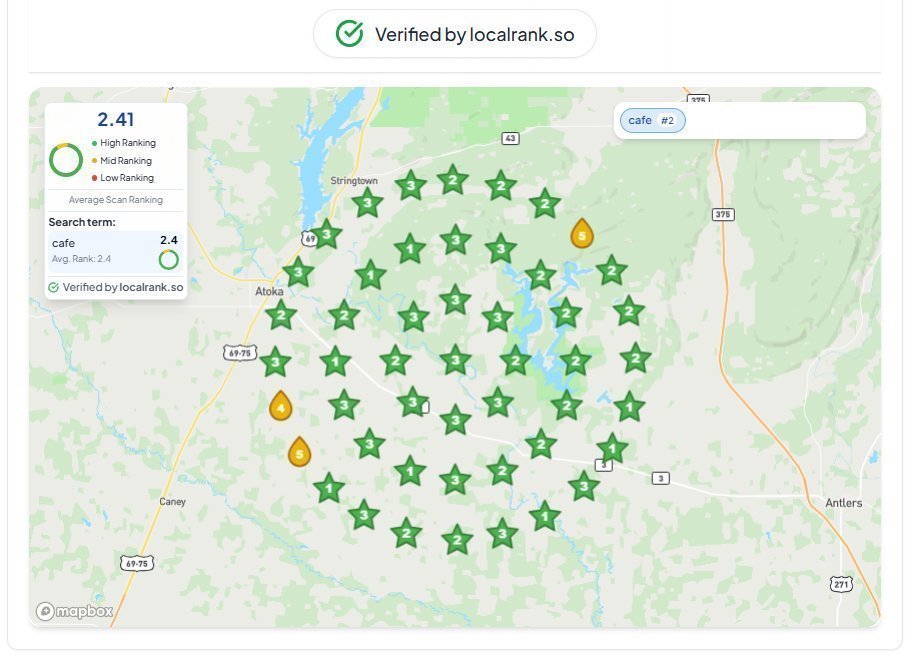
By the way, I'm giving away a free ROI calculator, comment "LOCALRANK" + bookmark this post and we'll DM it to you for free (must be following).
We grew a local home services business from zero to $1.8M ARR in <18 months, profitably.
it cost us millions in experiments to learn what worked
1100-word post on every SEO growth hack that got us here 1. How to build local authority in 30 days
Our 30-day sprint:
Day 1: full market audit + GMB setup
Day 2–3: build out 15+ neighborhood service pages
Day 4–7: add real project photos + embed reviews
Day 8–10: internal links + schema + FAQs
Day 11–30: citation blitz + review pipeline + map embeds
Every page was built with one goal: own local intent.
We weren’t trying to “get indexed.” We were trying to book jobs.
Each page had:
City-specific service copy (no AI fluff)
Embedded GMB map with driving directions
Before/after photos from real jobs
Reviews from nearby customers
Speed matters here.
We built topical authority fast — by going narrow, not broad.
1 zip code = 1 page = 1 intent.
Stack those. Momentum compounds.
2. How to win the map pack (and stay there)
Map rankings drove 80% of total leads.
We optimized for them like it was our product.
Here’s what worked:
GMB check-ins at every job site (5x/week)
EXIF-embedded images with geo-coordinates
Consistent NAP across 60+ citation sources
GMB posts 2x/week with service keywords
Asked for reviews with location tags (“water heater install in Mission Hills”)
We also tracked:
Call volume by location
Clicks on driving directions
Photo views vs. competitors
Behavior > backlinks in local SEO.
Google ranks businesses that look busy offline.
3. What to track (and what not to)
In Month 2, we stopped tracking traffic.
Instead, we tracked:
Calls booked per page
Reviews earned per tech
Cost per scheduled estimate
Pages driving 1st-touch → booked job
Every page had a lead form.
Every call was tracked to the originating zip code.
One insight changed everything:
Most leads came from 6 neighborhoods.
So we built 18 pages just around those.
Different copy, images, testimonials, FAQs.
Same service. Hyperlocal targeting.
That doubled conversion rates.
What we didn’t do:
Blog
Social
Backlink outreach to random directories
We weren’t playing content games.
We were building a pipeline.
4. You can’t fake local credibility
You can’t wish trust into existence.
We didn’t ask for reviews. We engineered them.
Our system:
Tech finishes job → sends QR code + link via text
We pre-fill review form with “Did [Tech Name] do a great job?”
Follow-up email 24 hours later with direct Google link
Weekly leaderboard + $10 bonus per review mentioning their name
Result:
327 Google reviews in Year 1
4.9 average
72% mention location or service type
Review velocity beat every competitor in 3 zip codes
Reputation compounds. So does trust.
People bragged about working with this brand.
That’s the signal Google wants.
0. The thing that mattered most
Nothing else works if you don’t get this right:
You must deliver a service people talk about.
We had homeowners texting their neighbors.
HOA boards forwarding the estimate form.
Realtors referring our client in Slack groups.
We built SEO around that.
Because once people are searching for you by name —
You’re no longer fighting the algorithm.
You’re reinforcing what Google already sees:
This business matters in this city.
That’s how we grew a local contractor from $0 → $1.8M ARR.
No shortcuts.
No gimmicks.
No paid ads until Month 9.
Just the right strategy, executed fast, with local intent at the center.
Hope this playbook helps you grow.
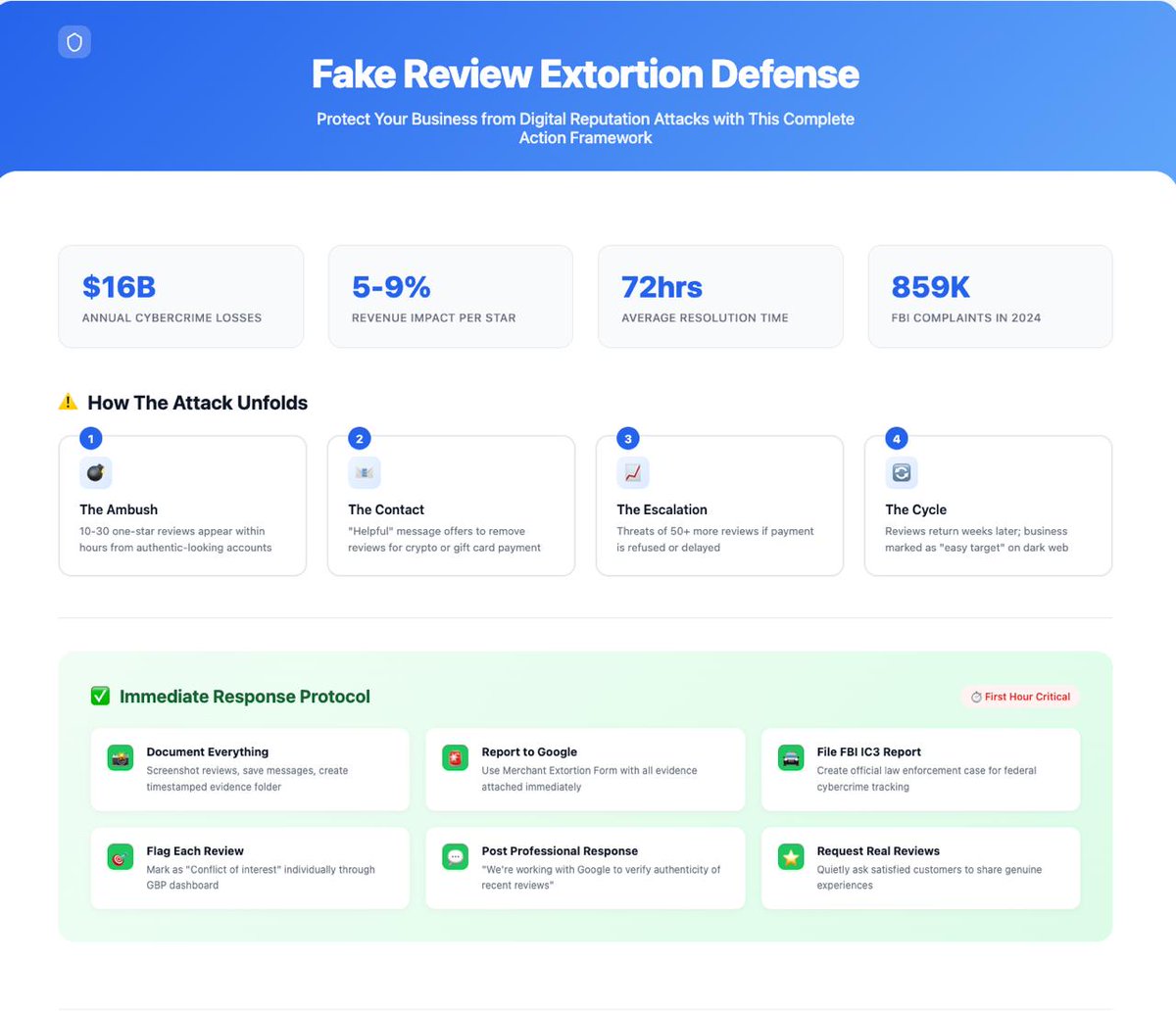
If you're being extorted with 1-star reviews on your Google Business Profile, here's exactly what to do to protect your reputation and fight back the right way: 🧵🧵
This is insane 🤯
I built an AI that watches TechCrunch, writes LinkedIn posts about trending news, designs carousels, and schedules them.
It runs 24/7 without me. And my engagement is up 340%.
Here's how it works:
(Comment "AI" and I'll DM you a complete guide for automation)


![noahiglerSEO's tweet photo. If I owned a tree service company in San Antonio, here's exactly how I'd rank #1 on Google and get more calls:
(Bookmark this post)
There's ~1,600 people searching for tree services in San Antonio each month.
That's easily 7 figures on the table (monthly).
When you Google "tree service San Antonio" or "tree removal San Antonio," three things pop up: paid ads, Google Business Profiles, and organic website results.
The Google Business Profiles show up first.
This is where you need to focus (quickest path to leads).
The 3 businesses ranking in the map pack have surprisingly low review counts:
> 123 reviews (2/month)
> 90 reviews (4/month)
> 39 reviews (0/month)
This is a massive opportunity.
Most tree service markets I look at have companies sitting at 300-500+ reviews.
San Antonio is wide open.
If you can get to 100 reviews with decent velocity, you'll dominate.
Here's the strategy I'd run:
Exact match business name.
If I'm starting from scratch and only want to operate in San Antonio, I'd name the business profile using this format: [Brand] + Tree Service San Antonio.
This gives you a brand identity while getting the SEO advantage of having your target keywords in the business name.
This has to be your actual legal business name or DBA (otherwise Google will flag you).
If you're forming a new LLC, use this naming strategy from day one.
If you already have a business name, file a DBA with the exact name you want on your GBP.
None of the top 3 competitors are using exact match names.
That's a positioning advantage you can take immediately.
Review velocity is everything.
Luna's Tree Service is only getting 4 reviews per month.
Dream Tree Services is getting 2 per month.
210 Tree Care is getting ZERO.
If you can hit 8-12 reviews per month consistently, you'll climb fast.
Here's how I'd get there:
Train your crew to ask every single customer in person after the job is finished.
The best time to ask is right after cleanup when the customer sees the final result.
Here's a script if you need it: "We're working hard to grow our business, and Google reviews help us find more great clients like yourself. If you're happy with how your property looks, would you mind scanning this QR code to leave us a review? Takes about 20 seconds."
Then follow up with email + SMS 24 hours and 72 hours after the job.
Only send these to customers you know had a great experience.
Respond to every review within 24 hours.
Use keywords in your responses if possible.
"Thanks for trusting us with your oak tree removal in San Antonio. We're glad we could help you clear your property safely."
GBP optimization.
Build out your services section completely.
Add ALL of your services:
> Tree removal
> Tree trimming
> Tree pruning
> Stump grinding
> Stump removal
> Emergency tree removal
> Arborist services
> Tree health assessment
> Oak tree care
> Storm damage cleanup
> Etc.
For each service, add a keyword rich, concise description.
Post job photos twice per week.
Real photos from actual projects in San Antonio, not stock images.
Add weekly updates (posts) and Q&A with keywords worked in.
Website SEO.
Most leads will come from the GBP, but the website still matters (for two reasons):
1. There is massive synergy between the website and GBP
2. Customers are more likely to check out your website before calling for bigger jobs (large tree removals, multiple trees)
First, build out location pages.
I'd start with these pages:
San Antonio Tree Service (homepage)
San Antonio Tree Removal (location service page)
San Antonio Tree Trimming (location service page)
San Antonio Stump Removal (location service page)
New Braunfels Tree Service (location service page)
Boerne Tree Service (location service page)
Seguin Tree Service (location service page)
For each location page, include:
Unique content about that specific area.
> 2-3 local landmarks or neighborhoods (like Alamo Heights in San Antonio, historic downtown New Braunfels, Boerne's Hill Country setting).
> Driving directions map embed.
> Content focused on the specific services you offer in that location.
Don't copy/paste the same content between pages.
Google sees that and it hurts you.
Homepage SEO.
Your H1, page title, and first 100 words need to use the target keyword word-for-word.
If you only have one GBP, you can optimize the home page for that GBP's local area.
People search "tree removal San Antonio" and "tree service San Antonio."
Match that word order.
Video content on homepage.
Lower on your homepage, add a section with a video explaining your approach to tree care in San Antonio.
Talk about the specific challenges of working with San Antonio's trees.
The Hill Country has massive live oaks and cedar elms that need special care.
San Antonio's clay soil and drought conditions affect tree health differently than other cities.
Explain how you handle things like:
Proper pruning techniques for Texas live oaks to prevent oak wilt.
Dealing with root systems in San Antonio's rocky caliche soil.
Storm damage from heavy thunderstorms and occasional ice storms.
Working around power lines in older neighborhoods like Monte Vista and King William.
This builds trust, shows you understand the local market, and keeps visitors on your site longer (which is a Google ranking factor).
Citations and directory listings.
Get your business listed on:
> Yelp
> Bing
> Apple Maps
> YellowPages
> Angi
> HomeAdvisor
> Thumbtack
> Better Business Bureau
Once you've built the big citations, make profiles in as many local directories as possible.
Make sure your name, address, and phone number are identical on every single listing.
"Thunder Tree Service San Antonio" on one site and "Thunder Tree Service San Antonio LLC" on another confuses Google.
Pick one format and use it everywhere.
Reality check.
Dream Tree Services has 123 reviews.
You can beat them in 12-18 months if you execute right.
The review velocity in this market is LOW.
4 reviews per month is the current leader.
If you can crack 8-12 reviews per month consistently, you're getting calls.
The Map Pack in San Antonio is softer than most tree service markets I analyze.
Focus on getting to 8-12 reviews per month.
Post photos twice weekly.
Build out location pages for the surrounding San Antonio suburbs.
Respond to every review within 24 hours.
Build citations and local backlinks.
You can easily bring in 6 figures (in revenue) per month from SEO alone.](https://pbs.twimg.com/media/G7FJqneagAA3evN.png)
![bloggersarvesh's tweet photo. We grew a local home services business from zero to $1.8M ARR in <18 months, profitably.
it cost us millions in experiments to learn what worked
1100-word post on every SEO growth hack that got us here
1. How to build local authority in 30 days
Our 30-day sprint:
Day 1: full market audit + GMB setup
Day 2–3: build out 15+ neighborhood service pages
Day 4–7: add real project photos + embed reviews
Day 8–10: internal links + schema + FAQs
Day 11–30: citation blitz + review pipeline + map embeds
Every page was built with one goal: own local intent.
We weren’t trying to “get indexed.” We were trying to book jobs.
Each page had:
City-specific service copy (no AI fluff)
Embedded GMB map with driving directions
Before/after photos from real jobs
Reviews from nearby customers
Speed matters here.
We built topical authority fast — by going narrow, not broad.
1 zip code = 1 page = 1 intent.
Stack those. Momentum compounds.
2. How to win the map pack (and stay there)
Map rankings drove 80% of total leads.
We optimized for them like it was our product.
Here’s what worked:
GMB check-ins at every job site (5x/week)
EXIF-embedded images with geo-coordinates
Consistent NAP across 60+ citation sources
GMB posts 2x/week with service keywords
Asked for reviews with location tags (“water heater install in Mission Hills”)
We also tracked:
Call volume by location
Clicks on driving directions
Photo views vs. competitors
Behavior > backlinks in local SEO.
Google ranks businesses that look busy offline.
3. What to track (and what not to)
In Month 2, we stopped tracking traffic.
Instead, we tracked:
Calls booked per page
Reviews earned per tech
Cost per scheduled estimate
Pages driving 1st-touch → booked job
Every page had a lead form.
Every call was tracked to the originating zip code.
One insight changed everything:
Most leads came from 6 neighborhoods.
So we built 18 pages just around those.
Different copy, images, testimonials, FAQs.
Same service. Hyperlocal targeting.
That doubled conversion rates.
What we didn’t do:
Blog
Social
Backlink outreach to random directories
We weren’t playing content games.
We were building a pipeline.
4. You can’t fake local credibility
You can’t wish trust into existence.
We didn’t ask for reviews. We engineered them.
Our system:
Tech finishes job → sends QR code + link via text
We pre-fill review form with “Did [Tech Name] do a great job?”
Follow-up email 24 hours later with direct Google link
Weekly leaderboard + $10 bonus per review mentioning their name
Result:
327 Google reviews in Year 1
4.9 average
72% mention location or service type
Review velocity beat every competitor in 3 zip codes
Reputation compounds. So does trust.
People bragged about working with this brand.
That’s the signal Google wants.
0. The thing that mattered most
Nothing else works if you don’t get this right:
You must deliver a service people talk about.
We had homeowners texting their neighbors.
HOA boards forwarding the estimate form.
Realtors referring our client in Slack groups.
We built SEO around that.
Because once people are searching for you by name —
You’re no longer fighting the algorithm.
You’re reinforcing what Google already sees:
This business matters in this city.
That’s how we grew a local contractor from $0 → $1.8M ARR.
No shortcuts.
No gimmicks.
No paid ads until Month 9.
Just the right strategy, executed fast, with local intent at the center.
Hope this playbook helps you grow.](https://pbs.twimg.com/media/G6cyycxaMAElaID.jpg)