Chuang Tzu 6.12
Yen Hui asked Kung-nì, saying, "When the mother of Mang-sun Tshâi died, in all his wailing for her he did not shed a tear; in the core of his heart he felt no distress; during all the mourning rites, he exhibited no sorrow.
"Without these three things, he was considered to have discharged his mourning well—is it that in the state of Lû one who has not the reality may yet get the reputation of having it? I think the matter very strange."
Kung-nì said, "That Mang-sun carried out his views to the utmost. He was advanced in knowledge; but in this case it was not possible for him to appear to be negligent in his ceremonial observances, but he succeeded in being really so to himself.
"Mang-sun does not know either what purposes life serves, or what death serves; he does not know which should be first sought, and which last. If he is to be transformed into something else, he will simply await the transformation which he does not yet know. This is all he does.
"And moreover, when one is about to undergo his change, how does he know that it has not taken place? And when he is not about to undergo his change, how does he know that it has taken place? Take the case of me and you—are we in a dream from which we have not begun to awake?
"Moreover, Mang-sun presented in his body the appearance of being agitated, but in his mind he was conscious of no loss. The death was to him like the issuing from one's dwelling at dawn, and no more terrible reality.
"He was more awake than others were. When they wailed, he also wailed, having in himself the reason why he did so. And we all have our individuality which makes us what we are as compared together; but how do we know that we determine in any case correctly that individuality?
"Moreover, you dream that you are a bird, and seem to be soaring to the sky; or that you are a fish, and seem to be diving in the deep. But you do not know whether we that are now speaking are awake or in a dream.
"It is not the meeting with what is pleasurable that produces the smile; it is not the smile suddenly produced that produces the arrangement of the person. When one rests in what has been arranged, and puts away all thought of the transformation, he is in unity with the mysterious Heaven."
IMAGE: Zhu Da, Fish and Birds (17th century)
Vivekachudamani 136-153
BONDAGE AND FREEDOM
Then, holding firmly mind, with knowing soul at rest, know your self within yourself face to face saying, "This am I" The life-ocean, whose waves are birth and dying, is shoreless; cross over it, fulfilling the end of being, resting firm in the Eternal.
Thinking things not self are "I"—this is bondage for a man; this, arising from unwisdom, is the cause of falling into the weariness of birth and dying; this is the cause that he feeds and anoints and guards this form, thinking it the Self; the unreal, real; wrapping himself in sensuous things as a silkworm in his own threads.
The thought that what is not That is That grows up in the fool through darkness; because no discernment is there, it wells up, as the thought that a rope is a snake; thereupon a mighty multitude of fatuities fall on him who accepts this error, for he who grasps the unreal is bound; mark this, my companion.
By the power of wakefulness, partless, external, secondless, the Self wells up with its endless lordship; but this enveloping power wraps it round, born of Darkness, as the dragon of eclipse envelops the rayed sun.
When the real Self with its stainless light recedes, a man thinking "this body is I," calls it the Self; then by lust and hate and all the potencies of bondage, the great power of Force that they call extension greatly afflicts him.
Torn by the gnawing of the toothed beast of great delusion; wandered from the Self, accepting every changing mood of mind as himself, through this potency, in the shoreless ocean of birth and death, full of the poison of sensuous things, sinking and rising, he wanders, mean-minded, despicable-minded.
As a line of clouds, born of the sun's strong shining, expands before the sun and hides it from sight, so self-assertion, that has come into being through the Self, expands before the Self and hides it from sight.
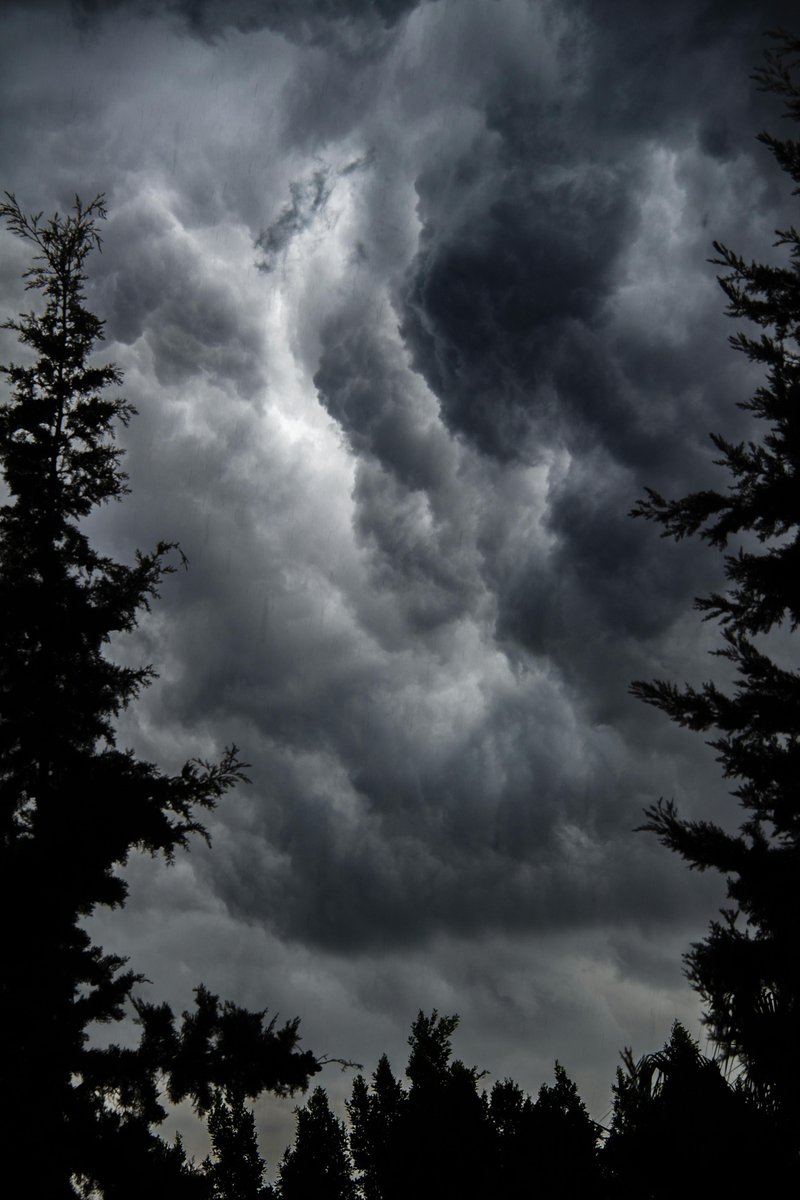
As when on an evil day the lord of day is swallowed up in thick, dark clouds, an ice-cold hurricane of wind, very terrible, afflicts the clouds in turns; so when the Self is enveloped in impenetrable Darkness, the keen power of extension drives with many afflictions the man whose soul is deluded.
From those two powers a man's bondage comes; deluded by them he errs, thinking the body is the Self.
Of the plant of birth and death, the seed is Darkness, the sprout is the thought that body is Self, the shoot is rage, the sap is deeds, the body is the stem, the life-breaths are the branches, the tops are the bodily powers, sensuous things are the flowers, sorrow is the fruit, born of varied deeds and manifold; and the Life is the bird that eats the fruit.
This bondage to what is not Self, rooted in unwisdom, innate, made manifest without beginning or end, gives life to the falling torrent of sorrow, of birth and death, of sickness and old age.
Not by weapons nor arms, not by storm nor fire nor by a myriad deeds can this be cut off, without the sword of discernment and knowledge, very sharp and bright, through the grace of the guiding power.
He who is single-minded, fixed on the word divine, his steadfast fulfillment of duty will make the knowing soul within him pure; to him whose knowing soul is pure, a knowing of the Self supreme shall come; and through this knowledge of the Self supreme he shall destroy this circle of birth and death and its root together.
Wisdom from the Early Cynics, Diogenes 42
Diogenes was gathering figs, and was told by the keeper that not long before a man had hanged himself on that very fig tree.
"Then," said he, "I will now purge it."
Seeing an Olympian victor casting repeated glances at a courtesan, "See," he said, "yonder ram frenzied for battle, how he is held fast by the neck fascinated by a common minx."
Handsome courtesans he would compare to a deadly honeyed potion.
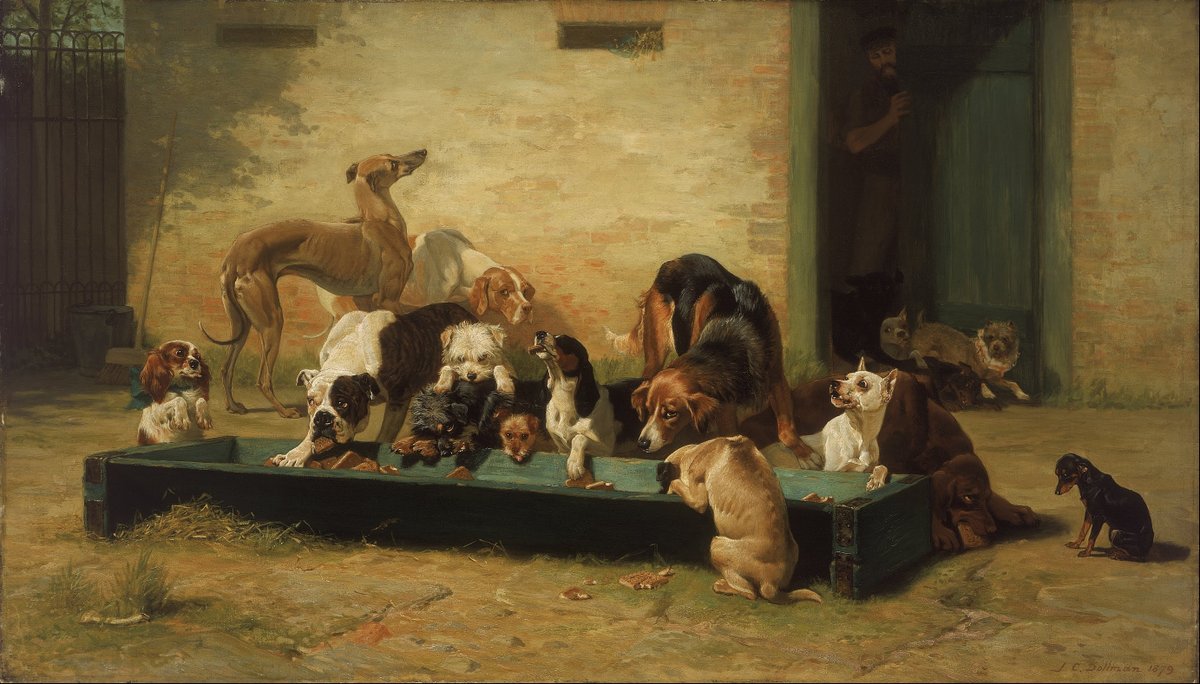
He was breakfasting in the marketplace, and the bystanders gathered round him with cries of "dog!"
"It is you who are dogs," cried he, "when you stand round and watch me at my breakfast."
When two cowards hid away from him, he called out, "Don't be afraid, a hound is not fond of beetroot."
—Diogenes Laërtius, 6.61
IMAGE: John Charles Dollman, Table d'Hote at a Dogs' Home (1879)
Wisdom from the Early Stoics, Zeno of Citium 82
The Stoic definition of love is an effort toward friendliness due to visible beauty appearing, its sole end being friendship, not bodily enjoyment.
At all events, they allege that Thrasonides, although he had his mistress in his power, abstained from her because she hated him.
By which it is shown, they think, that love depends upon regard, as Chrysippus says in his treatise Of Love, and is not sent by the gods.
And beauty they describe as the bloom or flower of virtue.
—Diogenes Laërtius, 7.130
IMAGE: Alessandro Rosi, Love of Virtue (c. 1660)
How does the ruling faculty make use of itself? For all lies in this.
But everything else, whether it is in the power of your will or not, is only lifeless ashes and smoke.
—Marcus Aurelius, Meditations 12.33
IMAGE: David Roberts, The Siege and Destruction of Jerusalem (1850)
Songs of Innocence 12
The Divine Image (1789)
William Blake (1757-1827)
To Mercy Pity Peace and Love,
All pray in their distress;
And to these virtues of delight
Return their thankfulness.
For Mercy Pity Peace and Love,
Is God our father dear;
And Mercy Pity Peace and Love,
Is Man his child and care.
For Mercy has a human heart
Pity, a human face;
And Love, the human form divine,
And Peace, the human dress.
Then every man of every clime,
That prays in his distress,
Prays to the human form divine
Love Mercy Pity Peace.
And all must love the human form,
In heathen, turk or jew.
Where Mercy, Love & Pity dwell,
There God is dwelling too.