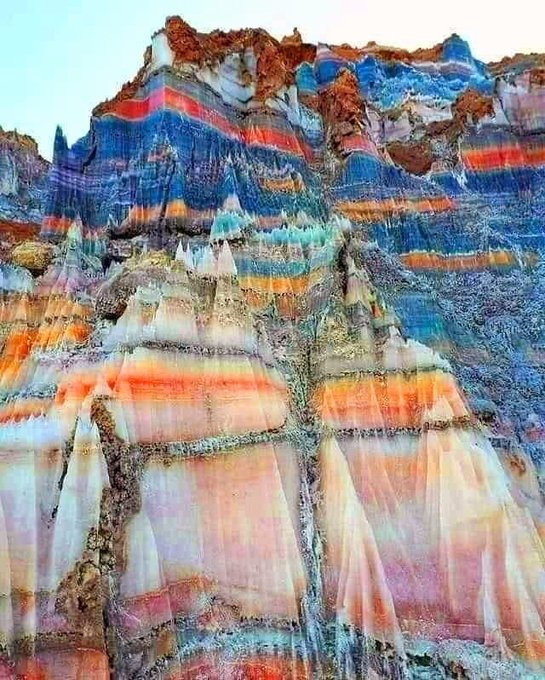
These incredible salt formations can be seen in the south, southwest, and central areas of Iran.
The best examples are found in the Zagros mountains that run parallel to Iran’s coast on the Persian Gulf.
Giant stone mill in Pingshui Village, Chengdu, China. According to locals from the town it was used to supply armies in ancient times, but I’ve never seen one of this scale before so there may be a hidden story behind this structure.
Another example of advanced engineering, using megalithic stone, built by “primitive” people, for unknown purposes. Move along. Nothing to look at here. 🤭
The 180-Ton Secret Buried Beneath Spain… 😳
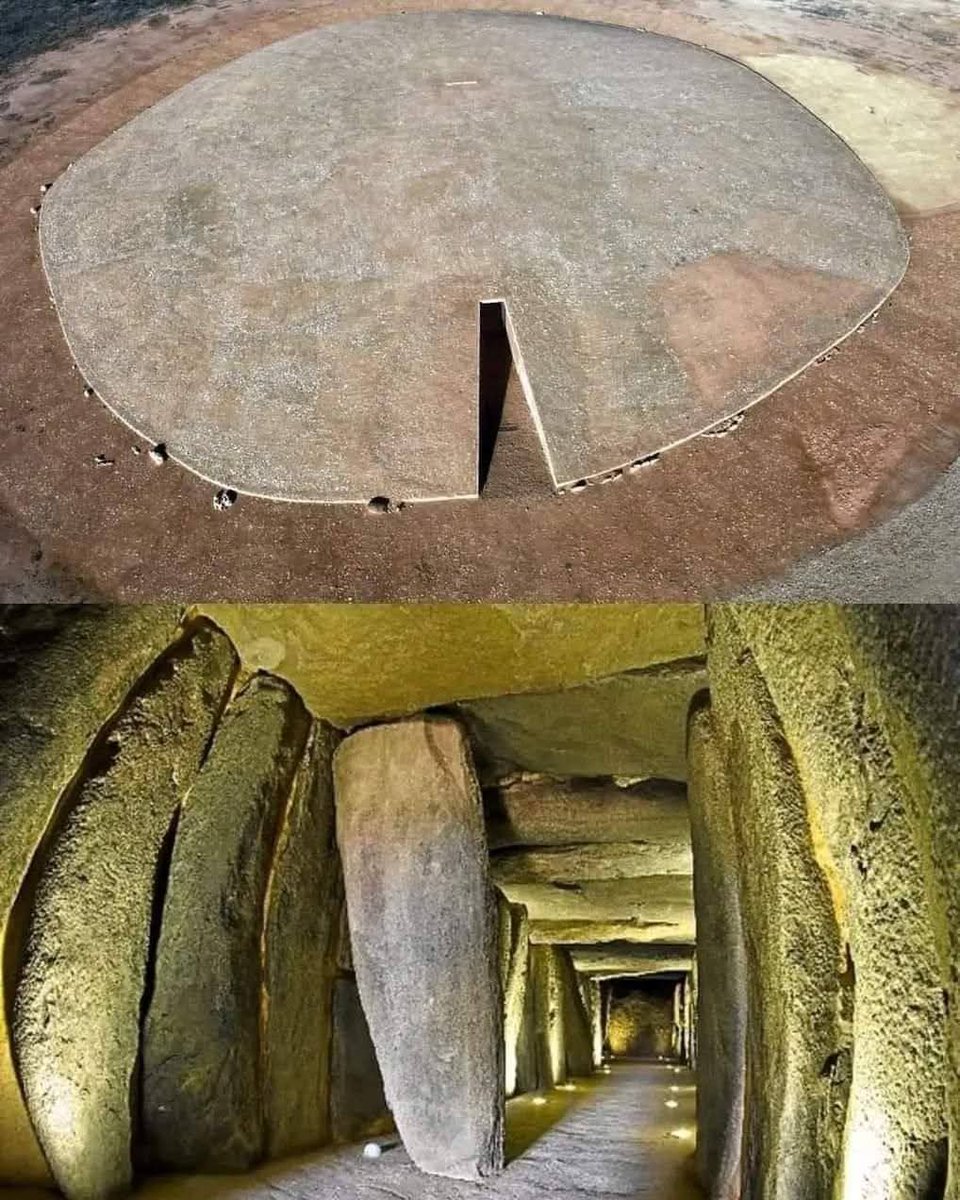
Beneath the quiet fields of southern Spain lies something that shouldn’t exist—at least, not for its time. Hidden under a simple grassy hill is the Dolmen of Menga, a massive underground structure built nearly 6,000 years ago… long before modern machines, metal tools, or advanced engineering.
At first glance, it looks like nothing. Just a mound. Easy to ignore. Easy to scroll past.
But step inside—and everything changes.
A narrow stone passage leads you into darkness. The air turns cool. Silent. Heavy. Towering slabs of stone rise around you, each one weighing more than you can imagine—some as heavy as 180 tons. And somehow… ancient humans moved them. Shaped them. Placed them with precision.
No one knows exactly how.
This wasn’t just a tomb. It feels intentional. Almost… calculated. As if it was built for something more than burial.
And then comes the strangest part.
At a specific time, when the sun rises just right, its light travels deep into the chamber… illuminating the interior in a soft golden glow. Not randomly—but aligned perfectly with a distant mountain on the horizon.
Coincidence? Or something they wanted us to notice?
Standing there, surrounded by silence and stone, one question refuses to leave your mind:
How did people with no technology create something so massive, so precise… and so mysterious?
Maybe they knew something we’ve forgotten.
Or maybe… this structure was never meant to be fully understood.
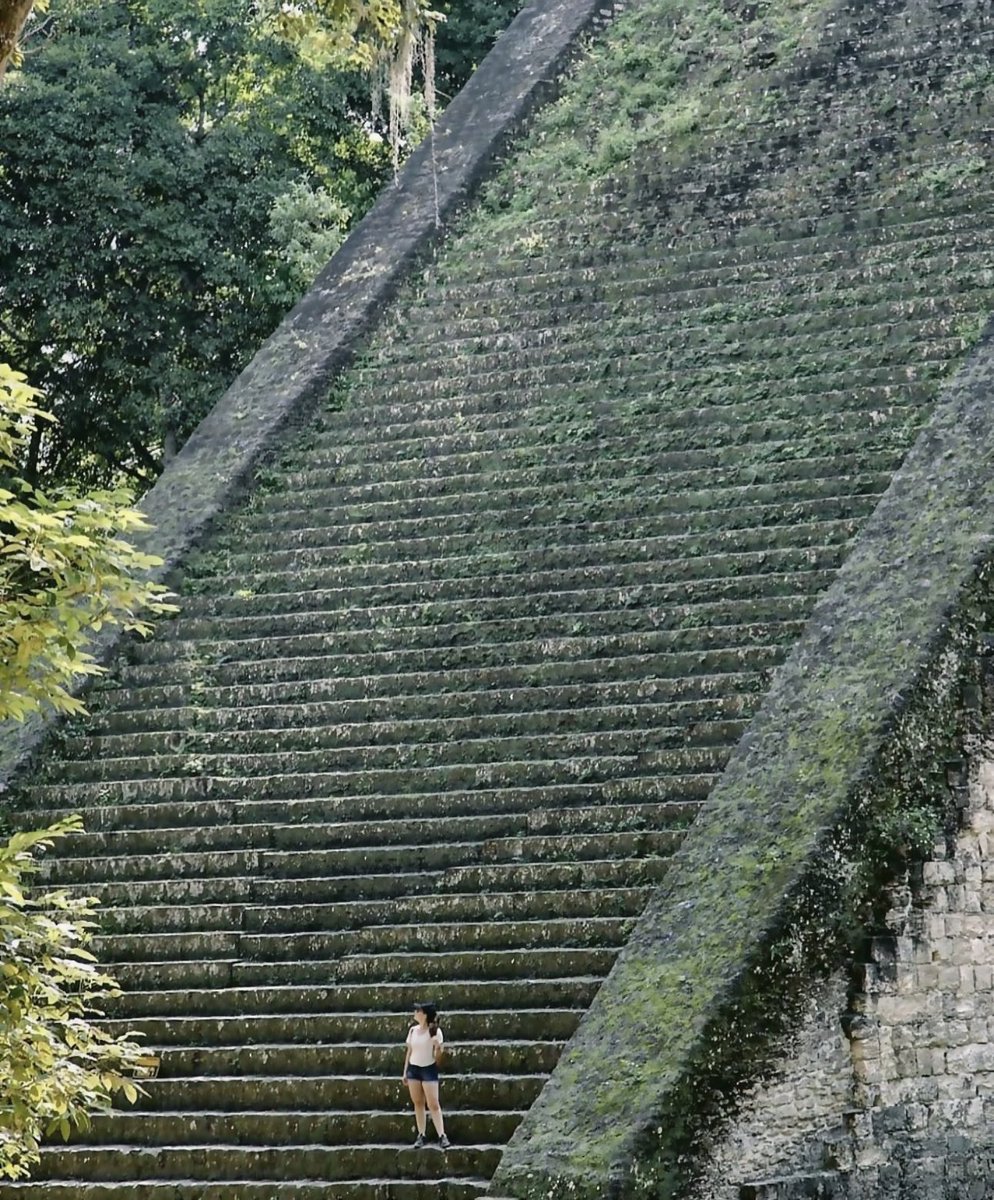
The scale of this shot at Tikal in Guatemala always gets me, & is a reminder of the sacred geometry & engineering knowledge we’ve lost.
📷 Lia Dima
Mount Nemrut is a 2,134-metre-high (7,001 ft) mountain in southeastern Turkey, notable for the summit where a number of large statues are erected around what is assumed to be a royal tomb from the 1st century BCE.
In 1916 someone dug a well to find water for irrigation, in the middle of a desert. Scalding water exceeding 200°F, has flowed ever since. Calcium carbonate deposits building up into this cone shape with colourful thermophilic algae.
This is the Fly Geyser.
For over a thousand years, historians thought the Viking "sunstone" was nothing more than a myth, until the ocean gave up its secret.
The Norse sagas repeatedly referenced a mysterious object called a "sólarsteinn" or sunstone, a navigational tool so powerful that Viking sailors could locate the exact position of the sun even on the most overcast and cloudy days. For centuries, scholars debated whether this was real technology or simply folklore embellished over generations of retelling. Most assumed it was legend. They were wrong.
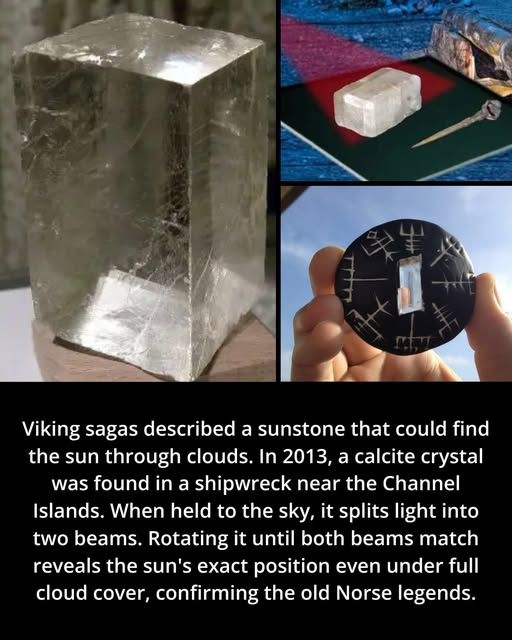
In 2013, marine archaeologists excavating a British warship that sank near the Channel Islands in 1592 made a stunning discovery buried among the wreckage. Alongside navigational instruments including a pair of dividers and a slate, they found a rectangular chunk of translucent crystal. Testing confirmed it was Iceland spar, a remarkably pure form of calcite with extraordinary optical properties. The fact that it was found stored alongside other precision navigation tools was not a coincidence.
Iceland spar possesses a property called birefringence, meaning it splits a single beam of light entering the crystal into two separate beams. When you hold the crystal up toward the sky and slowly rotate it, the two beams will vary in brightness independently until, at one specific angle of rotation, they become perfectly equal in intensity. That precise angle points directly toward the sun, regardless of whether the sun is visible to the naked eye. Cloud cover, fog, and even twilight conditions cannot defeat it.
Researchers from the University of Rennes in France conducted extensive testing and published their findings in the Proceedings of the Royal Society A. Their experiments demonstrated that Iceland spar could locate the sun's position with an accuracy of within one degree, even under completely overcast skies. For Viking navigators crossing the North Atlantic toward Iceland, Greenland, and eventually North America, this accuracy would have meant the difference between a successful voyage and sailing hopelessly off course into open ocean.
The Viking Age spanned roughly 793 to 1066 AD, and during this period Norse sailors were completing oceanic crossings that would not be replicated by other European cultures for another 400 years. Historians had long puzzled over how they achieved such consistent navigational precision without magnetic compasses, which did not reach Europe until the 12th century. The sunstone appears to be a significant part of that answer.
What makes the Channel Islands find especially compelling is that the 1592 shipwreck is far outside the traditional Viking era, suggesting that knowledge of this navigational technique survived and was still being used by European sailors centuries after the Viking Age officially ended. The crystal was not a relic or a curiosity on that ship. It was working equipment.
The sagas specifically describe King Olaf consulting a sunstone on a cloudy day to verify the position of the sun, with a separate observation then confirming the stone's accuracy. For generations this was dismissed as poetic invention. Science has now confirmed that every element of that description is physically possible and practically achievable with a simple piece of Icelandic calcite.
The Vikings were not lucky explorers stumbling across new lands by accident. They were sophisticated navigators armed with technology so elegant and effective that it required no moving parts, no maintenance, and no power source beyond the sky itself.
via Timedust
#Vikings #Norse #ThorsDay #Heathen