The US naval blockade is definitely biting, and Iranian crude exports are cratering, but the street is completely misreading the mechanics here.
Iran's oil export engine is nothing but a massive, structural money-and-logistics laundering matrix. On the physical side, the whole game is evading US eyes to scrub Iranian barrels and make them look completely kosher on paper.
The second these tankers clear the Strait of Hormuz or hit the Indian Ocean, they flip the switch and turn off their AIS. They’ll even manually paint over or mask the hull numbers to stay invisible to satellite tracking.
The real action happens via STS transfers in the EOPL or UAE, bleeding the cargo into un-sanctioned dark fleet.
While doing this, they doctor the Bill of Lading to wipe the origin clean, magically re-christening Iranian crude as Malaysian Blend or Omani barrels.
Those barrels eventually show up at the doorsteps of Shandong Teapots in China to discharge. That’s exactly why Beijing's official import prints show a massive spike in Malaysian volumes, while Iranian imports look like zero.
Obviously, standard trade finance rails like SWIFT and USD clearing are dead in the water. To bypass this, Tehran runs a bulletproof shadow banking network.
They’ve layered dozens of shell companies across Dubai, Hong Kong, and Turkey. Domestic Iranian networks, like the Amin Exchange, act as the central bank for these offshore front accounts.
The tape settles in RMB or AED, never greenbacks. Once a teapot wires cash to a shell account, the funds are instantly fractured and routed across multiple front profiles via Hawala style to completely blind any tracking.
When cash routing hits a brick wall, they just pivot to straight-up barter—clearing the oil bill in exchange for Chinese refined products, industrial machinery, consumer goods, or military hardware components.
This entire clunky setup creates a massive lag in the cash conversion cycle. Moving from Iranian loading docks, steaming dark at low speeds, floating in international waters waiting for an STS window, forging the papers, and finally getting the teapots to clear customs takes a solid 60 to 90 days.
Even when the teapots pay up, washing that money back through UAE and Hong Kong shells until it turns into spendable dry powder (or hard goods) for Tehran or the IRGC takes another 60 to 90 days.
Bottom line: Iran is running on a 3 to 6 month delay from the time the oil leaves the ground to when they can actually spend the cash.
This duration risk and the structural discount blow out even wider whenever the US drops a combined hammer—like the Economic Fury campaign—targeting not just the dark fleet, but the financial nodes and clearing desks in Hong Kong and the UAE at the same time.
Every sweep locks up accounts and forces them to rebuild their routing from scratch.
So the liquidity hitting Iran's balance sheet today is cash from oil traded months ago. Since they're still clearing out the oil on water floating outside the Strait, it’s going to take months before their actual financial runway gets cut off.
But the real macro question everyone is missing is this: these guys already proved they can survive on zero exports during the COVID pandemic. Why is everyone so sure this cycle plays out differently? Who breaks first under the weight of time—Tehran or Washington?
That’s the real chart worth watching.
#oott #iran
ARISTA (9348493) is not an American anything. She's a container ship under US sanctions and currently parked north of Hormuz Island, Iran at 27.12853, 56.462 since 2026-03-14. She arrived from the port of Damietta, Egypt.
Anthony Head got so famous in Britain for a coffee advert that his serious acting work dried up. So he moved to America and ended up on a hit show about hunting vampires. He died this week at 72, and that coffee advert is the least interesting thing he ever did.
It was for instant coffee. The story started in 1987 with a woman knocking on her neighbour's door to borrow some, and it ran for six years like a tiny soap opera, each instalment ending on a will-they-won't-they cliffhanger. The country got hooked. When the last one aired, around thirty million people tuned in to see if the couple would finally get together, and a newspaper ran it on the front page. There was even a spin-off novel and a hit album, all from a coffee advert.
That kind of fame can trap an actor. The bigger parts stopped coming, so Head went to America and landed Buffy the Vampire Slayer. He played Giles, the school librarian and guardian of a teenage girl who secretly hunts vampires, the calm grown-up quietly keeping her alive. He once said he based the character on Hugh Grant, all stammering and bookish. For seven seasons he was the warmest father figure on television.
Years later he got to play the exact opposite. Ted Lasso is a comedy about a kind American coach loose in English football, and Head was the villain, Rupert, a rich and cheating ex-husband. His former wife wants to hurt him so badly that she hires Ted hoping the team will collapse. Head started as an occasional guest, then joined the main cast, ending up in 18 episodes.
He said the bad guy was the fun part, because a villain has more going on, and he liked playing men who were nothing like him. You can see the care in it. Rupert starts out as a cartoon and slowly turns into something sadder, a man with money, a young wife and a new baby who still cannot enjoy a single thing he owns. By the end everyone around him grows up. He just shrinks.
None of that was him. His Ted Lasso castmate Brett Goldstein said Head "played the worst person in the world," and pulling it off so well took real talent, because in life he was the kindest man on the set. When the news broke, Sarah Michelle Gellar, the young actress he had looked after on Buffy, posted a photo of the two of them. "I'm not okay," she wrote.
He died months after losing Sarah Fisher, his partner of more than forty years. He leaves behind two men named Rupert, one a gentle teacher and one a cruel charmer, and a long line of people who knew him saying the same thing. The gentle one was closer to the truth.
🦔Google signed a deal to pay SpaceX $920 million a month for access to 110,000 Nvidia GPUs at SpaceX data centers. The contract runs October 2026 through June 2029, roughly $30 billion total. Google called it bridge capacity for surging Gemini Enterprise demand. SpaceX signed a similar deal with Anthropic last month, $1.25 billion a month through 2029 for all the compute at its Colossus 1 facility in Memphis.
Both contracts include 90-day cancellation clauses after December 2026. SpaceX goes public Thursday.
My Take
Google has more AI compute than anyone on earth and they still had to go to SpaceX for 110,000 GPUs. Their own buildout can't keep up with demand for Gemini Enterprise. They've committed $180 billion in capex this year and sold $80 billion in stock to fund more of it. And they still came up short.
This is the second deal like this in a month. Anthropic already signed for $1.25 billion a month at Colossus 1. Together those two deals put about $26 billion a year on SpaceX's books, right before an IPO where Goldman needs to justify a $1.75 trillion valuation on $322 billion in projected AI revenue. xAI built those data centers for Grok and lost $6.4 billion last year. So now Google and Anthropic pay rent on the hardware Grok couldn't use, and that rent is the AI revenue story SpaceX takes public on Thursday. I've tried to find where this stops being circular and I can't.
Hedgie🤗
@LeaPrunier2@FinotGael En plus il aura le pic des impacts des effets économiques de la guerre d'Ormuz à ce moment et il aura les élections de mi mandat aux States et le lockup de certains VC de Space X sera levé ce qui va faire pression à ́la baisse sur le titre à ce moment. Oui je suis en accord
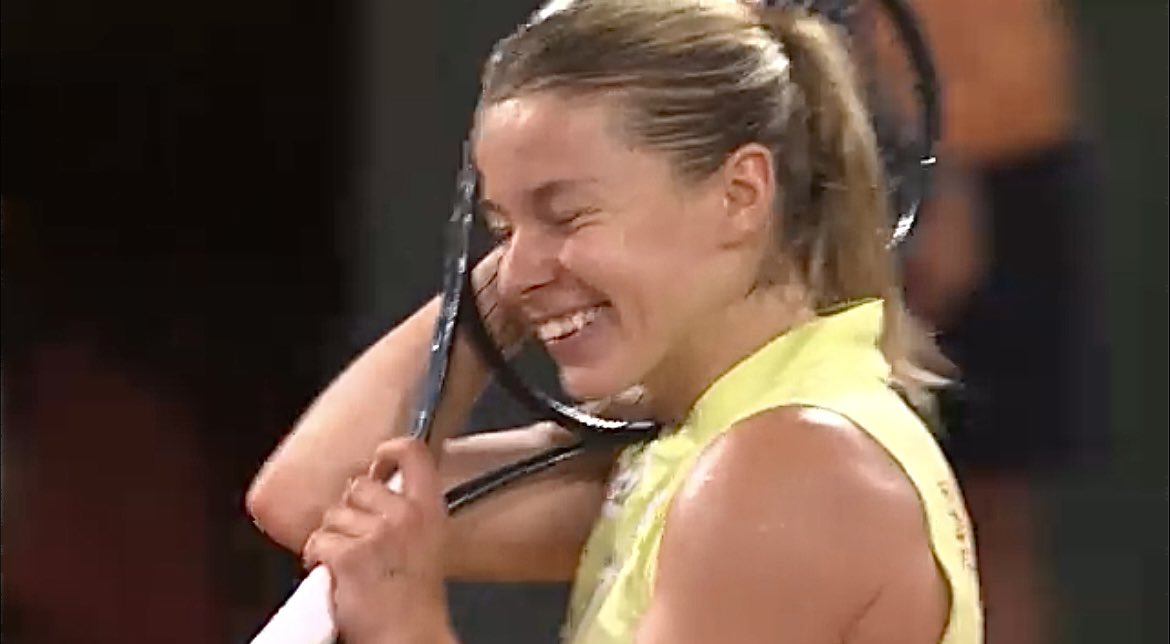
😍 Elle a stupéfié le monde du tennis.
Qui aurait pu imaginer que Chwalinska atteigne une finale en Grand Chelem ?
Grâce à cette performance unique à Roland-Garros, elle gagne 93 places.
Elle sera 21e lundi.
Une nouvelle vie l’attend.
À très vite, championne.
@satoshi_kuru@FEVRIERFranck@Olivier017906@AlexandreLaizet@Bthemoon2030 Oui Kuru, ensemble on va plus loin lorsque la liberté d'expression est admise, c'est la seule condition.
Mais quand seulement 2 ou 3 personnes se sont octroyer le droit de juger la bonne parole ou la mauvaise......le côté sectaire n'est plus très loin.....attention !
BREAKING: Meta stock, $META, extends losses to -7% on the day after the Financial Times reports that the company is considering a stock offering to raise capital.
The stock has now erased -$115 billion of market cap today.
@Damien96080823 Saylor a utilisé le cash qu'il avait réservé pour payer ́les dividendes pour retirer de la dette du marché car il savait que le refinancement lui serait bien + coûteux en termes de charge !!
BREAKING: MicroStrategy's, $MSTR, unrealized loss on its Bitcoin holdings rises to a record -$12.7 billion.
This puts the company's position down -$28 billion over the last 12 months.