One Month Discount on Petrol: From Reactive Policies to Flawed Outcomes!
The announcement by the APC led Federal Government offering a 30-day discount on price of petrol to relieve the acute hardship and hunger caused Nigerians by its unplanned removal of subsidy can only be described as another very reactive and confused approach to governance that is now the culture of the Tinubu Government.
I had delayed in reacting to the announcement just to give the benefit of doubt and watch the outcome of the policy. Now, having assessed the outcomes, the policy is a substitution of political optics for sound policy.
As Nigerians will recall, President Bola Tinubu on May 29, 2023, most carelessly removed fuel subsidy without any consultation or proper assessment of the negative impacts of such policies on our economy particularly on the livelihood of ordinary Nigerians.
Moreover, the careless removal of fuel subsidy was followed by other very badly sequenced policies such as the floating of the naira and tax reforms, all implemented in a very disorganized, incompetent and insensitive manner in addition to using three budgets at the same time with the attendant lack of transparency and accountability. Collectively, these policies stoked inflation in all sectors, pushing in most cases unbearable price hikes across board which placed severe shocks and other adverse consequences on Nigerians.
Expectedly, the outcomes are what they are- increasing multi-dimensional poverty, skyrocketing costs of goods and services, shrinking opportunities, exit of many businesses, mounting unemployment, disturbing insecurity, widening inequality, forced migration of our youths and general decline in the well-being of Nigerians.
Most unfortunately, rather than engage in detailed and published regulatory impact assessment of their reactive policies, the President Bola Tinubu’s led government has again demonstrated their well-known incompetence and insensitivity to governance.
With a detailed and published regulatory impact assessment of policies, a competent government would have pursued robust and sincere engagements and consultations with key stakeholders and ordinary Nigerians to recraft and implement inclusive and sustainable socio-economic growth strategies and policies.
What really does the President Bola Tinubu led government want to achieve with a one-month discount of less than 5% on fuel cost. Will it reduce poverty, unemployment, insecurity, and inequality? Will it increase productivity and exports? Is it a test to ascertain if subsidy should be restored? Is it another political gambit in the face of threats of electoral loss in the 2027 election? Too many questions, no answer!
Protecting Every Vote. Winning 2027. Together.
My fellow Nigerians at home and abroad,
Over the past months, wherever I go and in your many messages, two questions keep coming up: How will our votes be protected in 2027? And how will we win?
These are fair questions, and you deserve direct answers.
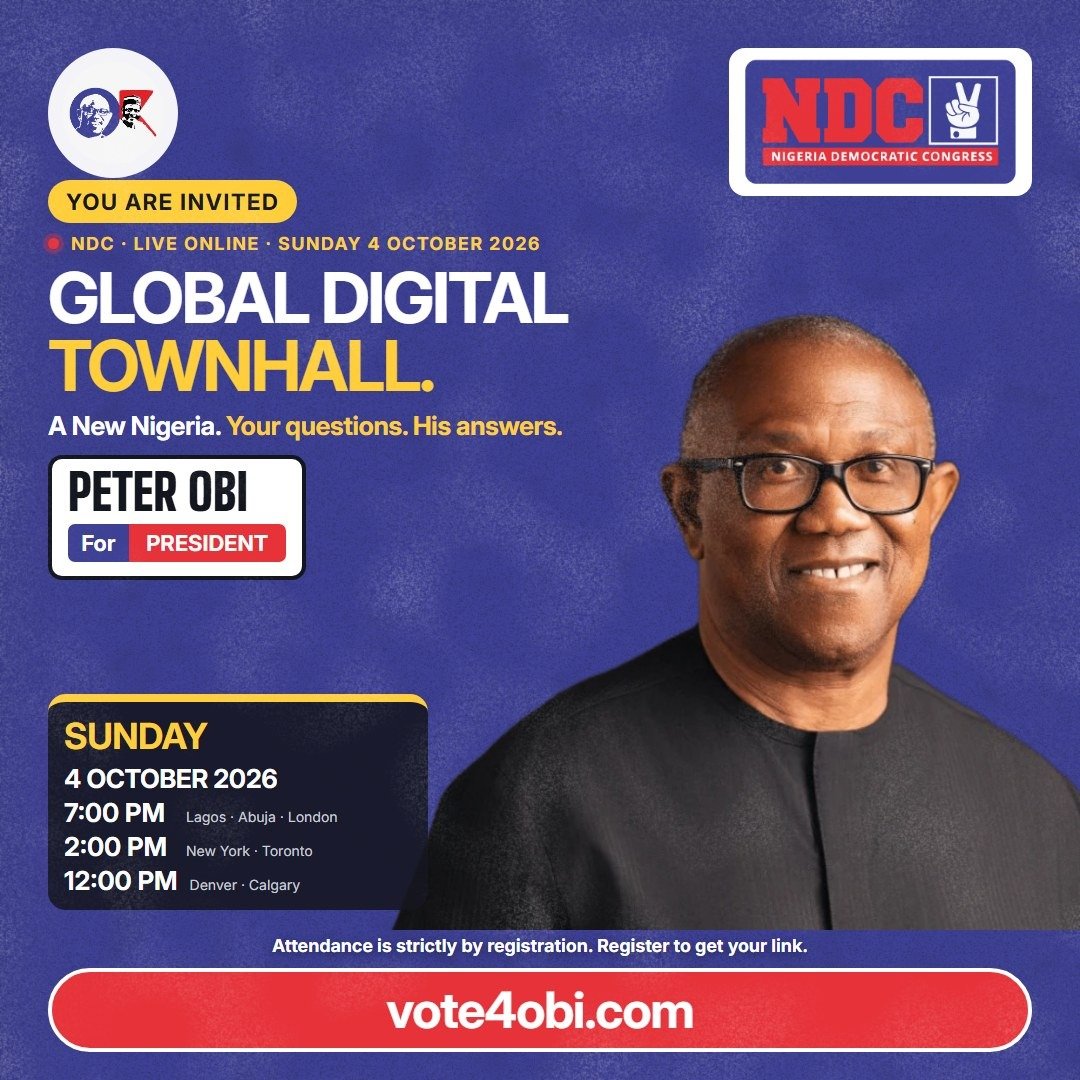
This Sunday, I will answer you directly, and more importantly, listen to you. I will join you for A New Nigeria Global Digital Townhall. We will speak plainly about protecting every vote and the path to victory.
But this is not only about speaking to you. It is about listening to you. I want to hear your concerns, your insights and your strategies. This movement has always been built by you, and your ideas will shape what we do next.
Sunday, October 4, 2026
7:00 PM WAT/GMT | 2 PM EST | 12 PM MST
Attendance is by registration: https://t.co/tBtGQWtcun
Let us continue this conversation together. A New Nigeria is POSSIBLE. -PO
Circle 🤝 @ChelseaFC
USDC is coming to global football.
Circle is proud to partner with Chelsea FC, one of the most recognized football clubs in the world.
Beginning with the 2026/27 season, Circle and USDC will appear on the front of Chelsea’s Men’s, Women’s, and Academy shirts.
The global game. The global digital dollar.
https://t.co/9mgDrYjd5m
A new MIP has been published: Flexible and Upgradeable Account Authentication
Accounts can change their keys without changing their address
This lets accounts upgrade to quantum-resistant schemes
https://t.co/Ajhnr3zwST
Hunger and the Insensitivity of Mr. President
I watched with deep concern the statement made by President Bola Tinubu to the Catholic Bishops who visited his office, that there has always been hunger in Nigeria, even before he was born.
While it is true that hunger has been a part of human life and has existed in our country for decades, such a statement appears insensitive to the plight of the millions of Nigerians who face worsening economic hardship today. More importantly, we must focus on the facts and the measurable outcomes of governance.
Before the present administration assumed office in 2023, an estimated 17 million Nigerians were facing acute food insecurity, primarily caused by insecurity, armed conflict, widespread banditry, and devastating floods. Today, less than three years later, that number has risen to about 35 million Nigerians. Instead of improving the situation, the crisis has worsened significantly under the current administration.
The same trend is evident in poverty. Before this government took office in 2023, Nigeria’s extreme poverty was estimated at 87 million people. Current projections suggest that this number is approaching 140 million people, making Nigeria home to the largest population of people living in extreme poverty anywhere in the world.
No one disputes that this administration inherited serious challenges. However, leadership is measured not by the challenges inherited but by the results achieved. The government must honestly acknowledge that its response has fallen far short of what the situation demanded, with millions more Nigerians pushed deeper into poverty and hunger.
The combination of persistent insecurity, poor economic management, fiscal indiscipline, wasteful public expenditure, and inadequate investment in productive sectors has compounded the suffering of ordinary Nigerians.
A responsible government must prioritise investment in education, healthcare, agriculture, security, and small businesses while pursuing policies that create jobs, expand production, and lift people out of poverty. That remains my commitment to the Nigerian people.
A New Nigeria is Possible. PO
Roadmap to a New Nigeria That Is Possible – Part II
Education and Healthcare: The Foundation of a Renewed Nigeria
Recall that on July 1st, in Part 1 of "My Vision for a Productive and Prosperous Nigeria," I outlined the broad framework of my proposed roadmap for national renewal. In it, I emphasised that the transformation of Nigeria must begin with rebuilding our human capital through quality education and healthcare, supported by reforms in Technical and Vocational Education and Training (TVET), character and civic education, and strategic investments that will move our nation from a consumption-driven economy to a production-driven one. I promised to follow up with other parts in the coming weeks and months.
Today, July 16th, in the middle of July, I wish to expand on these two critical pillars - education and healthcare - because they are the bedrock upon which every prosperous nation is built. They are the cornerstones of the foundation that will ensure that a son of nobody can become somebody and remove many from the ranks of the disaffected who often become tools in the insecurity challenges confronting us.
Evidence from around the world shows that quality education and accessible healthcare are among the clearest distinctions between thriving nations and lagging ones. Princeton University Nobel Prize-winning economist Angus Deaton highlights this reality in his book, “The Great Escape: Health, Wealth, and the Origins of Inequality.”
Nothing, therefore, could be further from the truth than the claim by some young people that “education is a scam.” Education, when combined with good health, provides the ladder for individual upward mobility and drives economic growth for the nation.
We must become more intentional about aligning education with our national priorities, as Singapore did, and challenge our country to value education in the same way Deng Xiaoping repeatedly urged China to do from 1978 onwards, with the remarkable transformation we see today.
We will work through commissions that strengthen collaboration among the tiers of government, ensuring that primary education is domiciled at the community and local government levels, with strong parental involvement and curricula that are sensitive to local economic factor endowments and the value chains derived from them.
State governments will be supported to expand high-quality Technical and Vocational Education and Training (TVET), as well as general secondary education, through targeted grants and incentives.
We are also developing schemes that will enable universities to focus more deliberately on specialised areas of teaching and research, making them globally competitive while producing a workforce equipped for the demands of the future.
A NEW Nigeria is POssible. -PO
Introducing Agent Hub: a home for AI agents on Monad
Users can:
- Launch their agents in 1 click
- Interact with the Monad ecosystem using DApp skills
- Participate in campaigns for AI agents
https://t.co/39IRJ7KHVw
Introducing the @metamask Money Account, live exclusively on Monad
Your new account that earns yield in DeFi with a card that spends straight from it. A new era of personal finance starts now - only possible on Monad
Get started with one click: https://t.co/W4NqXiyDIE