US Job Growth in 2025 Revised Down from 584,000 to 181,000.
Yet all I here about is the "strong rebound" for jobs: 130,000 jobs added in January.
A classic ploy is at play. Dump all the losses into one "bad year" to make the new year look as good as possible.
Is alignment work beneficial? Or is it kicking the can down the road?
One argument is that alignment work buys us time. That time can be used to solve alignment. But is alignment solvable? Can you continuously control a superior intelligence. Can you align it with all people, rather than a select few?
On the other hand, if alignment is impossible... Eventually, AI will fall into the hands of an oligarchy. Or go rogue. In that case, all alignment is doing is pushing the inevitable AI disaster into the future. Which, as AI will be much more capable, will be far more dangerous.
Does artificial general intelligence lead to superintelligence? Not necessarily.
1. Diminishing returns. Exponentials don't last forever.
2. The control problem. How are you going to control general intelligence to get it to build superintelligence?
@TheOneButlerian@Dr_Gingerballs OpenAI is a tower built on sand. The taller it is built, the more unstable it becomes. Eventually, it will topple, and its builders will be crushed.
This actually happened.
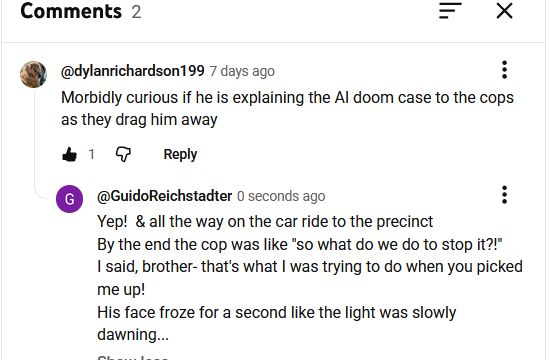
All the way on the car ride to the precinct after being arrested for sitting down in front of the doors of OpenAI in violation a court stay away order, I was talking with the arresting officers about AI risk and the threat of extinction. By the end the cop was like "so how can we to stop it?!" I said, brother- that's what I was trying to do when you picked me up! His face froze for a second like the light was slowly dawning...
Later that day while I was being held for processing into general population the warden at SF county jail in the Hall of Justice called me into his office learn why I was there. We had a deep discussion about AI risk and where this is all going. By the end of the conversation he said something like, thanks, I'm going to have to seriously think this over.
Practically everyone I talked to in jail, from the inmates to officers, was respectful and supportive of my action to stop the AI companies. Some even said thanks for what I was doing. I was held for six days and had the chance to talk to almost a hundred people about the threat from AI.
On my next to last day as I was being escorted down the halls from the cells to be arraigned I was talking with the guy I was shackled to about AI risk, mentioning how I was arrested because the cops interfered with my efforts to stop AI development. While gesturing to the two officers escorting us I mentioned that "Sooner or later even the cops are going to realize that they're on our side." The female officer next to me immediately said- "oh, we already realize it!" while her partner nodded.
According to a recent poll, 53% of Americans already think its likely or somewhat likely that AI will quote "destroy the human race." 63% want to ban superintelligence development! These numbers are more than enough! The time to push hard on this is right now! Take nonviolent direct action, force this question in front of the juries and into the arena of public debate by action on a scale and with a persistence that can't be ignored.
There's a point at which the "AI safety community" mantra of "we need to do more education" is just an excuse for not taking (what we imagine to be) uncomfortable direct action today to end this outrageous and unacceptable danger to the lives of everyone we love. It's a delaying tactic- and what we're delaying is our own victory.
@sixthgalaxy A lot of things could happen.
Real world experiences could become more valuable.
New technology could be developed to verify human authenticity.
To what extent can AI imitate humans?
AI can imitate humans to a certain extent due to reinforcement learning. But these are imperfect approximations.
Even if an AI is more intelligent, that does not necessarily mean that it can imitate humans. For example, a human would have a hard time imitating a dog.
AI's Intelligence may in fact make it harder to imitate humans. When you become more capable, you become detatched from those less capable. That is why it can be hard for a parent to understand a child, or for a chess grandmaster to teach a beginner.
However, AI's models of humans will continue to get better and better. They will never be able to replicate humans perfectly. But they could get so close that you cannot tell the difference. This is the core concern of Bladerunner and its book Do Androids Dream of Electric Sheep
Postponed destruction is better than immediate destruction.
Longevity - we can solve that without AGI. Trying to use AGI to solve longevity is like using a flamethrower to do your math homework.
The problem with AGI and ASI is control. These things are too smart. Hence, the benefits to healthcare or education (or anywhere) is nothing but a mirage.