Domino’s UK just roasted the new God of War game, and Santa Monica Studio got mad and responded quickly.
Domino’s UK posted:
“God of War game with no Kratos = Pepperoni Passion with no pepperoni.”
It went viral and Santa Monica Studio got so mad:
“OK thanks for the feedback, Domino's pizza corporate account.”
When a pizza company makes fun of your game, you know something is wrong.
Most Linux processes use far more virtual memory than physical memory.
A 20 MB program may have gigabytes (or even terabytes on 64-bit systems) of virtual address space available.
Virtual address space is cheap. Physical pages only consume RAM once they are actually mapped and used.
NEW: Vladimir Putin is reportedly pouring $26 billion into life-extension research involving gene therapy drugs, pig-grown organs for transplant, & 3D-printed human tissue.
when linux runs out of memory, the OOM killer scores processes based on memory usage and oom_score_adj.
RSS, swap usage, and page table memory all contribute to the score.
Higher score = more likely to be killed.
set oom_score_adj to -1000 and the process becomes effectively immune to OOM killing.
The worst thing social media did to smart people was convince them they need a personal brand.
Now everyone talks like a startup founder pitching investors instead of a human being with genuine thoughts.
In 1999, NASA lost a $125 million Mars spacecraft because of a unit conversion mistake.
One engineering team used metric units. another used imperial units. the mismatch caused incorrect trajectory calculations, sending the spacecraft too close to Mars, where it likely burned up in the atmosphere.
A tiny measurement error ended an entire space mission.
This is why the semiconductor industry is researching alternatives to copper for the tightest interconnect layers.
Ruthenium and Molybdenum are leading candidates because their shorter electron mean free paths make their resistivity scale more favorably at very small dimensions. Intel presented subtractive ruthenium interconnect research at IEDM 2024.
Future BEOL stacks will likely be hybrid. copper may remain preferable for wider global interconnects where its low bulk resistivity still dominates. but for the narrowest local interconnects, materials like ruthenium or molybdenum may offer lower effective resistance at advanced dimensions.
After decades of relying almost entirely on copper, advanced interconnect stacks are becoming increasingly multi-material.
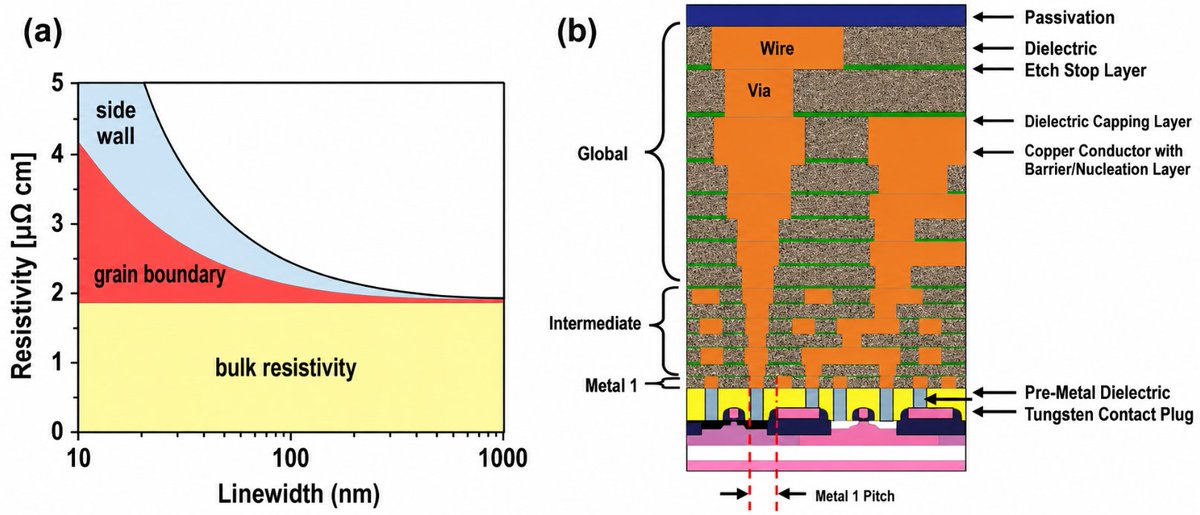
Copper’s electron mean free path at room temperature is ~39nm. the narrowest BEOL interconnects in advanced logic processes are approaching dimensions where the wire width becomes comparable to that scale. at that point, classical bulk conductivity assumptions begin to break down.
two scattering mechanisms dominate in ultra-scaled copper interconnects:
Surface scattering: electrons interact with wire boundaries and lose momentum.
Grain-boundary scattering: electrons scatter at interfaces between nanoscale copper grains.
both effects become more significant as interconnect dimensions shrink.
Copper has been the main interconnect metal inside advanced chips for ~25 years.
but as interconnects kept shrinking, copper stopped behaving like a bulk conductor.
at nanoscale dimensions, electron scattering from surfaces and grain boundaries can increase copper’s resistivity several times above its bulk value.
Netflix doesn’t just stream videos.
Before you hit play, each movie is transcoded into many renditions across different bitrates, resolutions, codecs, and device profiles.
During playback, adaptive bitrate algorithms continuously switch between these versions based on your real-time network conditions and buffer state.
The reason streaming feels instant is because massive encoding, caching, CDN, and delivery infrastructure already did the hard work before you pressed play.
fun fact: with io_uring SQPOLL mode, linux can submit disk and network I/O without a syscall on the fast path.
the kernel spins up a polling thread for the submission queue, so userspace just writes entries into shared memory and the kernel picks them up directly.
on linux, creating a new process is basically one function call. the kernel creates a near-identical copy of the running process, then both continue executing independently.