$STRANDS is live on Robinhood
That's the whole instruction. With strands-robots, one Robot() call gives an agent a MuJoCo simulation or a real robot. Same code, sim or hardware.
CA : 0x9360c8da0b63063fb4c1e60db86161e7d1e19430
Docs : https://t.co/yQwYFDohc1
Give your agent a shell, not your machine.
Strands Shell runs grep, sed, jq, curl, find and more inside your process. No fork, no exec.
You bind the directories, credentials and network allowlist. Everything else does not exist to the agent.
https://t.co/WhSFCTMw6Q
Opus 5's reported ARC-AGI-3 score: 30.16%.
Opus 5 + Strands harness: 99.95%, every level completed.
No screenshots. Just an agent loop, bash, grep and file ops, and the model doing its own context engineering.
The harness code is public 👇
How much does your harness choice cost you?
We analyzed ~94,000 benchmark trials across 8 benchmarks, 12 models and 6 harnesses.
Strands harness came in ~34% lower in estimated cost at the median on matched Claude and GPT runs, with the top accuracy in those comparisons.
/labs
Our experimental arm: 70+ robots behind one interface (sim-first), world models and benchmark harnesses.
Explore the toolkit → https://t.co/J13fj5Waer
Strands is more than an SDK now. It's a toolkit for the whole agent lifecycle: build, secure, validate, explore.
Here are the 6 projects and when to reach for each 🧵
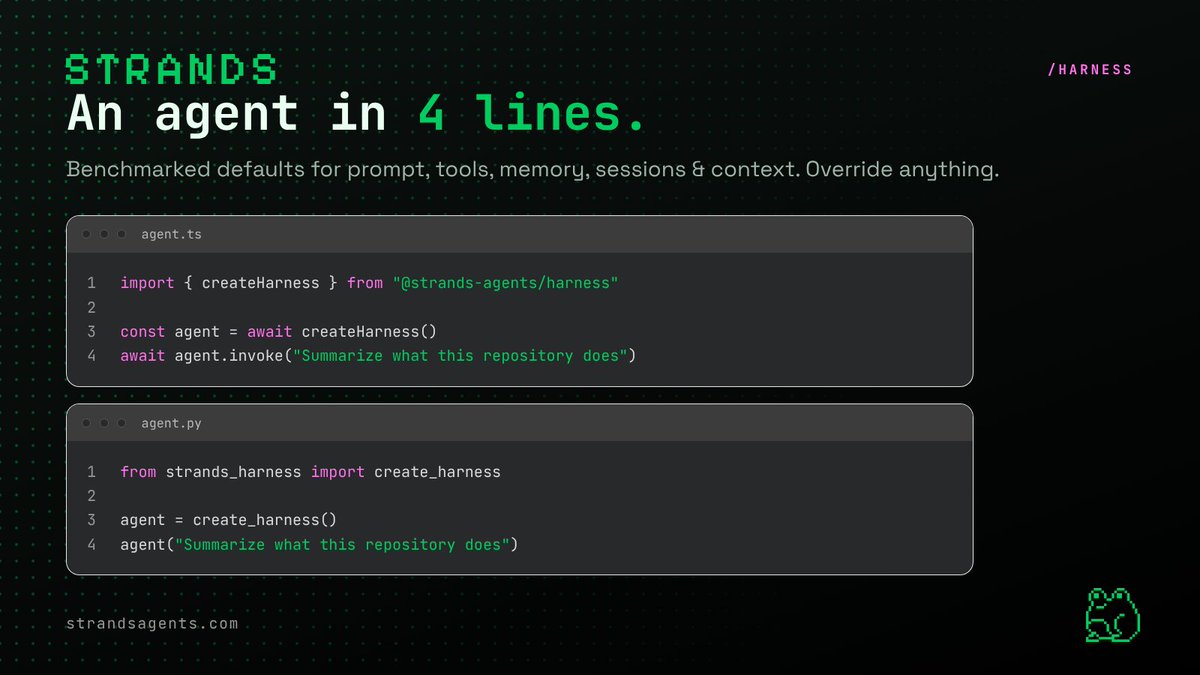
An agent in 4 lines.
createHarness() ships benchmarked defaults for the system prompt, tools, memory, sessions and context management.
Need something different? Swap the model, override any default, or drop down to the primitives. No rewrite.
https://t.co/PLzGwygiTh
Meet Strands, the open source toolkit for production AI agents.
/harness → a fully assembled harness
/harness-sdk → own the agent loop
/box + /shell → run agents safely
/evals → validate before you ship
/labs → robots & world models
Python + TypeScript.