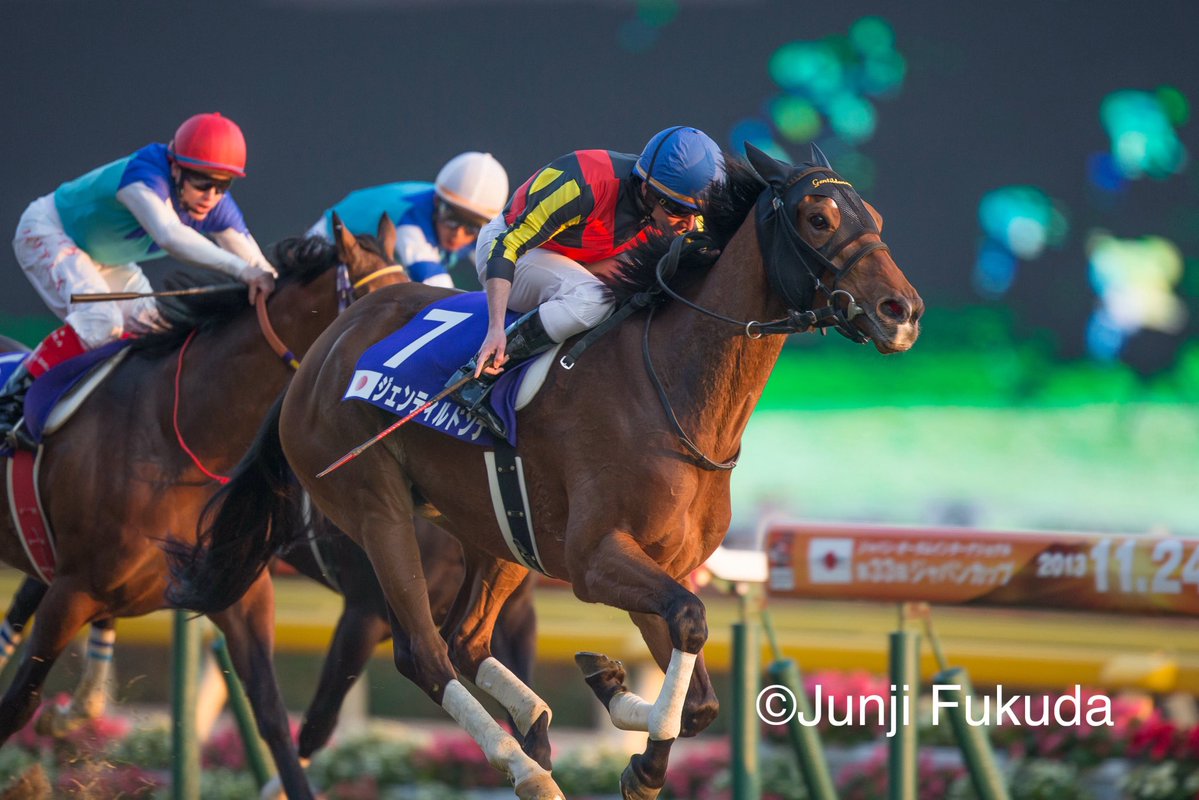
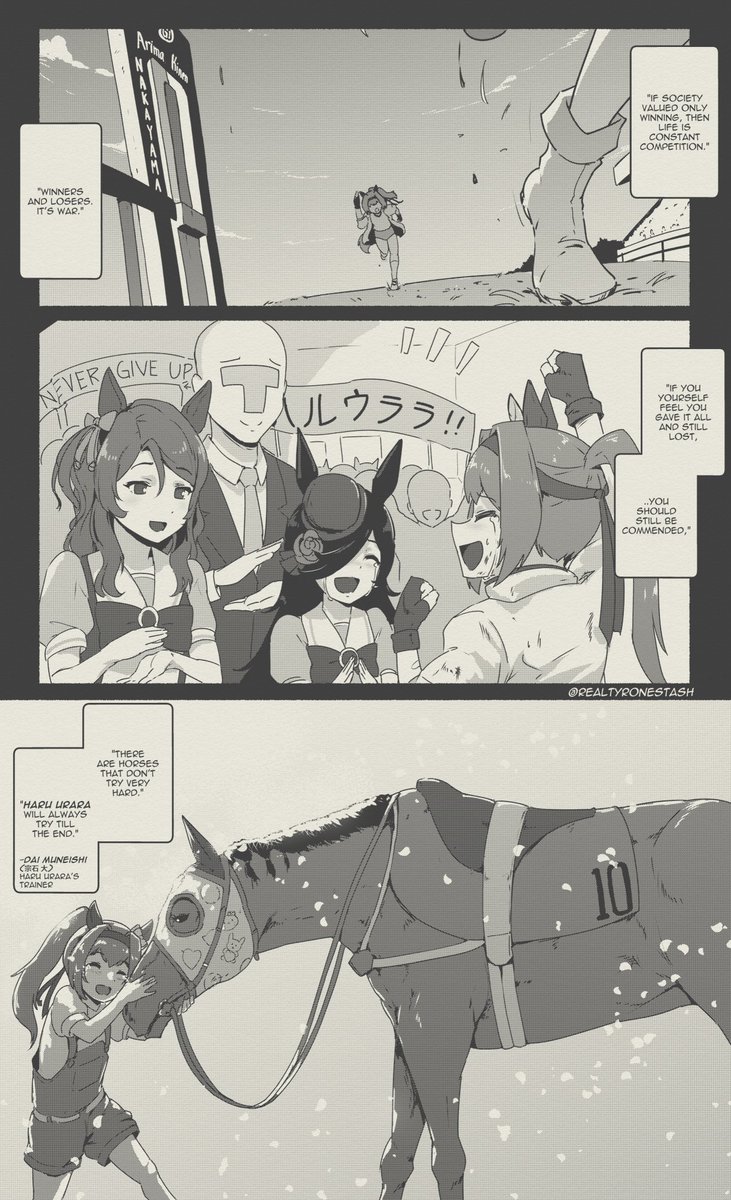
Racehorses are truly national heroes in Japan. This is a tribute to Gentildonna. The Japanese filly Triple Crown winner passed away three days ago. Today, fans brought flowers, wrote their names in guest books and prayed at a memorial set up for her at Tokyo Racecourse.
62.
"Behind every champion horse, there's a hardworking groom"
- Imanami Takatoshi & Gold Ship -
You might’ve wondered why this old man got a few frames next to Gold Ship. Some of you probably already know who he is — 今浪隆利 (Imanami Takatoshi), sometimes regarded as “日本一有名な厩務員” (the most famous groom in Japan).
He’s the perfect starting point for a new series (I dug a new hole) focused on the real people who revolve around racehorses. Unlike in Uma Musume, where Trainer-san (like everyone who is reading this) seems to be the only one interacting with the UMA girls, in actual horse racing, there are many more people involved behind the scenes. And speaking of who spends the most time with a horse at the track, the answer is usually their groom.
Imanami-san wasn’t just a "groom". He was Gold Ship’s "groom", and there’s hardly a better example of a duo whose chaotic bond became legendary, both on and off the track.
If Gold Ship is becoming a world-famous racehorse because of Uma Eng's release, then Imanami-san might as well deserve his place as the world’s most famous groom.😤
1.
Before we dive into Imanami-san’s story, it’s worth asking, what exactly is a “groom”?
(If you just want the story, scroll to 3)
In English, we’d call them “grooms” — someone who handles and cares for horses. But in Japan, the role is officially known as 厩務員(きゅうむいん), and while there’s overlap, it doesn’t translate perfectly. The title carries a broader, more structured meaning within the Japanese racing industry, where 厩務員 are an essential part of a stable’s professional system. (We’ll get into the specifics in just a moment.)
In Japan, while the trainer sets the overall plan, it’s the 厩務員 who carries it out, day in and day out. Their work includes feeding, mucking stalls, preparing clean bedding, tacking up for training, walking horses before and after workouts, bathing them, monitoring their health, and more. Often, they’re also the ones who decide on small but crucial details — like dietary supplements tailored to each horse’s needs. A 厩務員 is usually responsible for two horses, forming a close bond with each one.
To become a 厩務員 in the JRA (Japan Racing Association) system, aspiring candidates must complete a six-month course at the Japan Racing School. Afterward, they typically join a stable through recommendation, and are assigned specific horses to care for at either the Miho or Ritto Training Centers.
While 厩務員 can lead horses by hand and provide light exercise, they aren’t allowed to ride them during formal training unless they obtain an additional license as a 調教厩務員 (training groom). Even then, there are limits, generally, only two horses per person can be ridden this way within JRA guidelines.
The NAR (local racing) system also has its own licensing structure, with slight regional variations, but the heart of the job remains the same across Japan: total commitment to the wellbeing of the horse under your care, from sunrise to sundown.
2.
While the Japanese 厩務員 system is highly centralized and formalized, things look a bit different in North America and Europe, especially in the U.S.
In North America, there are no centralized training centers like Miho or Ritto. Instead, top trainers often maintain multiple stables across different racetracks around the country, moving with the racing calendar. Because of this, the staffing structure is more segmented. You’ll find grooms, yes — but also hot walkers, foremen, and assistant trainers, each with defined roles.
In the U.S., grooms also responsible for feeding, mucking out stalls, grooming, tacking up, inspecting the horse’s condition, and following veterinary instructions — those are all within their scope. But responsibilities like diet planning are typically handled by the foreman. Below grooms, hot walkers,often newcomers to the industry — are tasked with leading horses post-training for cooldowns. Many eventually work their way up to become grooms themselves.
On average, an American groom looks after around four horses. Their workdays start early, usually before dawn, and stretch long into the afternoon. Race days add another layer of pressure, as they handle paddock duties, pre-race prep, and post-race care. They typically work six days a week, weekends included, and are expected to travel as their stable moves from track to track.
In parts of Europe, the structure varies by country, but the lifestyle remains similarly intense — early mornings, physical labor, and a close, constant watch over the horses.
Yet despite being the backbone of the racing industry, grooms often go unrecognized. In the U.S., unlike in Japan, where 厩務員 may receive a share of the prize money (進上金), American grooms are generally paid a flat salary and don’t get any bonus from their horse’s winnings. This lack of financial incentive, coupled with long hours and demanding work, makes the job hard to sustain — especially for younger generations.
3.
When Imanami Takatoshi first met Gold Ship, he had a feeling — one he’d never quite had before.
“Out of all the horses I’d ever seen,” he recalled, “he was the best. Strong in the hindquarters, well-balanced… I couldn’t believe I’d be the one assigned to him.”
At first, Ship was calm — almost too calm. Imanami-san could hop on bareback and take him for a quiet walk. But everything changed around the Kyodo News Hai, the race that would mark Gold Ship’s coming-of-age. Something flipped. The horse that once stood still began lunging, spinning, and kicking at any horse that got too close. From that moment on, Imanami stuck by his side — literally. Every morning, he walked alongside Ship to and from the track, sometimes racking up over 30,000 steps a day, just to make sure no one got hurt.
“You never knew what he was going to do,” he said. “He’d suddenly kick out at a passing horse or start bucking. I had to be there to protect him — and everyone else.”
He called him “Ship/シップ,” affectionately, as if to ground him in something steady (he is aware of "Golshi/ゴルシ" tho). And over time, that chaotic energy between them became something more: trust.
Even in France, when they traveled for the Prix de l'Arc de Triomphe, the rhythm stayed the same. Ship trotted through the forest to Chantilly, and Imanami followed behind on foot — until one day, Ship got too excited and trotted off ahead.
“The horse kept going. I was left behind, alone in a French forest,” Imanami laughed.
But Ship never forgot the man who walked every step with him.
At his retirement ceremony, Imanami found himself overwhelmed with emotion. This really was the end. Tears welled up — and in that moment, Gold Ship, usually fidgety and unpredictable, stood still.
Just for a second, he behaved.
Even in retirement, their bond hasn’t faded. Once a year, Imanami visits Gold Ship at the stallion station. And every time, Ship walks over, quietly, like he remembers.
Maybe that’s why the world could love him too — not just as a wild legend, but as a horse whose fierce temperament, which might’ve been seen as a flaw in the wrong hands, was instead met with patience, humor, and care. In Imanami-san’s steady presence, Gold Ship never had to become a true monster.
*Imanami-san has now retired. After Gold Ship, he also took care of the famous white horse idol, Sodashi
He had been in this career for 48 years.