I built a credit card fraud detection model with Logistic Regression.
The fun part was that I walked through the class imbalance in the dataset, created a balanced sample, trained the model, and achieved 94% accuracy on both the training and test sets.
I built a credit card fraud detection model with Logistic Regression.
The fun part was that I walked through the class imbalance in the dataset, created a balanced sample, trained the model, and achieved 94% accuracy on both the training and test sets.
Just built a movie recommendation system using TF-IDF + cosine similarity.
It takes a movie you like, compares its genres, keywords, tagline, cast, and director, then recommends similar movies.
Learned a lot building this one. 🤭
https://t.co/1YZ8oFxi0c
Just built a movie recommendation system using TF-IDF + cosine similarity.
It takes a movie you like, compares its genres, keywords, tagline, cast, and director, then recommends similar movies.
Learned a lot building this one. 🤭
https://t.co/1YZ8oFxi0c
Do you know that in Random Forest, the more the number of decision trees, the more accurate our model performances, so each decision tree will give us a result and it will take the mean value output by the result from the decision tree
Do you know that in Random Forest, the more the number of decision trees, the more accurate our model performances, so each decision tree will give us a result and it will take the mean value output by the result from the decision tree
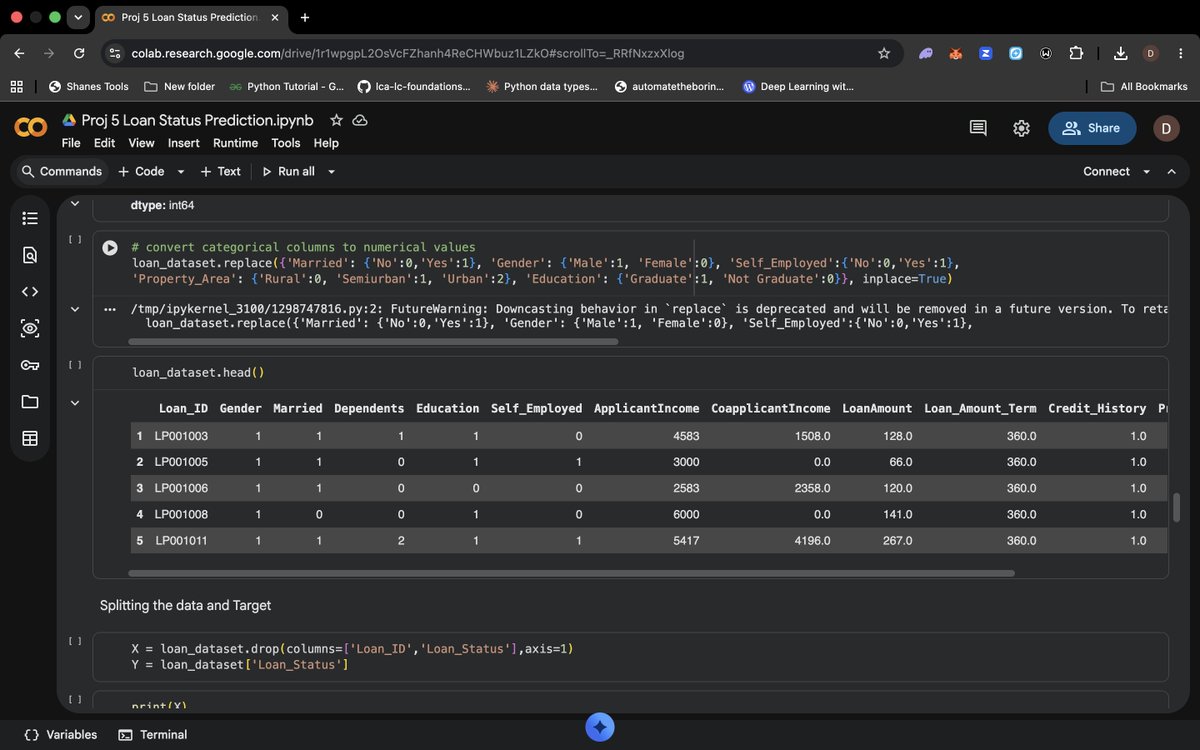
i don't want to bore you with my long talks 🤣..i built a predictive system where you pass in raw numbers and it spits out results to determine if "The person is Eligible"✅ or "Not Eligible"❌.
Now nobody talks about the fact that the dataset had "3+" as a value for the numbers of dependents😭. so i had to manually replace it using label encoding and i converted every categorical columns(Gender, Education, Property Area) to numbers, then i dropped missing rows.
Most people jump straight into building machine learning models.
Few take the time to understand the foundations.
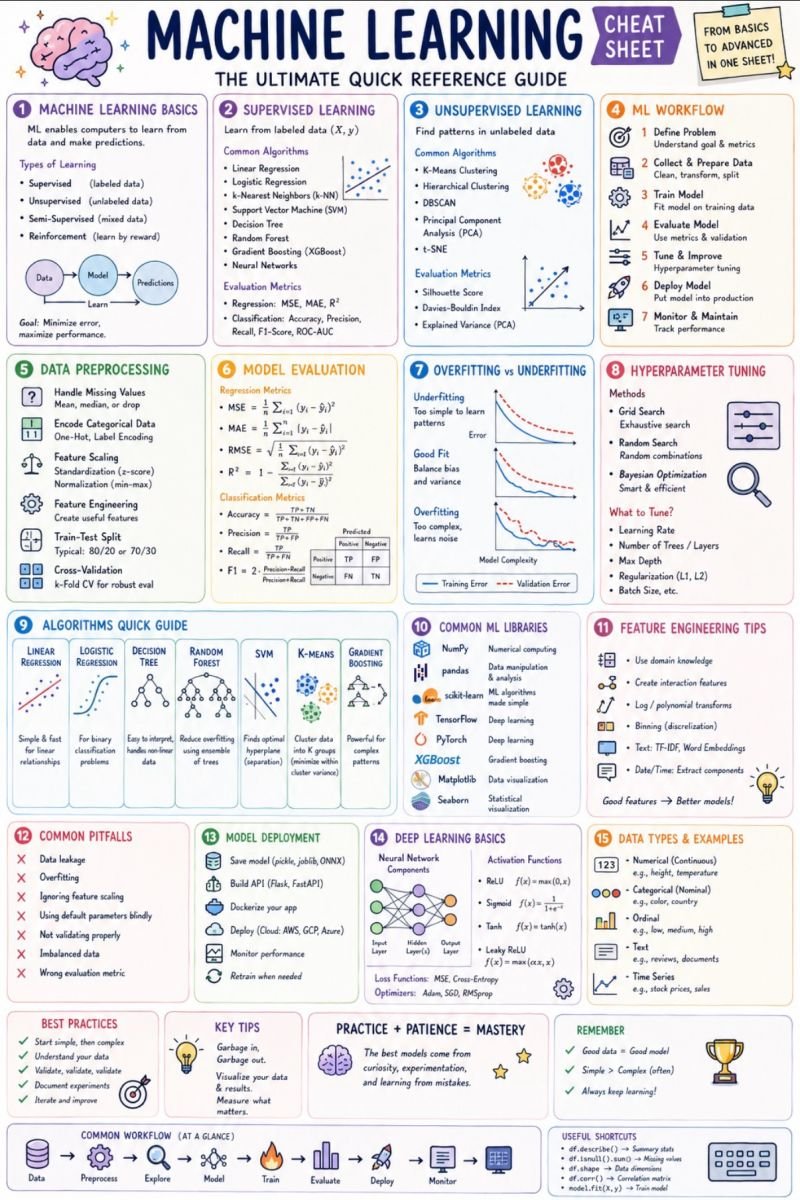
That is exactly why I created this Machine Learning Cheat Sheet.
It brings together the concepts I wish I had in one place when I started:
• Supervised and unsupervised learning
• Data preprocessing and feature engineering
• Model evaluation metrics
• Overfitting and underfitting
• Hyperparameter tuning
• Popular algorithms and libraries
• Deep learning fundamentals
• Deployment best practices
Machine learning is not about memorizing algorithms.
It is about understanding when to use them, why they work, and how they fit into the bigger picture.
Whether you are a student, developer, data analyst, or aspiring AI engineer, having a strong mental framework is often more valuable than knowing another library.
What is the one machine learning concept that took you the longest to truly understand?
Share it in the comments.
Today, I built and evaluated a regression model to predict house prices using the Kaggle house prices dataset. This expands my EDA work by adding feature engineering, multiple algorithms, and proper regression values.
Gradient Boosting won by a decent margin. Linear Regression was okay, but the more complex model just performed better.
Main lesson: spend time on feature engineering and data cleaning before throwing anything at a model
#MLjourney#Machinelearning#EDA#python
Today, I built and evaluated a regression model to predict house prices using the Kaggle house prices dataset. This expands my EDA work by adding feature engineering, multiple algorithms, and proper regression values.
I split the data 80/20 for training and testing. I learned to use random_state=42 so my results stay consistent every time I run the code. I tested three models: Linear Regression, Random Forest, and Gradient Boosting. Evaluated each using R² score and RMSE.