@adriel_rose There’s a person I know that thought of Covid as the flu until on his 5th infection it went to his lungs, became pneumonia, and almost hospitalized him.
Others I know are learning the seriousness by getting Long Covid. I hate seeing them learn it this way.
I just saw a post from an MD about the increase in athletes dying of heart attacks, then I lost it. Search is broken, so I can’t find the post or the threads I made when heart attacks increased 30% in Americans ages 18-44 from 2020-2021.
2026: 66% increase. Godspeed, all.
It's strange how masks work when it's billionaires' chauffeurs, and rock stars' personal assistants, and the doctors treating olympic athletes, and hollywood movie sets, but they don't work for a cancer ward.
I am crashing out. We just watch our certain doom approach, doing nothing.
Newsweek Headline from 2024: Cat Owners Are Infecting Their Pets With Bird Flu, Officials Suspect.
I even made a thread I will post below.
That's always been why so many were anti-remote work though.
1. A lot more people than you think are dependent on work for socialization - very Michael Scott like.
2. A lot of others dislike their spouses and kids and want an excuse to leave every day.
3. Another group are micromanagers/people with poor management skills, and/or people whose jobs really don't need to exist if people prove able to work independently and they know it.
4. A small group loses money on commercial real estate if remote work is successful.
And those groups of people are trying to hold everyone else hostage in offices.
Pope Leo XIV says that the Catholic Church’s teaching on sexual ethics must be less prioritized over “greater, more important issues.”
“We tend to think that when the Church is talking about morality, that the only issue of morality is sexual. And in reality, I believe there are much greater, more important issues, such as justice, equality, freedom of men and women, freedom of religion, that would all take priority before that particular issue.”
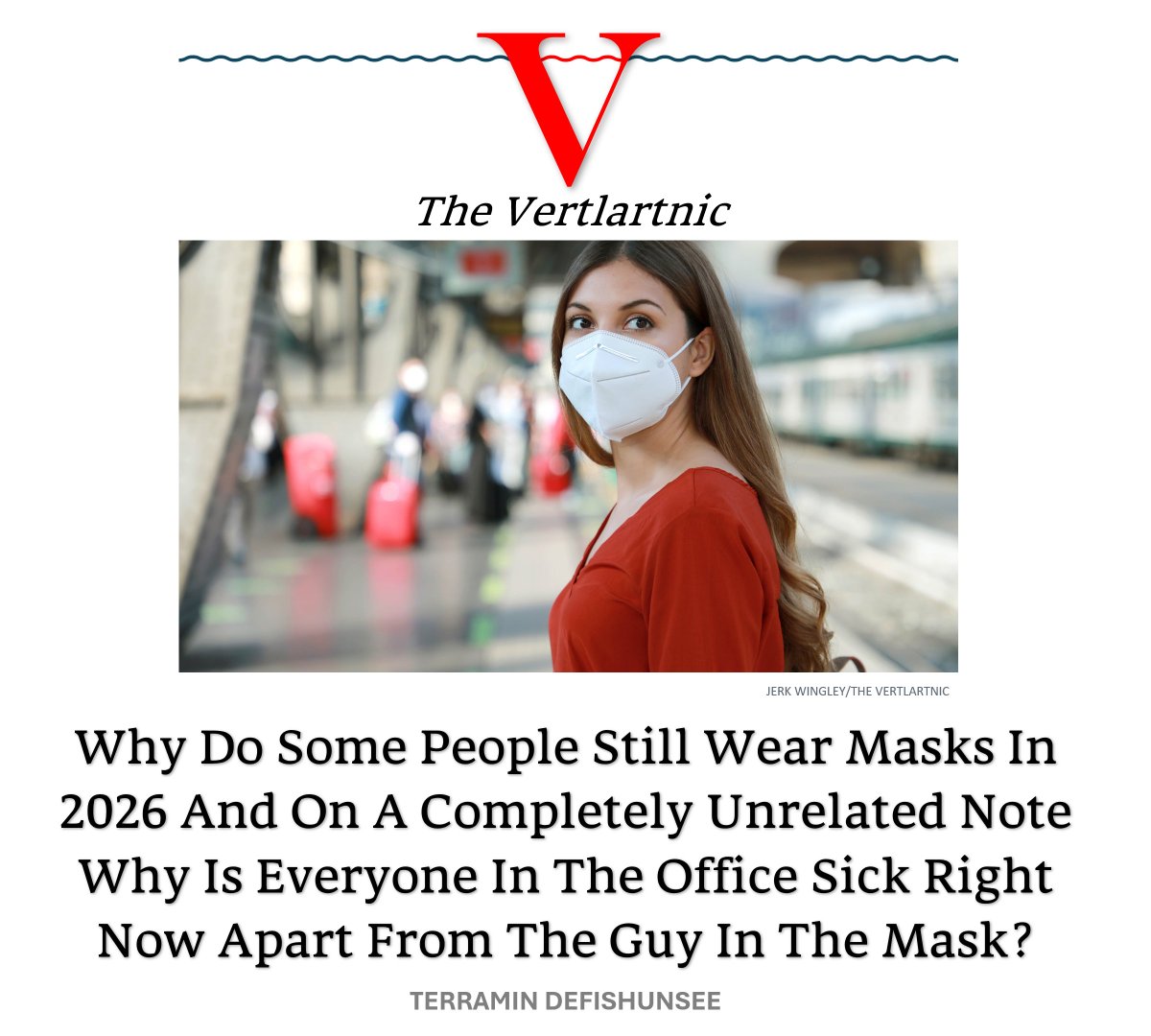
Why Do Some People Still Wear Masks In 2026 And On A Completely Unrelated Note Why Is Everyone In The Office Sick Right Now Apart From The Guy In The Mask?
The authors don't explore if remote work benefits groups such as single parents, caregivers, disabled or immunocompromised people, neurodivergent workers, those with long commutes
You know what's bad for mental health? Being pushed out of the workforce because it's inaccessible
@MillieMarconnni I literally went to school in Japan with a boy named Chung Li who was born in China but a Japanese citizen. The comments are funny, do you think it’s impossible to have an Ameican professor named O’Sullivan?
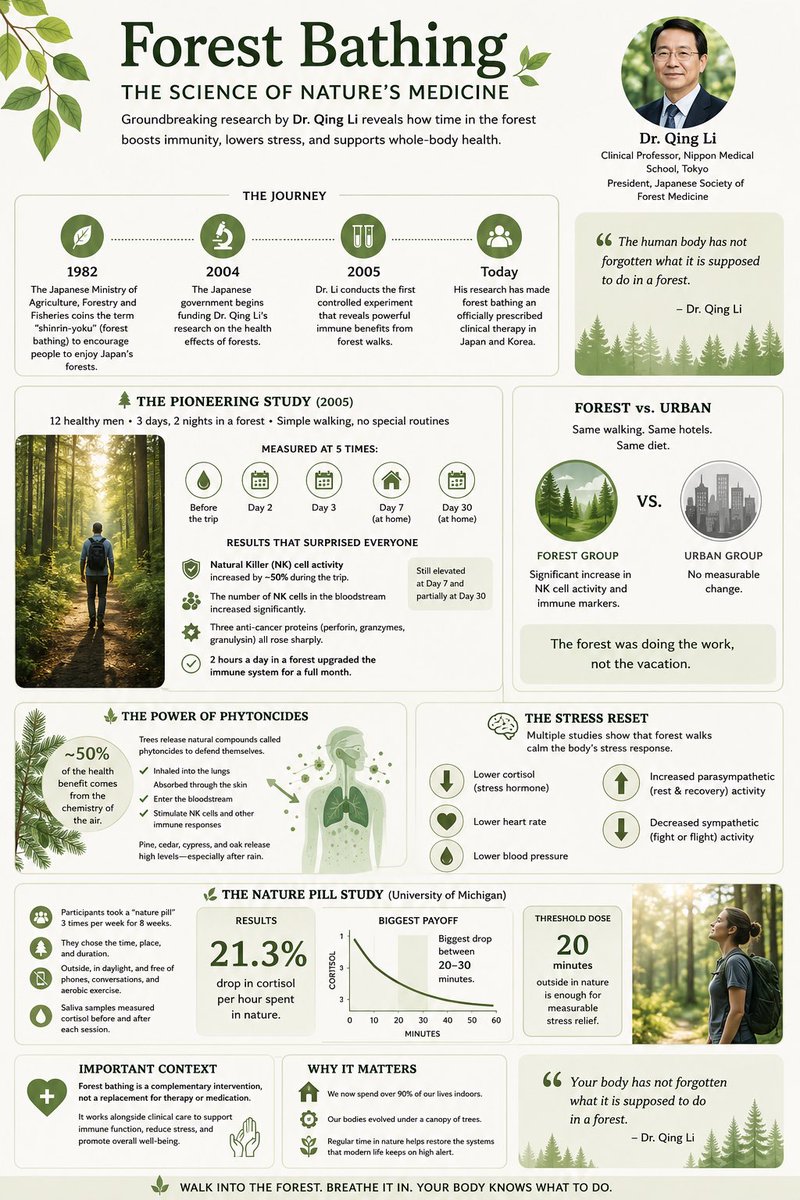
A Japanese immunologist spent 20 years proving that the chemicals trees release into the air walk into your bloodstream, hunt down your stress hormones, and arm your immune system in ways no therapist or pharmaceutical has ever matched, and most of the data has been sitting in Japanese medical journals for two decades waiting to be translated.
His name is Qing Li.
He is a clinical professor at Nippon Medical School in Tokyo and the president of the Japanese Society of Forest Medicine. The Japanese government has been funding his research since 2004, and the body of work he has produced is the reason forest bathing is now an officially prescribed clinical therapy in Japan and Korea.
The story actually starts in 1982, when the Japanese Ministry of Agriculture, Forestry and Fisheries coined the term shinrin-yoku to describe the practice of slow, mindful walking in a forest. They did it for a practical reason.
Japan was urbanizing fast, stress-related illness was climbing, and the country had thousands of square kilometers of forest sitting unused. The idea was to give people a reason to walk into the trees... They had no idea what was actually happening to the human body during those walks until Qing Li ran the first proper experiment in 2005.
He took twelve healthy adult men on a three-day, two-night trip to a forest park. They walked for a few hours each day. Nothing strenuous. No prescribed routes or breathing exercises. They simply walked slowly through the trees, breathing the air, looking at the forest.
Li drew blood and urine samples before the trip, on the second day, on the third day, on day seven after returning home, and again on day thirty.
The numbers that came back from the lab were not what anyone expected.
The activity of a specific type of immune cell called the natural killer cell, which is the cell your body uses to hunt down cancer cells and virus-infected cells before they can spread, had jumped by roughly 50 percent during the forest trip. The actual number of natural killer cells circulating in the bloodstream had increased significantly.
Three different anti-cancer proteins that those cells produce, called perforin, granzymes, and granulysin, had all risen sharply. And the effect did not disappear when the men went home. The immune boost was still measurable on day seven and was still partially present on day thirty.
Two hours a day in a forest had upgraded the immune system for a full month.
Li ran the same experiment with women a year later and found nearly identical results. Then he ran it with a control group who took a three-day trip through an urban area with the same amount of walking, the same hotel quality, and the same diet.
The urban group showed no measurable change in natural killer cell activity at all. The forest was doing the work, not the vacation.
The mechanism turned out to be a class of airborne molecules called phytoncides. Trees produce these compounds to defend themselves against insects, bacteria, and fungi. Pine, cedar, oak, and cypress trees release them in particularly large amounts, especially in warmer weather and after rainfall.
When you walk through a forest, you are inhaling those molecules into your lungs and absorbing them through your skin, and once inside your body they appear to directly stimulate the production and activity of the very immune cells Li was measuring in his lab.
Roughly 50 percent of the health benefit of a forest walk, according to Li's data, comes from the chemistry of the air itself. The other half comes from what the forest is doing to your nervous system.
This is where it stops being only about the immune system and starts being about stress.
A separate Japanese research team measured cortisol, the body's main stress hormone, in 84 participants across 35 different forest sites. They drew samples before and after a 30-minute walk in each forest and compared them to control walks in matched urban environments. The cortisol levels of the people who walked in the forest were lower than the cortisol levels of the people who walked in the city by a significant margin. Their heart rates were lower. Their blood pressure was lower.
The activity of their parasympathetic nervous system, which is the part responsible for rest and recovery, had gone up. The activity of their sympathetic nervous system, which is the part that drives fight or flight, had gone down.
Then a researcher at the University of Michigan named MaryCarol Hunter ran the cleanest version of this experiment ever done. She recruited participants from a city and told them to take a nature pill three times a week for eight weeks.
They were free to choose the time, the place, and the duration of the nature experience, as long as it was outside, in daylight, and free of phones, conversations, and aerobic exercise. They sent her saliva samples before and after each session so she could measure cortisol changes accurately and rule out the normal daily drop in stress hormones that happens to everyone.
The result was that participants experienced a 21.3 percent drop in cortisol per hour spent in nature, with the biggest payoff happening between minutes 20 and 30 of the walk.
After that, the cortisol kept dropping, but more slowly. The threshold dose for measurable stress relief was just 20 minutes outside in something that looked and felt like nature.
What none of this means is that nature is a substitute for therapy or for medication when someone genuinely needs them. Therapy treats different things than a walk does, and Li himself has been careful in interviews to call forest bathing a complementary intervention rather than a replacement for clinical care.
But what the research has settled is that the human body has a physiological response to being among trees that operates on the same biological systems modern medicine is trying to reach with drugs and clinical protocols, and that response is fast, measurable, and free.
The strangest part of Li's work is the implication he keeps repeating in interviews. The average person now spends more than 90 percent of their life indoors. Their cortisol stays elevated. Their natural killer cells stay sluggish.
Their parasympathetic nervous system rarely gets a chance to take over. The system that was tuned by millions of years of life under a canopy of trees is being asked to run permanently inside a box made of drywall and screens.
Your body has not forgotten what it is supposed to do in a forest. It is waiting for you to walk into one.
From a study of 349 children and adolescents in Mexico,
"The prevalence of long COVID was 11.8%.
For “persistence”, the most frequent symptoms were cough (50%) and rhinorrhea (15.4%); for “post-COVID conditions”, the most common symptoms were myalgia (33.3%), asthenia and irritability (26.7% each), and constipation (20%)..
the associated factors for individuals aged over 8 years were a history of reinfection (OR 9.7) and BMI at the time of the survey (1.1), while for those aged under 8 years, the associated factor was male sex (4.7)."
Be aware of reinfection, kids.
'SARS-CoV-2 reinfection: a possible contributing factor to long COVID in children and adolescents'
https://t.co/yGYlT1WrnH
You can literally already do this, with products that we already have on the market (like CPC mouthwash and iota-carrageenan lozenges or oral sprays).
It’s not really anything groundbreaking. Obviously, lowering viral load in saliva can’t prevent you from getting sick on its own. But as a layer in addition to masking, nasal sprays, Nuvaxovid, and support of the innate immune system - yes, it’s something that folks can and should already be focusing on.
I’m sure the gum actually does the 95% reduction claims, and it could be another option. But with the context that we already have this type of intervention on the market, it’s really just the most useful for advancing the careers of the people working on it.
There are a ton of oral items that could already be part of someone’s prophylaxis routine:
🟣Pre-exposure immunity support: In addition to essential vitamins and systemic supplements that also support mucosal immunity:
• Blis K12 probiotic lozenges (https://t.co/rOKI5uEmYk)
• Mycoshield mushroom extract spray, where beta glucans support innate immunity
🟣Pre-exposure barriers:
• Iota-carrageenan lozenges (or sprays) (https://t.co/0NKheI0zEh)
🟣Pre/post:
• ClorRelief (Chlorpheniramine) antihistamine oral spray, where antihistamines in general prevent ACE2 binding
• Golaprop glycyrrhizic acid spray (https://t.co/Htqm76tXm0)
🟣Post-exposure:
• Gargling with mouthwash containing 0.10% Cetylpyridinium Chloride (CPC) (eg. Crest pro-health clinical or Therabreath deep clean) (https://t.co/oYN3nFjAzr)
• Gargling with green tea (https://t.co/o1clOZJ3qE)
15 years ago today—after five long months of beginning to relearn how to walk and talk—I was released from TIRR Memorial Hermann.
I’ll always remember how it felt reaching this milestone as I readied myself for the road ahead. Like so many victims of gun violence, my recovery is a lifelong journey. After being shot in the head, I was left partially paralyzed and with a condition called aphasia. Words used to come so easily to me, and now I struggle to speak.
As I reflect on how far I’ve come in the past 15 years, I know I could never have done it alone. I’ll forever be grateful to the doctors, nurses, and therapists who fought this battle alongside me in those early days. They are true heroes ♥️
This is a portrait I painted of one of many heroes of mine from the Civil Rights movement. The Rev. James Zwerg, circa 1961. He was one of the Freedom Riders, along with John Lewis, William Barbee, Catherine Burks, and many others, who pulled into Montgomery, AL on a bus May 20, 1961.
He volunteered to step off first.
The mob was waiting with baseball bats, chains, and clubs. They beat him until three of his vertebrae cracked, his nose broke, and every tooth in his head was fractured. They beat him unconscious on the pavement. A Black stranger in coveralls walked up and said, “Stop beating that kid. If you want to beat someone, beat me.” And they did. He saved Zwerg’s life.
White ambulances refused to take him. He lay in the street for over an hour. That is the moment I painted. Bloodied suit. Head bowed.
At Martin Luther King Jr.’s urging, Zwerg later went to seminary and was ordained in the United Church of Christ.
Rev. Zwerg is now 86 and lives in Tucson, Arizona. His courage and conviction, alongside that of countless others, helped save this nation. These are the people I celebrate as we near our 250th anniversary as a nation.
In the UK, the number of kids with long covid doubled from March 2023-March 2024, totaling an estimated 111 816 children affected and then they stopped doing updates. The government solution to the covid problem has been to stop collecting and reporting data.