Got my drafts ready for the next few pieces.
Over the next week, I'll start rewriting and refining them.
I've split the research into two broad concepts:
🔹Actionable Relative Strength: How to actually use it to find setups.
🔹The Science of Sizing, Stops, Trailing stops and Pyramiding.
Which series would you like to see released first?
💯
Trading with the market and letting your portfolio guide your risk is how you survive volatility.
But that last line is what really resonates with me. FinTwit is so full of "my way is the only way" noise, with very little openness to different styles.
In reality, there are a million ways to trade and just like the wand chooses the wizard, the right approach chooses the trader.
Great stuff, Francesco.
@alphatrends Left out the link to the article! If you fancy some bedtime reading on how Anchored VWAP is a stronger indicator of timeframe continuity than the classic close > open
https://t.co/NaXpp7W2Ja
This small section by @alphatrends was the exact trigger for my latest study.
It led directly to the creation of the AVWAP TFC dots, and the data that proves -- when you combine Anchored VWAP with classic TFC (close >open), you massively reduce shakeouts and increase your probability of hitting magnitude.
Thank you for the spark, Brian!
@galfi_robert@alphatrends You are very kind Robert. Glad you enjoyed it.
Amazon have a robust moderation process. It sometimes takes a few days before it shows up .
This small section by @alphatrends was the exact trigger for my latest study.
It led directly to the creation of the AVWAP TFC dots, and the data that proves -- when you combine Anchored VWAP with classic TFC (close >open), you massively reduce shakeouts and increase your probability of hitting magnitude.
Thank you for the spark, Brian!
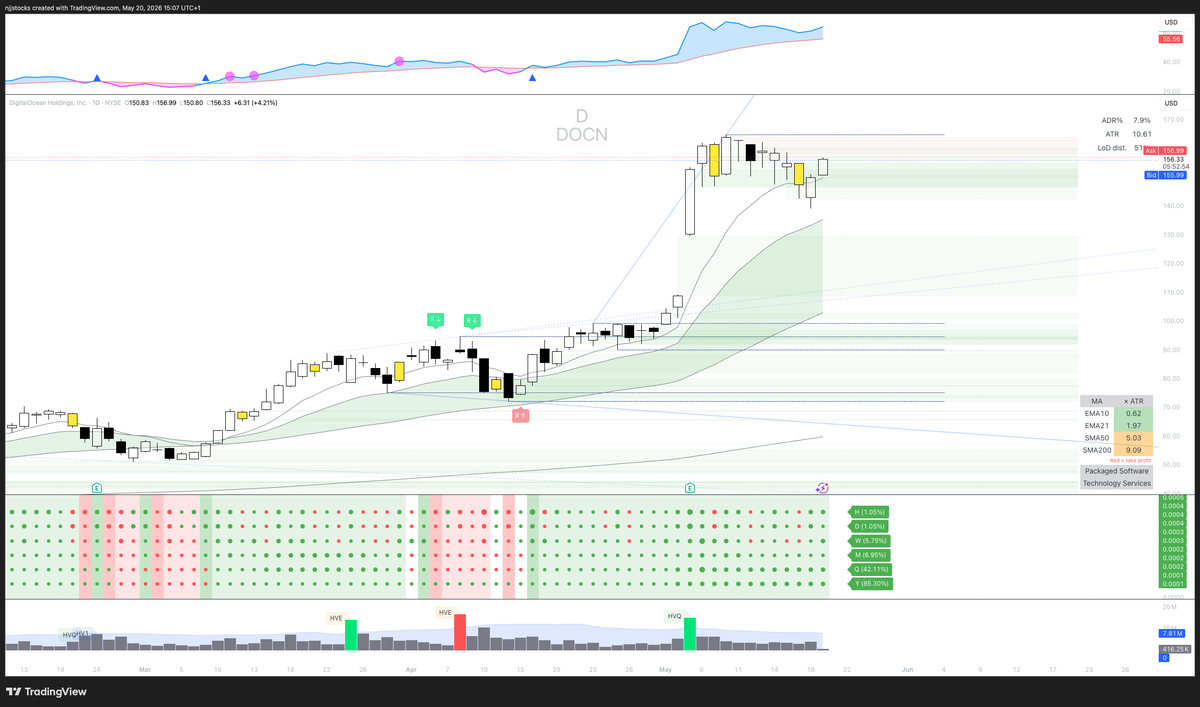
The breakthrough for me? I turned this multi-timeframe AVWAP data into a simple set of dots to prevent chart clutter.
No more manually anchoring VWAPs on every ticker. Each dot represents a timeframe. The colour shows alignment and size shows trend strength.
Couldn't agree more with the need for intentionality. Pre-made deep dives rob the trader of the actual process that builds their edge.
I do think there's a flip side to software, though --when it's used as a pure simulation environment. I remember reading a research paper many moons ago that @stamatoudism was involved in, which led me to a simulator (https://t.co/pTLA9dS2MG). I still use it.
It strips away the ticker and gives you nothing but price and volume to trade. It’s fascinating because it doesn't give you the answers; it just puts you in the hot seat. It also makes you realise that you make biased decisions when you know the ticker you are trading.
Software that automates the thinking is a trap, but software that forces deliberate practice is a great way to put in the reps. :)